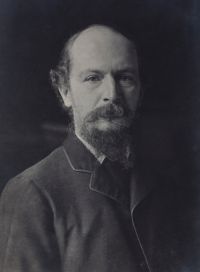
Algernon Charles Swinburne

Algernon Charles Swinburne

Summary

Portrait of Algernon Charles Swinburne Algernon Charles Swinburne A Study of Shakespeare — Third Period… (1880)

Marlowe alone stood apart and above them all—the young Shakespeare among the rest; but among these we cannot count, we cannot guess, how many were wellnigh as competent as he to continue the fluent rhyme, to prolong the facile echo, of Greene and Peele, their first and most famous leaders.
No more docile or capable pupil could have been desired by any master in any art than the author of David and Bethsabe has found in the writer of this second act. He has indeed surpassed his model, if not in grace and sweetness, yet in taste or tact of expression, in continuity and equality of style.
Source: Wikisource

Portrait of Algernon Charles Swinburne Algernon Charles Swinburne A Study of Shakespeare — Third Period… (1880)

It is very like the Shakespeare who wrote the Comedy of Errors—Love's Labour's Lost—Romeo and Juliet. It is so like that had we fallen upon it in any of these plays it would long since have been a household word in all men's mouths for sweetness, truth, simplicity, perfect and instinctive accuracy of touch. It is very much liker the first manner of Shakespeare than any passage in King Edward III. And no Sham Shakespearean critic that I know of has yet assigned to the hapless object of his howling homage the authorship of Green's Tu Quoque.
Source: Wikisource

Portrait of Algernon Charles Swinburne Algernon Charles Swinburne A Study of Shakespeare — Third Period… (1880)

Thomas Lord Cromwell is a piece of such utterly shapeless, spiritless, bodiless, soulless, senseless, helpless, worthless rubbish, that there is no known writer of Shakespeare's age to whom it could be ascribed without the infliction of an unwarrantable insult on that writer's memory. Sir John Oldcastle is the compound piecework of four minor playwrights, one of them afterwards and otherwise eminent as a poet—Munday, Drayton, Wilson, and Hathaway: a thin sample of poetic patchery cobbled up and stitched together so as to serve its hour for a season without falling to pieces at the first touch.
Source: Wikisource

Get perspective with Kwize: daily news enlightened by great literature