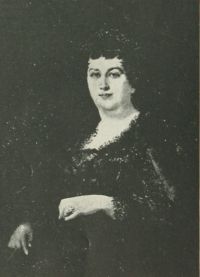
Mary Elizabeth Wilson Sherwood

Mary Elizabeth Wilson Sherwood

Summary

Portrait of Mary Elizabeth Wilson Sherwood Mary Elizabeth Wilson Sherwood An Epistle to Posterity — Chapter II (1897)

Transcendentalism broke to pieces, like a cosmical ring, each piece flying off to revolve in its own orbit.
I can only remember how much she was talked about all my youth, and sometimes laughed at. Zenobia, Hawthorne's beautiful dream, supposed to somewhat embody Margaret Fuller, has embalmed her and put her in the world's picture-gallery forever.
Source: Wikisource

Portrait of Mary Elizabeth Wilson Sherwood Mary Elizabeth Wilson Sherwood An Epistle to Posterity — Chapter II (1897)

The demand for woman's emancipation of thought, her breadth of freedom of action, met with its first great interpreter in Margaret Fuller: she fed that first hunger.
From the glimmer of twilight's solitude through which Hawthorne's shrewd and curious eye dissected the movements of the human heart, Margaret Fuller might have seemed to be like Zenobia, but I did not think it a portrait.
Source: Wikisource

Portrait of Mary Elizabeth Wilson Sherwood Mary Elizabeth Wilson Sherwood An Epistle to Posterity — Chapter II (1897)

When Hawthorne had a sombre mystery he made a story out of it, and so got rid of it, possibly. We are very grateful to him for confiding his mysteries to us — that man of immense genius, that prince of all the romance writers who use our English speech, for his mastery of language was unique, and also his exquisite grace of comedy, which appears in his English Notes.
"The hunger of an age is alike a presentiment and a pledge of its own supply."
Source: Wikisource

Get perspective with Kwize: daily news enlightened by great literature