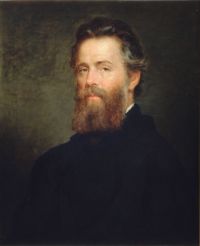
Herman Melville

Herman Melville

Summary

Portrait of Herman Melville Herman Melville Hawthorne and His Mosses (1850)

You may be witched by his sunlight,—transported by the bright gildings in the skies he builds over you;—but there is the blackness of darkness beyond; and even his bright gildings but fringe, and play upon the edges of thunder-clouds.—In one word, the world is mistaken in this Nathaniel Hawthorne. He himself must often have smiled at its absurd misconceptions of him. He is immeasurably deeper than the plummet of the mere critic. For it is not the brain that can test such a man; it is only the heart. You cannot come to know greatness by inspecting it
Source: Wikisource

Portrait of Herman Melville Herman Melville Hawthorne and His Mosses (1850)

But there is no man, in whom humor and love, like mountain peaks, soar to such a rapt height, as to receive the irradiations of the upper skies;—there is no man in whom humor and love are developed in that high form called genius; no such man can exist without also possessing, as the indispensable complement of these, a great, deep intellect, which drops down into the universe like a plummet. Or, love and humor are only the eyes, through which such an intellect views this world.
Source: Wikisource

Portrait of Herman Melville Herman Melville Hawthorne and His Mosses (1850)

What a mild moonlight of contemplative humor bathes that Old Manse!—the rich and rare distilment of a spicy and slowly-oozing heart. No rollicking rudeness, no gross fun fed on fat dinners, and bred in the lees of wine,—but a humor so spiritually gentle, so high, so deep, and yet so richly relishable, that it were hardly inappropriate in an angel. It is the very religion of mirth; for nothing so human but it may be advanced to that.
Source: Wikisource

Get perspective with Kwize: daily news enlightened by great literature