“ A century has just closed upon the work of Junius. The causes which produced it, either in act or person, have long since passed away. The foolish king, the corrupt minister, and the prostituted legislature are forgotten, or only recalled to be despised; but the work of Junius, startling in thought, daring in design, bristling with satire, a consuming fire to those he attacked, remains to be admired for its principles, and to be studied for its beauty and strength. ”
Junius
Definition and stakes
Junius, a pseudonymous author of 18th-century political pamphlets, is renowned for his incisive satire and anonymous critiques of British governance. His writings, marked by sharp wit and moral passion, ignited discussions on liberty and corruption. Joel Moody admired Junius’s enduring principles, while William Hazlitt contrasted his rhetorical skill with the weakness of his opponents.
Turgenev, in a fictional context, portrayed Junius’s turbulent public reception, and Warwick Wroth emphasized his scholarly commitment. Though his identity remains a mystery, Junius’s legacy persists through his stylistic mastery and the enduring relevance of his political ideals.
Quotes about “Junius”
William Hazlitt, The Collected Works of William Hazlitt…
“ He no where makes so poor a figure as in his controversy with Junius. He has evidently the best of the argument, yet he makes nothing out of it. He tells a long story about himself, without wit or point in it; and whines and whimpers like a school-boy under the rod of his master. Junius, after bringing a hasty charge against him, has not a single fact to adduce in support of it; but keeps his ground and fairly beats his adversary out of the field by the mere force of style. One would think that ‘Parson Horne’ knew who Junius was, and was afraid of him. ”
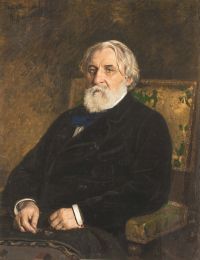 Ivan Sergeevich Turgenev,
A Reckless Character, and Other Stories
Ivan Sergeevich Turgenev,
A Reckless Character, and Other Stories
“ Junius tumbled headlong from the tribune ... but before he had succeeded in fleeing to his own house, outbursts of rapturous applause, cries of laudation and shouts reached his ear.Filled with amazement, but striving not to be detected (for it is dangerous to irritate an enraged wild beast) , Junius returned to the square. ”
Warwick William Wroth, Dictionary of National Biography… (1892)
“ Junius was a man of kindly nature and blameless character. A laborious student, he rose at four all the year, worked till one, then engaged in ‘walking or running,’ and again worked from three till eight. A portrait of him, sketched by Vandyck, hangs in the Bodleian Library. An engraving of this by G. Vertue is prefixed to the ‘Etymologicum Anglicanum,’ and there is another, by Burghers, prefixed to C. Rawlinson's ‘Boethius,’ 1698, a work printed from the Gothic and Saxon types left by Junius to the university of Oxford. ”
David McDowall Hannay, 1911 Encyclopædia Britannica, Volume 15… (1911)
“ He communicated with Chatham, with George Grenville, with Wilkes, all enemies of the duke of Grafton, and also with Henry Sampson Woodfall, printer and part owner of the Public Advertiser. This private correspondence has been preserved. It is written in the disguised hand used by Junius. The letters are of interest on three grounds—their political significance, their style, and the mystery which long surrounded their authorship. As political writings they possess no intrinsic value. Junius was wholly destitute of insight, and of the power to disentangle, define and advocate principles. ”
“ From this pride of character, so strong and peculiar, we may draw no weak conclusion in regard to the authorship of Junius, for the parallel is perfect, and the age in which he wrote gave us nothing like it in any one but Paine. This characteristic gives tone to the whole mind, and a shade of coloring to every faculty. It reflects itself upon the people, and draws therefrom the conclusion that they have more "sense and spirit" than they really possess. It gives a double coloring to hope, paints two bows instead of one, and reduces the time for the establishment of right. ”
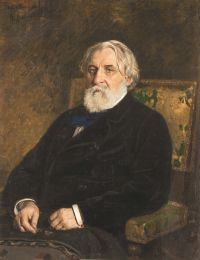 Ivan Turgenev,
The Novels of Ivan Turgenev
(1897)
Ivan Turgenev,
The Novels of Ivan Turgenev
(1897)
“ Filled with amazement, Junius returned to the square, trying however to avoid being noticed (for it is dangerous to irritate an infuriated beast) . And what did he behold? High above the people, upon their shoulders, on a flat golden shield, wrapped in a purple chlamys, with a laurel wreath on his flowing locks, stood his rival, the young poet Julius. . . . And the populace all round him shouted: 'Glory! Glory! Glory to the immortal Julius! He has comforted us in our sorrow, in our great woe! ”
“ This is an opinion so singular and prominent, so rare among men, and expressed so boldly and unqualifiedly, by both Paine and Junius, that it furnishes a parallel which comes with positive and telling force. Perhaps Paine and Junius were the only two writers at the time who held this opinion. And that they should express it in the same manner, with all the fine shades and attending peculiarities the same, and be at the same time two persons, is a phenomenon which nature never exhibited but once, and never will again among mankind. ”
“ England, and all further effort there being at an end, that if Junius lived he would change his base of operations if a favorable opportunity offered, and strike once more for the liberties of the people. Thus the natural order of things leads us to an irresistible conclusion. But in order not to be too hasty we ought to ask: Is there not one fact in the whole life and character of Mr. Paine incompatible with Junius? When it is found I will surrender the argument. But let us proceed.Nature is prodigal of varieties. No two individuals are alike, either in physical form or mental features. ”
1911 Encyclopædia Britannica, Volume 15… (1911)
“ Junius escaped as soon as he could from that post, and returning to his church remained there till 1573. From 1573 till 1578 he was at Heidelberg, assisting Emmanuel Tremellius (1510–1580) , whose daughter he married, in his Latin version of the Old Testament (Frankfort, 1579) ; in 1581 he was appointed to the chair of divinity at Heidelberg. Thence he was taken to France by the duke of Bouillon, and after an interview with Henry IV. was sent again to Germany on a mission. As he was returning to France he was named professor of theology at Leiden, where he died on the 13th of October 1602. ”
“ That the reader may see the value Junius placed on such men as Onslow, I will place before him a short address of Junius to the king: "As you are a young man, sir, who ought to have a life of happiness in prospect; as you are a husband, as you are a father (your filial duties I own have been religiously performed) , is it bona fide for your interest or your honor, to sacrifice your domestic tranquillity, and to live in perpetual disagreement with your people, merely to preserve such a chain of beings as North, Barrington, Weymouth, Gower, Ellis, Onslow, Rigby, Jerry Dyson, and Sandwich? ”
David McDowall Hannay, 1911 Encyclopædia Britannica, Volume 15… (1911)
“ There are passages in his writings which can be best described in the words which Burke applied to another writer: “A mere mixture of vinegar and water, at once vapid and sour.” But at his best Junius attains to a high degree of artificial elegance and vigour. He shows the influence of Bolingbroke, of Swift, and above all of Tacitus, who appears to have been his favourite author. The imitation is never slavish. Junius adapts, and does not only repeat. The white heat of his malignity animates the whole. ”
Junius, Letters of Junius (1772)
“ Modestus could not, without great affectation, mistake the meaning of Junius, when he speaks of a man, who is the bitterest enemy of his friends. He could not but know, that Junius spoke, not of a false or hollow friendship, but of a real intention to serve, and that intention producing the worst effects of enmity. Whether the description be strictly applicable to Sir William Draper, is another question. Junius does not say that it is more criminal for a man to be the enemy of his friends than his own ”
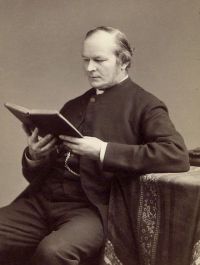 F. W. Farrar,
Darkness and Dawn; Or, Scenes in the Days of Nero…
F. W. Farrar,
Darkness and Dawn; Or, Scenes in the Days of Nero…
“ She was doubly afraid of Junius, both because the blood of Augustus flowed in his veins, and because she feared that he might one day be the avenger of his brother, though he was a man of mild disposition. She sent the freedman Helius and the knight Publius Celer, who were procurators in Asia, to poison him at a banquet, and the deed was done with a cynical boldness which disdained concealment. ”
Junius, Letters of Junius (1772)
“ Disappointed ambition, resentment for defeated hopes, and desire of revenge, assume but too often the appearance of public spirit: but be his designs wicked or charitable, Junius should learn that it is possible to condemn measures, without a barbarous and criminal outrage against men. Junius delights to mangle carcases with a hatchet ”
Johan Horrins, Memoirs of a Trait in the Character of George III. of these United Kingdoms (1835)
“ A NOTE ON JUNIUS AND WOLCOT. What would Junius, [1] who, whatever might be his rank or destination, was one of the proudest of men, have said, on finding himself assimilating so closely with such refuse as he would have deemed Wolcot? Yet these people who disgraced more than they did honour to the species, were from the same stock: the same ill blood runs in their veins. Junius suffered a malevolent spirit to suppress all regard for truth in too numerous instances; and Wolcot, in the vulgar phrase, would have lied with the devil for a bean-stack, and won it. ”
Josiah Quincy, Memoir of the Life of John Quincy Adams
“ Junius was essentially a sophist. His religion was infidelity, his abstract ethics depraved, his temper bitterly malignant, and his nervous system timid and cowardly. The concealment of his name at the time when he wrote was the effect of dishonest fear. The perpetuation of it could only proceed from the consciousness that the disclosure of his person would be discreditable to his fame. The object of Junius, when he began to write, was merely to overthrow the administration then in power. He attacked them in a mass and individually ”
“ This is also the spirit of Junius when he says with such withering sarcasm: "It may be matter of curious speculation to consider, if an honest man were permitted to approach a king, in what terms he would address himself to his sovereign." And after having gained the ear of the king, when he says: "Let it be imagined, no matter how improbable, that he has spirit enough to bid him speak freely and understanding enough to [134] listen to him with attention. Unacquainted with the vain impertinence of forms, he would deliver his sentiments with dignity and firmness." ”
“ JUNIUS NOT A PARTISAN.But let us continue the method of elimination till we find his true position. Because we can not safely affirm what he was, till we know in some particulars, what he was not; and it is thus the spirit and object of Junius may be made visible. I affirm, therefore, Junius was not a partisan. In proof of which I submit the following, from Let. 58, to the study of the reader:"No man laments more sincerely than I do the unhappy differences which have arisen among the friends of the people, and divided them from each other. ”
“ Paine and Junius were Christians; in the latter sense, they were not. And now for the proof. Junius says, in Letter 15, to the Duke of Grafton: "It is not, indeed, the least of the thousand contradictions which attend you, that a man marked to the world by the grossest violation of ceremony and decorum, should be the first servant of a court in which prayers are morality, and kneeling is religion." For this, and his attacks on the priesthood, and his frequently putting piety in antithesis to morality, he was at last accused of being an impious and irreligious man. ”
Ivan Turgenev,
The Novels of Ivan Turgenev
(1897)
“ Consequently, he is all right; while for you is left the consolations of a good conscience.' But while his conscience, to the best of its powers—not over successfully, to tell the truth—was consoling Junius as he was shoved on one side—in the distance, amid shouts of applause and rejoicing, in the golden radiance of the all-conquering sun, resplendent in purple, with his brow shaded with laurel, among undulating clouds of lavish incense, with majestic deliberation, like a tsar making a triumphal entry into his kingdom, moved the proudly erect figure of Julius . ”
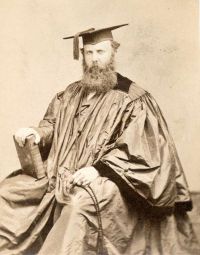 Henry Coppée,
English Literature, Considered as an Interpreter of English History
Henry Coppée,
English Literature, Considered as an Interpreter of English History
“ Junius is an unusual phenomenon, on which some have gazed with wonder and some with terror; but wonder and terror are transitory passions. He will soon be more closely viewed, or more attentively examined, and what folly has taken for a comet, that from its flaming hair shook pestilence and war, inquiry will find to be only a meteor formed by the vapors of putrefying democracy, and kindled into flame by the effervescence of interest struggling with conviction, which, after having plunged its followers into a bog, will leave us inquiring why we regarded it. ”
 Norman MacColl,
Dictionary of National Biography…
(1888)
Norman MacColl,
Dictionary of National Biography…
(1888)
“ The mystery attaching to the authorship of the ‘Letters of Junius’ especially fascinated him, and he acquired with his wonted thoroughness a knowledge of everything bearing on the problem that none of his contemporaries could rival. Unlike other students of the riddle, he was not so anxious to find out who Junius was as to show who he was not ”
“ On one side, our warmest patriots would disclaim me as a burthen to their honest ambition. On the other, the vilest [54] prostitution, if Junius could descend to it, would lose its natural merit and influence in the cabinet, and treachery be no longer a recommendation to the royal favor."—Let. 44. "He is not paid for his labor, and certainly has a right to choose his employment."—Let. 63. "As for myself, it is no longer a question whether I shall mix with the throng and take a single share in the danger. Whenever Junius appears he must encounter a host of enemies. ”
Junius, Letters of Junius (1772)
“ People cannot bear any longer your Lion's skin, and the despicable imposture of the old Roman name which you have affected. For the future assume the name of some modern [1] bravo and dark assassin: let your appellation have some affinity to your practice. But if I must perish, Junius, let me perish in the face of day: be for once a generous and open enemy. I allow that gothic appeals to cold iron, are no better proofs of a man's honesty and veracity, than hot iron and burning plough-shares are of female chastity: but a soldier's honour is as delicate as a woman's ”
1911 Encyclopædia Britannica, Volume 15… (1911)
“ He went in 1562 to study at Geneva, where he was reduced to the direst poverty by the failure of remittances from home, owing to civil war in France. He would accept only the barest sustenance from a humble friend who had himself been a protégé of Junius’s family at Bourges, and his health was permanently injured. The long-expected remittance from home was closely followed by the news of the brutal murder of his father by a Catholic fanatic at Issoudun; and Junius resolved to remain at Geneva, where his reputation enabled him to live by teaching. ”
Junius, Letters of Junius (1772)
“ But why must Junius be an Irishman? The absurdity of his writings betrays him. Waving all consideration of the insult offered by Modestus to the declared judgment of the people (they may well bear this amongst the rest) , let us follow the several instances, and try whether the charge be fairly supported. First then,—the leaving a man to enjoy such a repose as he can find upon a bed of torture, is severe indeed ”
“ The last parallel above will bear a moment's thought and study. Paine says: "Without the least merit in the man." Junius says: "We owe it to the bounty of Providence." They were both deeply read in the history of the human heart. The following is of the same nature, showing the same mental philosophy:The above are a few of the similar figures which have come under my eye. ”
“ Under this Taylor begins by observing: "One method of discovering the rank and station of Junius is to see with whose names he is most familiar." He then says: "The only persons to whom Junius applies epithets of familiarity are Welbore Ellis, Esq., Lord Barrington, Messrs. Rigby, Whateley, Bradshaw, and Chamier." Taylor then proves Junius to have been familiar with Whateley by a long quotation from miscellaneous letters, one without a signature, and one signed Henricus. See Taylor's Junius Identified, page 54. In this connection comes a very important disclosure in regard to Mr. Grenville. ”
Various, Notes and Queries, Number 222, January 28…
“ Are there many copies of this edition, or may I congratulate myself upon possessing the one ordered by Junius? It is quite possible that my grandfather possessed this copy some years before his return from India; and I may mention that I also have a great many political pamphlets and satires, chiefly in poetry, of different dates, from 1760 to 1780, such as Catiline's Conspiracy; The Diaboliad; Ditto, with additions, dedicated to the worst man in the kingdom (Rigby) , and containing allusions to all the most celebrated characters of Junius ”
