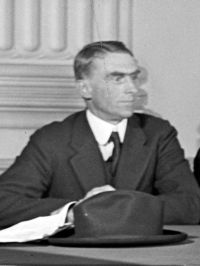
Matthew Page Andrews

Matthew Page Andrews

Summary

Portrait of Matthew Page Andrews Matthew Page Andrews The Dixie Book of Days

Richard Henry Lee, and the near kinsman of the noblest of Christian warriors, the greatest of generals, Robert E. Lee?... Your name will stand on history’s page as the Hunter of weak women and innocent children; the Hunter to destroy defenseless villages and refined and beautiful homes—to torture afresh the agonized hearts of widows; the Hunter of Africa’s poor sons and daughters, to lure them on to ruin and death of soul and body; the Hunter with the relentless heart of a wild beast, the face of a fiend and the form of a man.
Source: Gutenberg

Portrait of Matthew Page Andrews Matthew Page Andrews The Dixie Book of Days

In bidding you farewell, rest assured that you carry with you my best wishes for your future welfare and happiness.... I now cheerfully and gratefully acknowledge my indebtedness to the officers and men of my command, whose zeal, fidelity, and unflinching bravery have been the great source of my past success in arms. I have never on the field of battle sent you where I felt myself unwilling to pursue. You have been good soldiers, you can be good citizens. Obey the laws, preserve your honor, and the government to which you have surrendered can afford to be and will be magnanimous.
Source: Gutenberg

Portrait of Matthew Page Andrews Matthew Page Andrews The Dixie Book of Days

The great mind of Madison was one of the first to entertain distinctly the noble conception of two kinds of government, operating at one and the same time, upon the same individuals, harmonious with each other, but each supreme in its own sphere. Such is the fundamental conception of our partly Federal, partly National Government, which appears throughout the Virginia plan, as well as in the Constitution which grew out of it.
Source: Gutenberg

Get perspective with Kwize: daily news enlightened by great literature