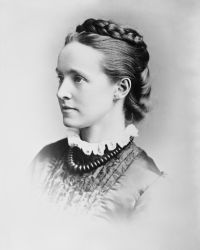
Millicent Garrett Fawcett

Millicent Garrett Fawcett

Summary

Portrait of Millicent Garrett Fawcett Millicent Garrett Fawcett The Case for Women's Suffrage… (1907)

A man is taught to dread the eye of God; but women were taught to dread nothing but the eye of man. Rousseau embodies the then current doctrine, that reputation in the case of women takes the place of virtue, in a passage which Mary Wollstonecraft quotes. "To women," he says, "reputation is no less indispensable than chastity: . . . what is thought of her is as important to her as what she really is. It follows hence that the system of a woman's education should in this respect be directly contrary to that of ours. Opinion is the grave of virtue among the men, but its throne among women."
Source: Wikisource

Portrait of Millicent Garrett Fawcett Millicent Garrett Fawcett The Case for Women's Suffrage… (1907)

Women need education, need economic independence, need political enfranchisement, need social equality and friendship, mainly because without them they are less able to do their duty to themselves and to their neighbours. What was false and unreal in the old system of treating women she showed up in its ugliness, the native ugliness of all shams. That woman must choose between being a slave and a queen, quickly scorn'd when not ador'd," is a theory of pinchbeck and tinsel; it is difficult to discover its relation to the realities of life.
Source: Wikisource

Portrait of Millicent Garrett Fawcett Millicent Garrett Fawcett The Case for Women's Suffrage… (1907)

With a touch of humour, more common in her private letters than in her more studied works, Mary Wollstonecraft expresses her conviction that there is really no cause to counsel women to pretend to be sillier and more ignorant than they are. "When a woman has sufficient sense not to pretend to anything which she does not understand in some degree, there is no need of determining to hide her talents under a bushel.
Source: Wikisource

Get perspective with Kwize: daily news enlightened by great literature