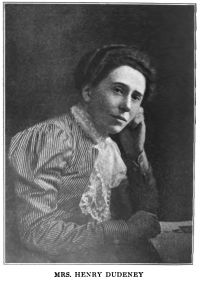
Mrs. Henry Dudeney

Mrs. Henry Dudeney

Summary

Portrait of Mrs. Henry Dudeney Mrs. Henry Dudeney Men of Marlowe's (1900)

You understand the sort of thing; avoiding the seams of paving stones, taking your fate from the chance expression of the first strange face you meet when you go out of doors, from the color of a horse, the chime of a clock, street cries—anything.
He was very candid when he stood on his trial for his life; he poured out all his troubles, piteously magnifying trifles, blaming the laundress, the blue dress, the clock in the square, the cab outside, for his misfortune.
Source: Gutenberg

Portrait of Mrs. Henry Dudeney Mrs. Henry Dudeney Men of Marlowe's (1900)

Covey’s window—a tiny window, set high in the brown thatch roof; a window with dim, greenish panes and the spectral suggestion of a limp calico curtain.
We heard the slipping, soft sound of feet. The stairs opened out from the sitting room. A beautiful old woman of forty-five or less—work in the fields and so many children make them old long before that—sidled up to the brothers, as they sat heavily in the Windsor chairs by the empty hearth. She was the village layer-out; once she had been the village coquette. Five shillings a corpse, and shillings hard to earn!
Source: Gutenberg

Portrait of Mrs. Henry Dudeney Mrs. Henry Dudeney Men of Marlowe's (1900)

He had sweepingly deemed nearly every other woman a fool. Yet she had simply died for her finery. You couldn’t have a meaner, a more frivolous end. She was only Eve, like all the rest, treasuring her apron of fig leaves. He blamed the inanimate thing of lace and soft wool for everything. He dragged it off the nail and trampled on it.
He went into the garden, at the piteous request of Betty, and played ball. She had on a pink frock, the color of the ragged robins that bloomed in the wood.
Source: Gutenberg

Get perspective with Kwize: daily news enlightened by great literature