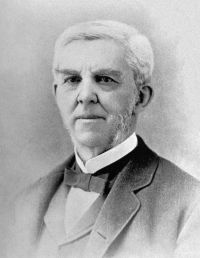
Oliver Wendell Holmes Sr.

Oliver Wendell Holmes Sr.

Summary

Portrait of Oliver Wendell Holmes Sr. Oliver Wendell Holmes Sr. Elsie Venner — Chapter I (1891)

The youth of the other aspect is commonly slender, his face is smooth, and apt to be pallid,—his features are regular and of a certain delicacy,—his eye is bright and quick,—his lips play over the thought he utters as a pianist's fingers dance over their music, and his whole air, though it may be timid, and even awkward, has nothing clownish.
Source: Wikisource

Portrait of Oliver Wendell Holmes Sr. Oliver Wendell Holmes Sr. Elsie Venner — Chapter I (1891)

There is, however, in New England, an aristocracy, if you choose to call it so, which has a far greater character of permanence. It has grown to be a caste,—not in any odious sense;—but, by the repetition of the same influences, generation after generation, it has acquired a distinct organization and physiognomy, which not to recognize is mere stupidity, and not to be willing to describe would show a distrust of the good-nature and intelligence of our readers, who like to have us see all we can and tell all we see.
Source: Wikisource

Portrait of Oliver Wendell Holmes Sr. Oliver Wendell Holmes Sr. Elsie Venner — Chapter I (1891)

There is nothing in New England corresponding at all to the feudal aristocracies of the Old World. Whether it be owing to the stock from which we were derived, or to the practical working of our institutions, or to the abrogation of the technical "law of honor," which draws a sharp line between the personally responsible class of "gentlemen" and the unnamed multitude of those who are not expected to risk their lives for an abstraction,—whatever be the cause, we have no such aristocracy here as that which grew up out of the military systems of the Middle Ages.
Source: Wikisource

Get perspective with Kwize: daily news enlightened by great literature