Summary

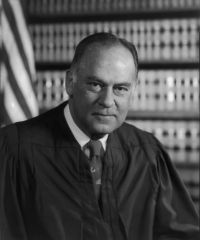
Portrait of Potter Stewart Potter Stewart Abington School District v. Schempp… (1963)

In that case the Court said: 'The First Amendment declares that Congress shall make no law respecting an establishment of religion or prohibiting the free exercise thereof. The Fourteenth Amendment has rendered the legislatures of the states as incompetent as Congress to enact such laws.' [2]
I accept without question that the liberty guaranteed by the Fourteenth Amendment against impairment by the States embraces in full the right of free exercise of religion protected by the First Amendment, and I yield to no one in my conception of the breadth of that freedom.
Source: Wikisource

Portrait of Potter Stewart Potter Stewart Abington School District v. Schempp… (1963)

We err in the first place if we do not recognize, as a matter of history and as a matter of the imperatives of our free society, that religion and government must necessarily interact in countless ways. Secondly, the fact is that while in many contexts the Establishment Clause and the Free Exercise Clause fully complement each other, there are areas in which a doctrinaire reading of the Establishment Clause leads to irreconcilable conflict with the Free Exercise Clause.
Source: Wikisource

Portrait of Potter Stewart Potter Stewart Abington School District v. Schempp… (1963)

Atheist, Buddhist or Freethinker, to believe or disbelieve, to worship or not worship, to pray or keep silent, according to his own conscience, uncoerced and unrestrained by government. It is conceivable that these school boards, or even all school boards, might eventually find it impossible to administer a system of religious exercises during school hours in such a way as to meet this constitutional standard-in such a way as completely to free from any kind of official coercion those who do not affirmatively want to participate.
Source: Wikisource

Get perspective with Kwize: daily news enlightened by great literature