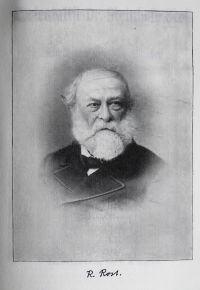
Reinhold Rost

Reinhold Rost

Summary

Portrait of Reinhold Rost Reinhold Rost,  1911 Encyclopædia Britannica (1911)

“ Though traces of a north Indian influence are palpable in all of them that have come down to us (see, e.g., F. W. Ellis's notes to the Kuṛaḷ) , we can at the same time perceive, as we must certainly appreciate, the desire of the authors to oppose the influence of Brahmanical writings, and create a literature that should rival Sanskrit books and appeal to the sentiments of the people at large. But the refinement of the poetical language, as adapted to the genius of Tamil, has been carried to greater excess than in Sanskrit ”
Source: Wikisource

Portrait of Reinhold Rost Reinhold Rost,  1911 Encyclopædia Britannica (1911)

“ The art of printing, however, which was introduced in southern India at an early date, while it has tended to the preservation of many valuable productions of the ancient literature, has also been the means of perpetuating and circulating a deal of literary rubbish and lasciviousness which would much better have remained in the obscurity of manuscript. ”
Source: Wikisource

Portrait of Reinhold Rost Reinhold Rost,  1911 Encyclopædia Britannica (1911)

“ Dr Pope, however, believed Tamil to be a corruption of tenmoli, southern speech, in contradistinction to vaḍugu, the northern, i.e., Telugu language. As in the case of the Kafir, Turkish, Tagala and other typical languages, the term Tamulic or Tamulian has occasionally been employed as the designation of the whole class of Dravidian peoples and languages, of which it is only the most prominent member. The present article deals with Tamil in its restricted sense only. The Tamils proper are smaller and of weaker build than Europeans, though graceful in shape. ”
Source: Wikisource

Get perspective with Kwize: daily news enlightened by great literature