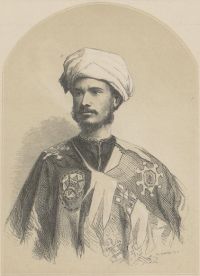
Robert Campbell

Robert Campbell

Summary

Portrait of Robert Campbell Robert Campbell A pilgrimage to my motherland (1861)

One of the chiefs of Abbeokuta, Atambala, was with us one day when a young missionary entered, and passed him with only a casual nod of the head. As soon as he was seated the haughty old chief arose and said, in his own tongue: "Young man, whenever any of my people, even the aged, approaches me, he prostrates himself with his face to the ground. I do not expect the same from you, or from civilized men, (oyibo,) nevertheless remember always that I shall demand all the respect due to a chief of Abbeokuta."
Source: Wikisource

Portrait of Robert Campbell Robert Campbell A pilgrimage to my motherland (1861)

Although, as I have before shown, slavery in Africa is not like slavery in America, or even as it is in Cuba, yet it is still a fact which must not be disregarded, that, more or less, it is slavery—such, it is true, as the teachings and example of good men might quietly but certainly in time overthrow, but which might also by an obverse course assume most of the abhorrent phases of the American institution.
Source: Wikisource

Portrait of Robert Campbell Robert Campbell A pilgrimage to my motherland (1861)

No wonder that the slave-trade should be so difficult to suppress, when no punishment awaits such wretches as these. What scamp would fear to embark in such an enterprise, if only assured that there was no personal risk—that he has only to destroy the ship's flag and papers on the approach of a cruiser, not only to shield himself and his crew from the consequence of his crime, but to receive the consideration rightly accorded distressed honest men.
Source: Wikisource

Get perspective with Kwize: daily news enlightened by great literature