Summary

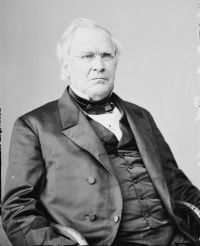
Portrait of Robert Cooper Grier Robert Cooper Grier De La Solidad v. United States…

Without stopping to inquire, whether, by the Spanish law, a subject could claim against the king by prescription, we will assume, for the purposes of this case, that as a presumption of fact, the court would be justified in presuming a grant on proof of fifty years continuous, notorious, adverse possession of a tract of land having certain admitted and well defined boundaries; and inquire whether we have such evidence as regards this valley of Raimundo, and the eight additional leagues of land now claimed to belong to the ranches of Las Pulgas.
Source: Wikisource

Portrait of Robert Cooper Grier Robert Cooper Grier De La Solidad v. United States…

No inference of an adverse claim or grant can be drawn from the fact that the commandant of a post pastured his own cattle with those of the king, or that the son and successor in office should continue in possession of the rancho by permission of the governor after the king's cattle were removed. The fact that the cattle of Arguello wandered to the mountains and over this valey afford no necessary presumption that he claimed it or owned it. And in a frontier country the cutting of timber is very equivocal evidence of even a claim of ownership of the land.
Source: Wikisource

Portrait of Robert Cooper Grier Robert Cooper Grier De La Solidad v. United States…

The fact that the governor, in 1835, refused to grant this valley to Alvisu, because it belonged or was claimed by the heirs of Arguello, cannot operate to give a title to them by way of estoppel. The only inferences that can be drawn from these proceedings are: 1. That Alvisu applied for the land. 2. That the Arguellos claimed it. 3. That the governor refused, for that reason, to grant it to Alvisu. It has always been the wise and just policy of the Mexican government to avoid granting litigious titles.
Source: Wikisource

Get perspective with Kwize: daily news enlightened by great literature