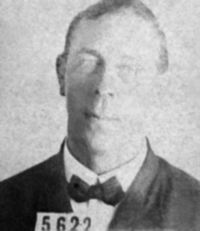
Robert Hichens

Robert Hichens

Summary

Portrait of Robert Hichens Robert Hichens The Desert Drum

The Spahi was a magnificent man, tall, lithe, bronze-brown and muscular. He looked about thirty-four, and had the face of a desert eagle. His piercing black eyes stared me calmly out of countenance, and he sat on his spirited horse like a statue, waiting patiently till the guardian of the Bordj was ready to attend to him. My gaze travelled from him along the cord to the man at its end, and rested there with pity. He, too, was a fine specimen of humanity, a giant, nobly built, with a superbly handsome face, something like that of an undefaced Sphinx.
Source: Gutenberg

Portrait of Robert Hichens Robert Hichens The Desert Drum

The Spahi scowled ferociously. I put my cigar-case back into my pocket. It is unwise to offend the powerful if your sympathy lies with the powerless.
Sidi-Massarli was soon explored. It contained a Café Maure, into which I peered. In the coffee niche the embers glowed. One or two ragged Arabs sat hunched upon the earthen divans playing a game of cards. At least I should have my coffee after my tinned dinner. I was turning to go back to the Bordj when the extreme desolation of the desert around, now fading in the shadows of a moonless night, stirred me to a desire.
Source: Gutenberg

Portrait of Robert Hichens Robert Hichens The Desert Drum

Of all the desert superstitions the one which appealed most to my imagination was the superstition of the desert drum. The Sahara-man declares that far away from the abodes of men and desert cities, among the everlasting sand dunes, the sharp beating, or dull, distant rolling of a drum sometimes breaks upon the ears of travellers voyaging through the desolation. They look around, they stare across the flats, they see nothing.
Source: Gutenberg

Get perspective with Kwize: daily news enlightened by great literature