Summary

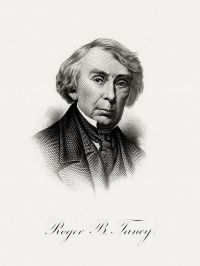
Portrait of Roger B. Taney Roger B. Taney Goodtitle v. Kibbe — Opinion of the Court

That the proprietorship of the soil between high and low tide belongs to the public, and may be acquired by individuals either by grant or prescription, is a doctrine of the common law, taught by Sir Matthew Hale in his treatise De Jure Maris (1 Hargrave's Law Tracts, p. 37) , citing Bracton, who, in turn, quotes the Roman civil law from Justinian's Digest.
Source: Wikisource

Portrait of Roger B. Taney Roger B. Taney Goodtitle v. Kibbe — Opinion of the Court

The party cannot, then, rest upon his Spanish title.
6. The opinion of the Supreme Court, reported in 3 Howard, 212, was very deliberately given. A motion for a rehearing was refused. The opinion comprehends within its principle property to a very large amount, and possessions and contracts have been made with respect to it.
In the State of Alabama, the Supreme Court has repeatedly acted in accordance with it, and has regarded it as the settled law of the land. An opinion so given, entering so far into the law of property of the country, cannot be questioned without producing great confusion.
Source: Wikisource

Portrait of Roger B. Taney Roger B. Taney Goodtitle v. Kibbe — Opinion of the Court

Such being the law upon this question, the only inquiry is, whether the production of an incomplete Spanish title (a mere permit to occupy) can change the result. This court has repeatedly decided that such a paper can give the party no standing in the court, no matter when it was executed. 12 Wheaton, 599; 4 Howard, 449.
This court has also decided, that a complete grant bearing date at the time this does (1809) can give the party no right to be heard in the courts of the United States.
Source: Wikisource

Get perspective with Kwize: daily news enlightened by great literature