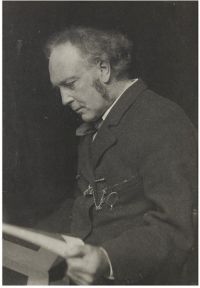
Stopford Augustus Brooke

Stopford Augustus Brooke

Summary

Portrait of Stopford Augustus Brooke Stopford Augustus Brooke Four Victorian Poets: a Study of Clough… (1908)

It were better to rise out of one's soul into love of the soul of the world, to lose oneself in its beauty and joy and peace by self-forgetfulness, to see the perfect good outside of one's self, and spring off one's own shadow into union with the infinite light. No man can change his yearning to the greatness of nature into possession of that greatness who is sunk in his personal soul. But outside of that prison, ravished by the love of the perfect—he retains in decay, in old age, in death, not the misery Arnold paints in the poem, but delight and life, even rapture.
Source: Wikisource

Portrait of Stopford Augustus Brooke Stopford Augustus Brooke Four Victorian Poets: a Study of Clough… (1908)

Yet if the poet love, he has charm; and to charm the heart of man, to loose our heart in tears and joy, to give us the freshness of the early world, to heal the soul, to make us see and feel and know,—this is the poet's dignity and use.
But he takes another view. The poet is, by his nature, alone (and here the personality of Arnold intrudes) , and solitude oppresses him. He flies from the noise of men which jars him. But can Life reach him in the solitude, and he is to express Life
Source: Wikisource

Portrait of Stopford Augustus Brooke Stopford Augustus Brooke Four Victorian Poets: a Study of Clough… (1908)

He contrasts her calm with our turmoil, her quiet changes of action day after day, her rest after action, with our hurry, our confusion, and our noise. Calm soul of things, he cries, make me calm, let the human world, like thee, perfect its vast issues "in toil unsevered from tranquillity." Again, he contrasts the immortal life of nature with our decay and death. That life existed before us, will exist after us, fulfilling pauselessly its pure eternal course.
Source: Wikisource

Get perspective with Kwize: daily news enlightened by great literature