Summary

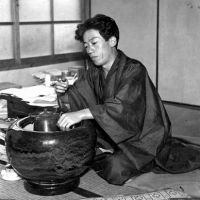
Portrait of Takiji Kobayashi Takiji Kobayashi The Cannery Boat — The Cannery Boat (1933)

When work was finished the fishermen filed down into their quarters. Their frozen limbs were stuck numbly on to their bodies. Like worms, they crawled into their separate bunks, with never a word. They grasped the iron rails because the ship shook herself desperately, like a horse trying to drive off gadflie. Some cast an aimless glances at the ceiling whose white paint had become yellowed with smoke, or at the black porthole almost buried in the depths of the ocean; others lay with their mouths half open, a blank expression on their faces. Not one was capable of thinking.
Source: Wikisource

Portrait of Takiji Kobayashi Takiji Kobayashi The Cannery Boat — The Cannery Boat (1933)

Now and again a rattling sound of winches came clear over the waves.
Next to this crabcanning steamer, the Hakko Maru, lay a sailing vessel, her paint peeling off and the chains of her anchor hanging down from holes in the bow that looked like the nostrils of an ox. Two foreigners could be seen with pipes in their mouths walking backwards and forwards all the time, like mechanical dolls, over the same strip of deck. It seemed to be a Russian ship—evidently told off to keep the Japanese crab steamers under surveillance.
Source: Wikisource

Portrait of Takiji Kobayashi Takiji Kobayashi The Cannery Boat — The Cannery Boat (1933)

Every sleeper on every track in Hokkaido represents the corpse of some worker. And the piles sunk in the harbour reclamation are all the bodies of workers who died of beri-beri.
Profits were just scooped up. Then very skilfully such catch phrases as “the development of national wealth” were tacked on to these enterprises, which were thus completely justified. The capitalists were very shrewd. “For the sake of their country” the workers were starved and beaten to death.
Source: Wikisource

Get perspective with Kwize: daily news enlightened by great literature