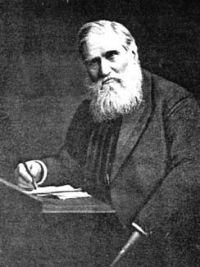
Thomas Bond Sprague

Thomas Bond Sprague

Summary

Portrait of Thomas Bond Sprague Thomas Bond Sprague Encyclopædia Britannica, Ninth Edition (1878)

So long as we consider the annuity to be payable yearly, no allowance being made for the time which elapses between the death of the nominee and the last previous payment of the annuity, it is, as we have seen, a very simple problem to calculate its value. But in practice annuities are generally payable by half-yearly instalments, and it is the custom to pay a proportionate part of the annuity for the odd time that elapses between the last half-yearly payment and the death of the nominee
Source: Wikisource

Portrait of Thomas Bond Sprague Thomas Bond Sprague Encyclopædia Britannica, Ninth Edition (1878)

If a simple mathematical law could be discovered which the mortality followed, then a mathematical formula could be given for the value of a life annuity, in the same way as we gave above the formula for the value of an annuity certain. In the early stage of the science, De- moivre propounded the very simple law of mortality which bears his name, and which is to the effect, that out of 86 children born alive 1 will die every year until the last dies between the ages of 85 and 86.
Source: Wikisource

Portrait of Thomas Bond Sprague Thomas Bond Sprague Encyclopædia Britannica, Ninth Edition (1878)

Even if the mortality table correctly represents in the long run the rate of mortality among the lives we are dealing with, we know that the rate of mortality will, from accidental circumstances, be some times greater and sometimes less than that indicated by the table. If, for example, we have 734 persons under observation all of the age 30, we have no certainty that at the end of 10 years exactly 77 will have died, leaving 657 alive. It is, indeed, within the range of possibility firstly, that the whole 734 persons may die before the age 40
Source: Wikisource

Get perspective with Kwize: daily news enlightened by great literature