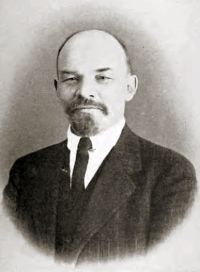
Vladimir Ilyich Lenin

Vladimir Ilyich Lenin

Summary

Portrait of Vladimir Ilyich Lenin Vladimir Ilyich Lenin What Is To Be Done? (1935)

You, gentlemen, who talk so much about the "average worker," as a matter of fact, rather insult the workers by your desire to talk down to them, to stoop to them when discussing labour politics or labour organisation. Talk about serious things in a serious manner; leave pedagogics to the pedagogues, and not to politicians and to organisers! Are there not advanced people, "average people," and "masses," among the intelligentsia? Does not every one recognise that popular literature is required for the intelligentsia and is not such literature written?
Source: Wikisource

Portrait of Vladimir Ilyich Lenin Vladimir Ilyich Lenin What Is To Be Done? (1935)

A man who is weak and vacillating on theoretical questions, who has a narrow outlook, who makes excuses for his own slackness on the ground that the masses are awakening spontaneously, who resembles a trade-union secretary more than a people's tribune, who is unable to conceive a broad and bold plan, who is incapable of inspiring even his enemies with respect for himself and who is inexperienced and clumsy in his own professional art—the art of combating the political police—such a man is not a revolutionist but a hopeless amateur!
Source: Wikisource

Portrait of Vladimir Ilyich Lenin Vladimir Ilyich Lenin What Is To Be Done? (1935)

Let no active worker take offence at these frank remarks, for as far as insufficient training is concerned, I apply them and foremost to myself. I used to work in a circle that set itself a great and all-embracing task: and every member of that suffered to the point of torture from the realisation that we were proving ourselves to be amateurs at a moment in history when we might have been able to say—paraphrasing a well-known epigram: "Give us an organisation of revolutionists, and we shall overturn the whole of Russia!"
Source: Wikisource

Get perspective with Kwize: daily news enlightened by great literature