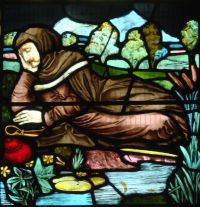
 William Langland,
The Vision and Creed of Piers Ploughman…
(1887)
William Langland,
The Vision and Creed of Piers Ploughman…
(1887)
“ The medieval notion of the manner in which the elements were mixed together in the formation of the human body, here alluded to, appears to partake more of Western legend than of Eastern tradition. In the English verses on Popular Science (given in my "Popular Treatises of Science written during the Middle Ages," p. 138) , we have the following curious account of the four things forming the body, and the influence of each:—Man hath of urthe al his bodi, of water he haveth wete, Of eyr he haveth wynd, of fur he haveth hete. ”
