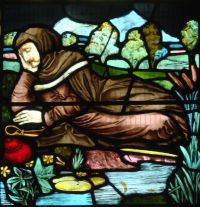
“ Calote set her finger upon his lips, but he drew away her hand:—How have I cried out upon the begging friars! But thrice in the month I sit and feed at my Lord Latimer's table,—my Lord Latimer that betrayeth the poor,—I and a friar we dip our fingers into the same dish for alms' sake. I live in London and on London both. I praise Piers Ploughman for his diligence, yet have I no wish to bow my back to his toil. I live like a loller. I am one of those that sits and swings 's heels, saying: 'I may not work, but I 'll pray for you, Piers.' Yet am I not minded to go hungry, neither. ”
Piers Ploughman
Definition and stakes
Quotes about “Piers Ploughman”
William Langland,
The Vision and Creed of Piers Ploughman
(1887)
“ In Piers Ploughman's Creed it is the church simply, and not the state, which is the object of attack. The clergy—and more particularly the monks—are accused of having falsified religion, and of being actuated solely by worldly passions—pride, covetousness, self-love. The writer, placing himself in the position of one who has just learnt the first grounds of religious knowledge, is anxious to find a person capable of instructing him in his creed, and with this object he addresses himself to the different orders of friars. ”
William Langland,
The Vision and Creed of Piers Ploughman…
“ These, though comparatively few, aggravated the evil, by affording a pretence for persecution. The history of England during the fourteenth century is a stirring picture; its dark side is the increasing corruption of the popish church; its bright side, the general spread of popular intelligence, and the firm stand made by the commons in the defence of their liberties, and in the determination to obtain a redress of grievances.Under these circumstances appeared Piers Ploughman. ”
Reuben Post Halleck, Halleck's New English Literature
“ Chambers, I.; and Manly, I. Skeat has edited a small edition of Piers the Plowman ("B" text) and also a larger edition, entitled The Vision of William concerning Piers the Plowman, in Three Parallel Texts. G.C. Macaulay has a good volume of selections from Gower's Confessio Amantis.What is the difference between the form of the verse in Piers Plowman and Handling Synne? Who is Piers? Who are some of the other characters in the poem? What type of life is specially described? In what sort of work are the laborers engaged? Why may the author of Piers Plowman be called a reformer? ”
William Langland,
The Vision and Creed of Piers Ploughman…
“ The answer expresses the whole force of the popular sentiment of the age: "because he would not have a retinue of greedy attendants by his side, in the shape of grooms and servants, to insult and oppress the peasantry." ”
“ Old Mrs. Ploughman said nothing, but regarded her friends with a gloomy and thoughtful air. On the other hand, Miss Beal, the dressmaker, saw no reason to keep her opinions to herself. "It's a scandal," she said to her friend Mrs. Grumble; "what with Eben Wicket scarcely cold in his grave, and John a thief, with his neck broke and heaven only knows what else besides."Nevertheless, that summer Noel Ploughman's sober, honest face was often to be seen in Mrs. Wicket's garden patch, among the beans and the lettuces. Who can say what they found in one another to admire? ”
Ethel M. Dell, The Bars of Iron
“ It's the children I want to help. I hate to think of fresh, clean lives being thrown on to the dust-heap. It's so futile,—such a crying waste.""If anyone can do it, you can," said Piers."Ah! I wonder. It won't be easy, but I know their temptations so awfully well. I've seen scores go under, I've been under myself. And that makes a lot of difference.""Life is infernally difficult for most of us," said Piers.They rode in silence for awhile, and then he changed the subject.It was not till they returned that Crowther announced his intention of leaving on the following day. ”
Ethel M. Dell, The Bars of Iron
“ They had reached the conservatory, and, entering, it was Piers who led the way. His face, as they emerged into the library, was deathly, but he was absolute master of himself."I believe there is a meal in the dining-room," he said. "Will you help yourself while I go up?""No," said Wyndham briefly. "I am coming up with you."He kept a hand upon Piers' arm all the way up the stairs, deliberately restraining him, curbing the fevered impetuosity that urged him with a grim insistence that would not yield an inch to any chafing for freedom. ”
Ethel M. Dell, The Bars of Iron
“ He spoke very earnestly, with a pleading that could not give offence. Piers' face softened almost in spite of him. "You're an awfully good chap," he said."Promise me, lad!" pleaded Crowther, still holding his arm in a friendly grasp; then as Piers hesitated: "You know, I'm an older man than you are. I can see further. You'll be making your own hell if you don't." ”
Ethel M. Dell, The Bars of Iron
“ Piers' eyes fenced with his, albeit a faint smile hovered about the corners of his mouth. "I really am not such a humbug as you are pleased to imagine," he said, after a moment with an oddly boyish touch of pride. "I'm feeling lighthearted, and that's a fact.""Then you are about the only man in England today who is," responded Crowther."That may be," carelessly Piers made answer. "Nearly everyone is more or less scared. I'm not. It's going to be a mighty struggle—a Titanic struggle—but we shall come out on top." ”
Ethel M. Dell, The Bars of Iron
“ After the first bitter outpouring of his soul, Piers had withdrawn himself with so obvious a desire for privacy that Crowther had never attempted to cross the boundary thus clearly defined. But his influence had made itself felt notwithstanding. It would have been impossible to have lived with the man for so long without imbibing some of that essential greatness of soul that was his main characteristic, and Piers was ever swift to feel the effect of atmosphere. He had come to look upon Crowther with a reverence that in a fashion affected his daily life. ”
Ethel M. Dell, The Bars of Iron
“ There was a queer, intangible species of mockery in Piers' attitude, as though he set the whole world at defiance.And yet he did not look like a man who had been stunned by an unexpected, sledge-hammer blow of Fate. He was keenly, fiercely alive to his surroundings. He seemed to be gibing rather at a blow that had glanced aside. Uneasily Crowther wondered.It was he who finally suggested a move. It was growing late."So it is!" said Piers. "You ought to be turning in if you really mean to make an early start."He stood still in the hall and held out his hand. "Good-night, old chap! ”
Frank Lillie Pollock, Rainbow Landing: An Adventure Story (1926)
“ He went to the open window to breathe, and on the dim gallery he perceived Henry Power, his feet on the railing, a pipe in his mouth. A little farther away he saw the gleam of a white dress in the faintly sweet darkness.He went quietly around to the door and upon the gallery. It was a hot, dark evening, with the moon not yet risen. Overhead the stars glowed like white fires, and low in the south, over the vast pine forests, there was a rapid intermittence of distance, silent lightning.“May I come out?” he asked, feeling for a chair. “Aren’t you a poker player, either, Mr. Power?” ”
Arthur Quiller-Couch,
Shakespeare's Christmas, and other stories
“ Polwhele, that always visited Plymouth once a year for a week's shopping. Having all these parcels to bring home, Mrs. Polwhele had crossed over by a waterman's boat two hours before, [Pg 162] packed the coach as full as it would hold, and stepped into the Ferry Inn for a dish of tea. "And glad I am to be across the river in good time," she told the landlady; "for by the look of the sky there's a thunderstorm coming." ”
Agatha Christie,
The Plymouth Express Affair
“ I’ve got the pick of Scotland Yard, but I’ll have my own man as well. Money no object. All the dollars were made for my little girl—and now she’s gone, I’ll spend my last cent to catch the damned scoundrel that did itl See? So it’s up to you to deliver the goods." Poirot bowed. "I accept, monsieur, all the more willingly that I saw your daughter in Paris several times. And now I will ask you to tell me the circumstances of her journey to Plymouth and any other details that seeni to you to bear upon the case." "Well, to begin with," responded Halliday, “she wasn’t going to Plymouth. ”
T. J. Llewelyn Prichard, The Comical Adventures of Twm Shon Catty…
“ Phillips started at such an assertion made in earnest, and Powell read, “Whoever fished the largest weight, no matter of what kind, would be declared the winner,” and as umpire, awarded the five pounds to our hero.Some merriment at the expense of Powell was caused by his declaring himself the unlucky proprietor of the said flock of ducks; but with his usual good-humour, he proposed that the ducks and the trout should be cooked at his house for their supper, in which Phillips acquiesced. ”
Various, Blackwood's Edinburgh magazine…
“ Masters of trades, and respectable shopkeepers, and professional men, and their families are in the boxes; and Mr Phelps is as great a benefactor to that neighbourhood as if he had established a public park, or opened a lyceum for education. There is a perceptible difference, we are told, in the manners of the district. You can’t raise a man in any one department without lifting him up in all. Improve his mind, you refine his character; teach him even mathematics, he will learn politeness; give him good society, he will cease to be coarse ”
Joseph Conrad,
Chance, Part II — Chapter 2. Young Powell Sees and Hears
(1913)
“ Powell--not the Mr. Powell we know taking solitary week-end cruises in the estuary of the Thames (with mysterious dashes into lonely creeks) but to the young Mr. Powell, the chance second officer of the ship _Ferndale_, commanded (and for the most part owned) by Roderick Anthony, the son of the poet--you know. A Mr. Powell, much slenderer than our robust friend is now, with the bloom of innocence not quite rubbed off his smooth cheeks, and apt not only to be interested but also to be surprised by the experience life was holding in store for him. ”
Agatha Christie,
Poirot Investigates
“ When we were in the train, speeding towards London, Poirot wrote busily for a few minutes, sealing up the result in an envelope.“This is for the good Inspector McNeil. We will leave it at Scotland Yard in passing, and then to the Rendezvous Restaurant, where I have asked Miss Esmée Farquhar to do us the honour of dining with us.”“What about Ridgeway?”“What about him?” asked Poirot with a twinkle.“Why, you surely don’t think—you can’t——”“The habit of incoherence is growing upon you, Hastings. As a matter of fact I did think. ”
Frank L. Packard,
The Four Stragglers
“ But for Polly's sake I cannot do it. I love her more than I hate you. I want to save her from the sorrow and distress she would suffer if she knew the truth of what has happened here; and above all I want to save her from the misery and shame of having her name publicly connected with yours were you brought as a common criminal to stand in the dock. And so you are going—where I do not know. Not London, or anywhere else, as Captain Francis Newcombe any more—for you would no longer dare do that with the police at last hot on the investigation of your career. ”
Ebenezer Cobham Brewer,
Character Sketches of Romance, Fiction and the Drama…
“ Paul Pry, an idle, inquisitive, meddlesome fellow, who has no occupation of his own, and is forever poking his nose into other people’s affairs. He always comes in with the apology, “I hope I don’t intrude.”—John Poole, Paul Pry. ”
Arthur Quiller-Couch,
News from the Duchy
“ Polwhele managed him in all the little business of life. "'Tis like looking after a museum," she used to declare. "I don't understand the contents, I'm thankful to say; but, please God, I can keep 'em dusted." A better-suited couple you couldn't find, nor a more affectionate; and whenever Mrs. Polwhele tripped it to Plymouth, the Parson would be at Falmouth to welcome her back, and they'd sleep the night at the "Crown and Anchor" and drive home to Manaccan next morning. ”
Various, Graham's Magazine, Vol. XIX, No…
“ Phelps’ face immediately parted with its combined expression, which was replaced by that peculiar one which talkative women always put on when they have an opportunity of indulging their propensity. “Ah, yes,” she sighed, “ah, dear yes, Major Pierpoint, she is indeed an orphan. She is a good child, and has a face that will be either the making or the breaking of her. I feel towards her just as if she was my own flesh and blood; though, between you and I, Major, I am neither kith nor kin to her or hers, though I lets her call me aunt for affection-like.” ”
William Hayman Cummings,
The Great Musicians: Purcell
“ A music book intituled Harmonia Sacra will shortly be printed for Mr. Playford. I need not say anything more to recommend it to you, than that you will find in it many of Mr. Henry Purcell's admirable composures. As they charm all men, they are universally extolled, and even those who know him no otherwise than by his Notes are fond of expressing their sense of his merit. ”
Agatha Mary Clarissa Christie, Poirot Investigates (1924)
“ Japp grinned more widely. "I don't know," he said. "Miller, the man who's on this case, is a smart chap. You may be very sure he won't overlook a footprint, or a cigar-ash, or a crumb even. He's got eyes that see everything." "So, mon ami," said Poirot, "has the London sparrow. But all the same, I should not ask the little brown bird to solve the problem of Mr. Davenheim." ”
Agatha Mary Clarissa Christie, Poirot Investigates (1924)
“ Once arrived at the quay alongside which lay the big transatlantic liner, Poirot became brisk and alert. Our proceedings consisted in interviewing four successive stewards and inquiring after a friend of Poirot's who had crossed to New York on the 23rd. "An elderly gentleman, wearing glasses. A great invalid, hardly moved out of his cabin." The description appeared to tally with one Mr. Ventnor who had occupied the cabin C 24 which was next to that of Philip Ridgeway. Although unable to see how Poirot had deduced Mr. Ventnor's existence and personal appearance, I was keenly excited. ”
Agatha Christie,
Poirot Investigates
“ Poirot waved an impatient hand.“Permit me to continue. The last moment that the bonds are seen as bonds is in the office of the London and Scottish Bank on the morning of the 23rd. They reappear in New York half an hour after the Olympia gets in, and according to one man, whom nobody listens to, actually before she gets in. Supposing then, that they have never been on the Olympia at all? Is there any other way they could get to New York? Yes. The Gigantic leaves Southampton on the same day as the Olympia, and she holds the record for the Atlantic. ”
Agatha Mary Clarissa Christie, Poirot Investigates (1924)
“ Poirot nodded gravely. He looked at his turnip of a watch again. "I understand that I have carte blanche, messieurs—in every way, I mean? I must be able to go where I choose, and how I choose." "Perfectly. There is a special train leaving for Dover in an hour's time, with a further contingent from Scotland Yard. You shall be accompanied by a Military officer and a C.I.D. man, who will hold themselves at your disposal in every way. Is that satisfactory?" "Quite. One more question before you leave, messieurs. What made you come to me? I am unknown, obscure, in this great London of yours." ”
P. G. Wodehouse,
Psmith, Journalist
“ He has felt, rightly, that this is no occasion for the old straw hat and the baggy flannels. I would not have it otherwise. It is the right spirit. Shall we give him audience, Comrade Windsor?" "I wonder what he wants." "That," said Psmith, "we shall ascertain more clearly after a personal interview. Comrade Maloney, show the gentleman in. We can give him three and a quarter minutes." Pugsy withdrew. Mr. Francis Parker proved to be a man who might have been any age between twenty-five and thirty-five. He had a smooth, clean-shaven face, and a cat-like way of moving. ”
William T. Davis, Plymouth memories of an octogenarian (1906)
“ Born and bred on Clark’s Island at the entrance of Plymouth harbor about four miles from town, and eighty acres in extent, he there spent his life a sailor and fisherman when occasion demanded, always a farmer familiar with the secrets which nature is ready to disclose to her lovers, a poet of no mean acquirements, and above all a student of the events of the world, a philosopher who acted his philosophy without preaching it, and who as much deserves the title of sage as some who in a broader field won a more notorious name. ”