Summary

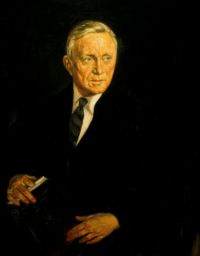
Portrait of William O. Douglas William O. Douglas Sierra Club v. Morton — Dissenting Opinion

Industry advisory committees exist inside most important federal agencies, and even have offices in some. Legally, their function is purely as kibitzer, but, in practice, many have become internal lobbies — printing industry handouts in the Government Printing Office with taxpayers' money, and even influencing policies. Industry committees perform the dual function of stopping government from finding out about corporations while at the same time helping corporations get inside information about what government is doing.
Source: Wikisource

Portrait of William O. Douglas William O. Douglas Sierra Club v. Morton — Dissenting Opinion

With all respect, the problem is to make certain that the inanimate objects, which are the very core of America's beauty, have spokesmen before they are destroyed. It is, of course, true that most of them are under the control of a federal or state agency. The standards given those agencies are usually expressed in terms of the "public interest." Yet "public interest" has so many differing shades of meaning as to be quite meaningless on the environmental front. Congress accordingly has adopted ecological standards in the National Environmental Policy Act of 1969, Pub.L. 91-190, 83 Stat.
Source: Wikisource

Portrait of William O. Douglas William O. Douglas Sierra Club v. Morton — Dissenting Opinion

Of clear-cutting, Senator Gale McGee, a leading antagonist of Forest Service policy, complains: "The Forest Service's management policies are wreaking havoc with the environment. Soil is eroding, reforestation is neglected, if not ignored, streams are silting, and clear-cutting remains a basic practice." N.Y. Times, Nov. 14, 1971, p. 60, col. 2. He adds: "In Wyoming . . . , the Forest Service is very much . . . nursemaid . . . to the lumber industry.
Source: Wikisource

Get perspective with Kwize: daily news enlightened by great literature