Summary

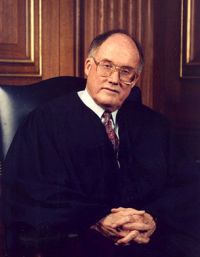
Portrait of William Rehnquist William Rehnquist Texas v. Johnson — Dissenting Opinion (1989)

The uniquely deep awe and respect for our flag felt by virtually all of us are bundled off under the rubric of "designated symbols," ante at 417, that the First Amendment prohibits the government from "establishing." But the government has not "established" this feeling; 200 years of history have done that. The government is simply recognizing as a fact the profound regard for the American flag created by that history when it enacts statutes prohibiting the disrespectful public burning of the flag.
Source: Wikisource

Portrait of William Rehnquist William Rehnquist Texas v. Johnson — Dissenting Opinion (1989)

Up from the meadows rich with corn, Clear in the cool September morn, The clustered spires of Frederick stand Green-walled by the hills of Maryland. Round about them orchards sweep, Apple- and peach-tree fruited deep, Fair as a garden of the Lord To the eyes of the famished rebel horde, On that pleasant morn of the early fall When Lee marched over the mountain wall, — Over the mountains winding down, Horse and foot, into Frederick town.
Source: Wikisource

Portrait of William Rehnquist William Rehnquist Texas v. Johnson — Dissenting Opinion (1989)

The result of the Texas statute is obviously to deny one in Johnson's frame of mind one of many means of "symbolic speech." Far from being a case of "one picture being worth a thousand words," flag burning is the equivalent of an inarticulate grunt or roar that, it seems fair to say, is most likely to be indulged in not to express any particular idea, but to antagonize others.
Source: Wikisource

Get perspective with Kwize: daily news enlightened by great literature