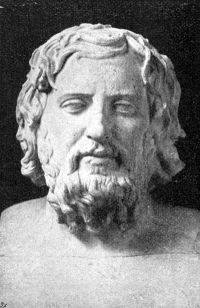
“ In the first place, you will by one swift stroke have brought about the very thing you have set your heart on, you will have won the affection of your subjects. Secondly, you will need no herald to proclaim your victory; not one man only, but all mankind, shall hymn your virtue.Wherever you set foot you shall be gazed upon, and not by individual citizens alone, but by a hundred states be warmly welcomed. You shall be a marvel, not in the private circle only, but in public in the sight of all. ”
Quotes from Hiero (Xenophon)
“ You shall command a world-wide loyalty; a whole people shall rejoice with you at your good fortunes, a whole people battle for your interests, as if in very deed and truth their own. Your treasure-houses shall be coextensive with the garnered riches of your friends and lovers. Therefore be of good cheer, Hiero; enrich your friends, and you will thereby heap riches on yourself. Build up and aggrandise your city, for in so doing you will gird on power like a garment, and win allies for her. ”
“ And, indeed, the robber derives some satisfaction from the spoils he wins and from the pain he causes to the man he hates. But to seek pleasure in the pain of one we love devoutly, to kiss and to be hated, to touch [46] and to be loathed—can one conceive a state of things more odious or more pitiful? ”
“ Hiero. That is easily explained, Simonides. What I most desire of him is no ready spoil, as men might reckon it, but rather what it is least of all the privilege of a tyrant to obtain. [42] I say it truly, I—the love I bear Dailochus is of this high sort. All that the constitution of our souls and bodies possibly compels a man to ask for at the hands of beauty, that my fantasy desires of him; but what my fantasy demands, I do most earnestly desire to obtain from willing hands and under seal of true affection. ”
“ The love of praise is a passion deeply fixed in the mind of every extraordinary person; and those who are most affected with it seem most to partake of that particle of the divinity which distinguishes mankind from the inferior creation. ”
“ Whereas the tyrant knows precisely the reverse; as soon as he arrives in his own city, he will find himself in the centre of hostility at once. Or let us suppose that an invading army, superior in force, is marching against a city: however much the weaker population, whilst they are still outside their walls, may feel the stress of danger, yet once within their trenches one and all expect to find themselves in absolute security. ”
“ Nay, as it seems to me, an honour from the gods, a grace divine, is shed about the path of him the hero-ruler. (12) Not only does command itself ennoble manhood, but we gaze on him with other eyes and find the fair within him yet more fair who is to-day a prince and was but yesterday a private citizen. (13) Again, it is a prouder satisfaction doubtless to hold debate with those who are preferred to us in honour than with people on an equal footing with ourselves. ”
“ And for my part, I hold it ill becomes a tyrant to enter the lists with private citizens. For take the case he wins, he will not be admired, but be envied rather, when is is thought how many private fortunes go to swell the stream of his expenditure; while if he loses, he will become a laughing-stock to all mankind. ”
“ To which Hiero: Nay, that is not so, Simonides, take my word for it; the fact is rather that the pleasures of the despot are far fewer than those of people in a humbler condition, and his pains not only far more numerous, but more intense. That sounds incredible (exclaimed Simonides) ; if it were really so, how do you explain the passionate desire commonly displayed to wield the tyrant's sceptre, and that too on the part of persons reputed to be the ablest of men? Why should all men envy the despotic monarch? ”
“ Since, it would seem, all living creatures alike take pleasure in meats and drinks, in sleep and sexual joys. Only the love of honour is implanted neither in unreasoning brutes (8) nor universally in man. But they in whose hearts the passion for honour and fair fame has fallen like a seed, these unmistakably (9) are separated most widely from the brutes. These may claim to be called men, (10) not human beings merely. So that, in my poor judgment, it is but reasonable you should submit to bear the pains and penalties of royalty, since you are honoured far beyond all other mortal men. ”
“ The tyrant, if he shared the pains before, no longer shares the pleasures now. What happens when a state has gained the mastery in battle over her antagonist? It would be hard (I take it) to describe the joy of that occurrence: joy in the rout, joy in the pursuit, joy in the slaughter of their enemies; and in what language shall I describe the exultation of these warriors at their feats of arms? With what assumption they bind on their brows the glittering wreath of glory ”
“ Simonides made answer: Yes, I must indeed admit, I do concede to you, that praise alone is sweetest which is breathed from lips of free men absolutely free. But, look you, here is a point: you will find it hard to persuade another, that you despots, within the limits of those things whereby we one and all sustain our bodies, in respect, that is, of meats and drinks, have not a far wider range of pleasures. ”
“ And further, even a tyrant cannot but be something of a patriot—a lover of that state, without which he can neither hope for safety nor prosperity. On the other hand, his tyrrany, the exigencies of despotic rule, compel him to incriminate his fatherland. (5) To train his citizens to soldiery, to render them brave warriors, and well armed, confers no pleasure on him; rather he will take delight to make his foreigners more formidable than those to whom the state belongs, and these foreigners he will depend on as his body-guard. ”
“ But there is yet another sore affliction to which the tyrant is liable, Sinmonides, which I will name to you. It is this. Tyrants no less than ordinary mortals can distinguish merit. The orderly, (1) the wise, the just and upright, they freely recognise; but instead of admiring them, they are afraid of them—the courageous, lest they should venture something for the sake of freedom; the wise, lest they invent some subtle mischief ”
“ Nor does the tyrant attain the object of his heart's desire more quickly than do humbler mortals theirs. For consider, what are their objects of ambition? The private citizen has set his heart, it may be, on a house, a farm, a servant. The tyrant hankers after cities, or wide territory, or harbours, or formidable citadels, things far more troublesome and more perilous to achieve than are the pettier ambitions of lesser men. ”
“ But the tyrant is not out of danger, even when he has passed the portals of his palace. Nay! there of all places most, he feels, he must maintain the strictist watch. (7) Again, to the private citizen there will come eventually, either through truce or terms of peace, respite from war; but for the tyrant, the day of peace will never dawn. What peace can he have with those over whom he exercises his despotic sway? (8) Nor have the terms of truce been yet devised, on which the despotic ruler may rely with confidence. ”
“ I tell you, Hiero, your battlefield, your true arena is with the champion presidents of rival states, above whose lesser heads be it your destiny to raise this state, of which you are the patron and supreme head, to some unprecedented height of fortune, which if you shall achieve, be certain you will be approved victorious in a contest the noblest and the most stupendous in the world. ”
“ And on this principle the tyrant, with his multiplicity of goods, is less well provided to meet necessary expenses than the private person; since the latter can always cut down his expenditure to suit his daily needs in any way he chooses; but the tyrant cannot do so, seeing that the largest expenses of a monarch are also the most necessary, being devoted to various methods of safeguarding his life, and to cut down any of them would be little less than suicidal. ”
“ But if you imagine that the tyrant, because he has more possessions than the private person, does for that reason derive greater pleasure from them, this is not so either, Simonides, but it is with tyrants as with athletes. Just as the athlete feels no glow of satisfaction in asserting his superiority over amateurs, (12) but annoyance rather when he sustains defeat at the hands of any real antagonist; so, too, the tyrant finds little consolation in the fact (13) that he is evidently richer than the private citizen. ”
“ The majority have come to the conclusion that we monarchs eat and drink with greater pleasure than do ordinary people, because they have got the notion, they themselves would make a better dinner off the viands served at our tables than their own. And doubtless some break in the monotony gives a fillip of pleasure. And that explains why folk in general look forward with pleasure to high days and holy days—mankind at large, but not the despot ”
“ His very virtue makes it hard to kill the creature, and yet to turn him to account alive is also hard; so careful must one be, he does not choose the thick of danger to work irreparable harm. And this, further, doubtless holds of all goods and chattels, which are at once a trouble and a benefit. If painful to their owners to possess, they are none the less a source of pain to part with. ”
“ VII Now when he had heard these reasonings, Simonides replied: O Hiero, there is a potent force, it would appear, the name of which is honour, so attractive that human beings strain to grasp it, (1) and in the effort they will undergo all pains, endure all perils. It would further seem that even you, you tyrants, in spite of all that sea of trouble which a tyranny involves, rush headlong in pursuit of it. You must be honoured. All the world shall be your ministers ”
“ For, it is a certainty, the ordinary person may accept at once each service rendered by the object of his love as a sign and token of kindliness inspired by affection, since he knows such ministry is free from all compulsion. Whilst to the tyrant, the confidence that he is loved is quite foreclosed. On the contrary, (47) we know for certain that service rendered through terror will stimulate as far as possible the ministrations of affection. And it is a fact, that plots and conspiracies against despotic rulers are oftenest hatched by those who most of all pretend to love them. ”
“ Esteem your fatherland as your estate, the citizens as comrades, your friends as your own children, and your sons even as your own soul. And study to excel them one and all in well-doing; for if you overcome your friends by kindness, your enemies shall nevermore prevail against you. ”
“ The tender service of the proudest-souled of women, wifely rendered, how superlatively charming! [36] and by contrast, how little welcome is such ministration where the wife is but a slave—when present, barely noticed; or if lacking, what fell pains and passions will it not engender!And if we come to masculine attachments, still more than in those whose end is procreation, the tyrant finds himself defrauded of such mirthfulness, [37] poor monarch! Since all of us are well aware, I fancy, that for highest satisfaction, [38] amorous deeds need love's strong passion. ”
“ Al. "Is not the man who has it in his power, etc., far above being pitied?" Now it is your tyrant who is perpetually driven to iniquitous spoilation of temples and human beings, through chronic need of money wherewith to meet inevitable expenses, since he is forced to feed and support an army (even in times of peace) no less than if there were actual war, or else he signs his own death-warrant. ”
“ Once more, the rest of mankind find in their fatherland a treasure worth all else beside. The citizens form their own body-guard (6) without pay or service-money against slaves and against evil-doers. It is theirs to see that none of themselves, no citizen, shall perish by a violent death. ”
“ And when those he dreaded are safely in their graves, he is not one whit more confident of spirit, but still more on his guard than heretofore. That is the kind of war with which the tyrant is beset from day to day continually, as I do prove. ”
“ To these arguments Simonides replied: Yes, but the topics you have named are to my thinking trifles; drops, as it were, in the wide ocean. How many men, I wonder, have I seen myself, men in the deepest sense, (1) true men, who choose to fare but ill in respect of meats and drinks and delicacies; ay, and what is more, they voluntarily abstain from sexual pleasures. No! it is in quite a different sphere, which I will name at once, that you so far transcend us private citizens. ”
“ To place more confidence in foreigners than in your fellow-citizens, nay, in barbarians than in Hellenes, to be consumed with a desire to keep freemen slaves and yet to be driven, will he nill he, to make slaves free, are not all these the symptoms of a mind distracted and amazed with terror? ”
“ Or, "if I may trust my powers of observation I would say that common men are capable of pains and pleasures conveyed through certain avenues of sense, as sight through our eyes, sounds through our ears, smells through our noses, and meats and drinks through our mouths." ”
“ Hiero took up the challenge and without demur made answer: For this good reason, best of poets, necessity constrains us, far more than ordinary people, to be busybodies. We are forced to meddle with concerns which are the very fount and springhead of half the hatreds of mankind.We have moneys to exact if we would meet our necessary expenses. Guards must be impressed and sentinels posted wherever there is need of watch and ward. We have to chastise evil-doers; we must put a stop to those who would wax insolent. ”
“ Or, "to display their wares of wisdom, beauty, excellence." The end will be, you shall not be loved alone, but passionately adored, by human beings. You will not need to woo the fair but to endure the enforcement of their loving suit. ”
“ Now of all functions, all abilities, none, I presume, is more required of a guard than that of faithfulness; and yet one faithful man is a commodity more hard to find than scores of workmen for any sort of work you like to name; (12) and the more so, when the guards in question are not forthcoming except for money's sake; (13) and when they have it in their power to get far more in far less time by murdering the despot than they can hope to earn by lengthened service in protecting him. (10) Or, "beyond the sentinels themselves is set the outpost of the laws, who watch the watch." ”
“ Wars doubtless there are, (10) wars waged by states and wars waged by autocratic monarchs against those whom they have forcibly enslaved, and in respect of these wars there is no hardship which any member of the states at war (11) can suffer but the tyrant will feel it also. That is to say, both must alike be under arms, keep guard, run risks; and whatever the pains of defeat may be, they are equally sustained by both. ”
“ Not so, but knowing they are his enemies, he must perform this dexterous feat: (14) he must keep them at arm's length, and yet be compelled to lean upon them. (14) Lit. "he must at one and the same moment guard against them, and yet be driven also to depend upon them." But be assured, Simonides, that when a tyrant fears any of his citizens, he is in a strait; it is ill work to see them living and ill work to put them to the death. Just as might happen with a horse; a noble beast, but there is that in him makes one fear he will do some mischief presently past curing. ”
Common terms
Similar works
Laws — Book IV (Plato)Laws — Book I (Plato)Laws — Book V (Plato)Protagoras (Plato)Politics — Book Five (Aristotle…Discourse on Voluntary Servitude…Utopia (1901) — Chapter 6: Of the Travelling of the Utopians…Essays of Michel de Montaigne…Laws — Book VIII (Plato)What to the Slave Is the Fourth of July…
