Summary

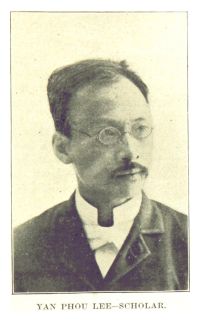
Portrait of Yan Phou Lee Yan Phou Lee When I was a boy in China

Schools of the lower grades never boast more than one teacher each. The combination system of a head-master and several assistants does not work well in China. The schoolmaster in China must be absolute. He is monarch of all he surveys; in his sphere there is none to dispute his rights. You can always point him out among a thousand by the scholar’s long gown, by his stern look, by his bent form, by his shoulders rounded by assiduous study. He is usually near-sighted, so that an immense pair of spectacles also marks him as a trainer of the mind.
Source: Gutenberg

Portrait of Yan Phou Lee Yan Phou Lee When I was a boy in China

There are the gods of war, literature, wealth, and medicine; and there are the goddesses of married women and of seamen. These are a few of the nobler specimens of the idols which are worshiped. The fertile imagination of the Chinese fills every lake and river with spirits, every street and house with ghosts, and every wood and mountain with deities. They believe the next world to be a shadow of this; that the dead have everything in the world below which they had on earth—only these premises exist as shadows instead of substance.
Buddhism entered China about the time of Christ.
Source: Gutenberg

Portrait of Yan Phou Lee Yan Phou Lee When I was a boy in China

There is no such thing as caste in China, in the sense that caste exists in India. In China, wealth, and literary and official honors ennoble a family and can lift it from a lower to a higher plane. The regulations and government of my family were as rigorous as possible. I lived the years of my childhood in a shrinking condition of mind. Like all youngsters, I wanted to shout, jump, run about, show my resentments, and my affections, give my animal spirits and affectionate impulses full play.
Source: Gutenberg

Get perspective with Kwize: daily news enlightened by great literature