“ At Stamford Hill he was met by the Lord Mayor Lee and the aldermen, all in scarlet robes, and 500 of the most eminent of the citizens, on horseback, all sumptuously apparelled in velvet, with gold [140] chains round their necks. The procession passed slowly along, pausing at intervals to look upon some ingeniously-contrived pageant, and listen to the congratulations of the characters represented, and along Aldersgate Street to the Charter House, where the king was magnificently entertained by Lord Howard four days. ”
Aldersgate Street
Definition and stakes
The theme of “Aldersgate Street” has been addressed by authors such as Thomas Peck, John Stow, Henry Mayhew, Hugh Roberts and Geraldine Edith Mitton. It is often associated with terms like London, Aldgate, Bishopsgate, house and city.
Quotes about “Aldersgate Street”
 Walter Besant,
Mediæval London, Volume 1: Historical & Social
Walter Besant,
Mediæval London, Volume 1: Historical & Social
“ The Fitz Alans, Earls of Arundel, had their town house in Botolph Lane, Billingsgate, down to the end of the sixteenth century. The street is, and always has been, narrow, and, from its proximity to the fish-market, is, and always has been,245 unsavoury. The Earls of Northumberland had town houses successively in Crutched Friars, Fenchurch Street, and Aldersgate Street. The Earls of Worcester lived in Worcester Lane, on the river-bank; the Duke of Buckingham on College Hill—observe how the nobles, like the merchants, built their houses in the most busy part of the town. ”
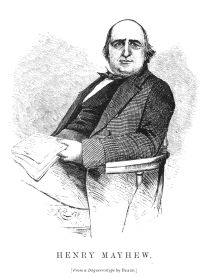 Henry Mayhew,
London Labour and the London Poor…
Henry Mayhew,
London Labour and the London Poor…
“ Some cans are carried about with yokes, like milk-cans, the mugs being kept in a basket. The best district for the night-trade is the City, and the approaches to the bridges. There are more men and women, I was told, walking along Cheapside, Aldersgate-street, Bishopsgate-street, and Fleet-street. ”
Anonymous, London and Its Environs Described…
“ He proposed that five principal cross streets should extend from Black Friars stairs into West Smithfield; from the Thames east of St. Paul’s to Aldersgate; from Queenhithe to Cripplegate; and from the Royal Exchange to Moorgate: that the street from the bridge should extend to Bishopsgate: that one from Billingsgate should extend near as far: and one from the Custom house to Aldgate. ”
“ John's, Clerkenwell, appointed to investigate the mystery of the Cock Lane Ghost.There have been several notable Nonconformist chapels in and about Aldersgate Street. Early [129] in the reign of Charles II., the Society of Friends established a meeting in Bull and Mouth Street, and George Fox frequently preached there. As was common at that time, the congregation was subjected to barbarous persecution. In 1662 a mob assembled, dragged them out into the street, beating and mauling them severely, and killing one outright. ”
John Rhode, The murders in Praed Street (1928)
“ Then he consumed a hasty lunch at a chop-house near-by, and walked down the street to Aldersgate Metropolitan station, where he took a ticket to Paddington. He emerged into Praed Street at about five minutes to two, and began to walk along that thoroughfare in the direction of Number 407.Praed Street, at this time on a fine afternoon, wore its usual air of busy activity. The exodus from central London was still at its height, the crowds still passed along in bus or taxi towards the portals of Paddington station. ”
Anonymous, London and Its Environs Described…
“ Little Gray’s Inn lane, Gray’s Inn lane, Holborn.Little Greenwich, Aldersgate street.Little Greenwich alley, Aldersgate street.Little Grosvenor street, Grosvenor square.Little Gun alley, Orchard, Wapping.*Little Hart street, near Covent Garden.Little St. Helen’s, Bishopsgate street. See St. Helen’s.Little St. Helen’s Almshouse, was erected by the Leathersellers company, pursuant to the will of John Hasilwood, of Waltham, Esq; in the year 1544, for the reception of four men and three women, who were allowed by the founder only 8d. per week each ”
Walter Besant,
Early London: Prehistoric, Roman…
“ The remains were first observed in clearing away the cellars of the houses which separated this building from Newgate Street and covered a considerable area. They were on the north side of the street, and appeared at a short distance from the surface. The City wall ran behind the houses, forming at this point an angle, whence it branched off beneath Christ’s Hospital in the direction of Aldersgate. Adjoining the wall was a long arched vault or passage, and upon the City side of this, a well, approached by a doorway leading to a flight of perhaps a dozen steps. ”
 John Gough Nichols,
Chronicle of the Grey friars of London
(1852)
John Gough Nichols,
Chronicle of the Grey friars of London
(1852)
“ To events of familiar notoriety, and the actors in them, particularly those in the earlier and more summary portions of the Chronicle, it will be easy to refer without the intervention of an Index. Albryght, William, 87 Aldersgate street, voice in the wall, 90 Allyn, doctor, 31, 33 Angus, Archibald earl of, passes through England, 31; conduct in Scotland, 46 st. Anne's Aldersgate, burnt. ”
W. R. Lethaby, London Before the Conquest
“ Wards without.—A good illustration of the [Pg 138] formation of the interior wards may be found in the growth of those without the walls. Bishopsgate Without, and Aldersgate Without, were evidently formed by clusters of dwellings springing up on either side of the roads outside the gates. Cottages outside Bishopsgate and at Holborn are mentioned even in Domesday, and Fleet Street appears to have been populous even earlier. The external wards extend to the boundary of the city liberties, or common land, and the roads passing through them had specific street-names as far as the several “Bars.” ”
Walter Thornbury, Old and New London, Volume I
“ The line of the Roman walls ran from the Tower straight to Aldgate; there making an angle, it continued to Bishopsgate. From there it turned eastward to St. Giles's Churchyard, where it veered south to Falcon Square. At this point it continued west to Aldersgate, running under Christ's Hospital, and onward to Giltspur Street. There forming an angle, it proceeded directly to Ludgate towards the Thames, passing to the south of St. Andrew's Church. The wall then crossed Addle Street, and took a course along Upper and Lower Thames Street towards the Tower. ”
Unknown, London in Modern Times
“ The boundaries of the conflagration were Temple-bar, Holborn-bridge, Pye-corner, Smithfield, Aldersgate, Cripplegate, near the end of Coleman-street, at the end of Basinghall-street, by the postern at the upper end of Bishopsgate-street, in Leadenhall-street, by the Standard in Cornhill, at the church in Fenchurch-street, by the Clothworkers' Hall, at the middle of Mark-lane, and at the Tower-dock. ”
John Rhode, The murders in Praed Street (1928)
“ Briggs had been made from a call-box at Aldersgate station, apparently at the very time when Mr. Martin was known to have been there. Lastly, the automatic was identified as the property of Mr. Martin, and a fingermark on the counter corresponded to an imprint taken from the dead man’s hand.The significance of the curious butt found by the electrician in the lamp-holder was not so clear. It seemed reasonable to assume that nobody but the dead man had entered the premises after they had been locked by the foreman on Saturday morning. ”
Osbert John Radcliffe Howarth, Thomas Allan Ingram, and Henry Benjamin Wheatley, 1911 Encyclopædia Britannica, Volume 16… (1911)
“ Moorgate is said to have fetched £166, Aldersgate £91, Aldgate £177, Cripplegate £90, and Ludgate £148. The statue of Queen Elizabeth which stood on the west side of Ludgate was purchased by Alderman Gosling and set up against the east end of St Dunstan’s church in Fleet Street, where it still remains. 8. Nineteenth Century.—In 1806 London saw the public funerals of three of England’s greatest men. On the 8th February the body of Nelson was borne with great pomp from the Admiralty to St Paul’s Cathedral, where it was interred in the presence of the prince of Wales and the royal dukes. ”
Cecil Headlam, Oxford and Its Story
“ The houses of the population which would spring up in connection with it were probably grouped on the slope by the northern enclosure wall of the nunnery, and were themselves bounded on the north by the road which afterwards became the High Street, and on the west by that which was afterwards named Southgate Street, then Fish Street, and is now known as S. Aldate’s. This road, giving access from Wessex to Mercia, was probably one of the direct lines from the north-west to London in the tenth century. ”
Anonymous, London and Its Environs Described…
“ The remains of the walls are at present much more extensive than is generally imagined. They still subsist in part between the houses on the east side of Poor Jewry lane, and the Minories, almost all the way along the back of Houndsditch, from Aldgate to Bishopsgate. The ruins of the wall are from thence visible to every passenger in the street, from where Little Moorgate lately stood to the end of Aldermanbury, and from thence extending behind the houses, it reaches to Cripplegate ”
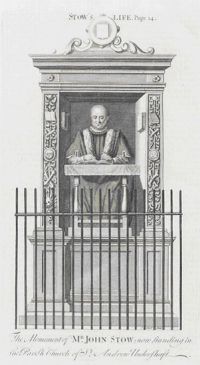 John Stow,
The Survey of London
John Stow,
The Survey of London
“ Now for Tower hill; the plain there is likewise greatly diminished by merchants [277] for building of small tenements; from thence towards Aldgate was the Minories, whereof I have spoken.From Aldgate east again lieth a large street, replenished with buildings; to wit, on the north side the parish church of St. Botolph, and so other buildings, to Hog lane, and to the bars on both sides. ”
Anonymous, London and Its Environs Described…
“ In the management of these affairs, every Alderman has his deputy, chosen out of the common council, and in some of the wards, that are very large, the Alderman has two deputies.Aldersgate, which is situated 1265 feet south west of Cripplegate, is, in Stow’s opinion, one of the original gates of the city; but this is disputed by Maitland, who observes, that the epithet of Alder does not necessarily imply its antiquity, as some derive the name of the gate from Aldrich, a Saxon; others from the seniors or old men by whom it was built ”
 Thomas Hughes,
The Stranger's Handbook to Chester and Its Environs
Thomas Hughes,
The Stranger's Handbook to Chester and Its Environs
“ There is a tide in the affairs of streets, Which taken at the flood, leads on to fortune;but the tide for Watergate Street has ebbed away, and now flows in other and more favoured channels. Still, as we shall presently see, this Street is not behind any of its neighbours in absorbing interest. You will perceive that, like Eastgate Street, it has the Cestrian characteristic on either side,—its high-level Row. The one upon the right hand, adjoining St. Peter’s Church, is, perhaps, as good a specimen as we have now left to us of the “Rows” of the last century. ”
 George W. M. Reynolds,
The Mysteries of London, v. 2/4
George W. M. Reynolds,
The Mysteries of London, v. 2/4
“ As for the Mansion House, it is the finest building in the world; and Lombard Street is the very focus of attraction. With Aldgate I am well acquainted; and a pleasant spot it is, too. The butchers' shops in the neighbourhood must be quite healthy for consumptive people. ”
Emily Constance Baird Cook, Highways and Byways in London
“ Thames Street, like its adjoining Billingsgate, is, I may remark, nearly always muddy, whatever the time of year. On rainy days, it is like a Slough of Despond. If by chance you wish to land at All Hallows or London Bridge Piers, you must first climb endless wooden and slippery steps, then wend your way carefully, past threatening cranes, and along narrow alleys between high houses, alleys blocked by heavy waggons, from which tremendous packages ascend, by rope, to top stories; alleys where there is barely room for a solitary pedestrian to wedge himself past the obstruction. ”
Emily Constance Baird Cook, Highways and Byways in London
“ The tower of All Hallows, a stranded fragment of antiquity, forms the centre piece of the garden court, where its effect is most curious and striking.The narrow old streets that lead north out of Cheapside, the "Chepe" of the middle ages, with their quaint old names, afford many pleasant rambles. In Wood Street, the old plane-tree, still standing, recalls Wordsworth's poem. Milk Street leads by the old church of St. Mary Aldermanbury, with the statue of Shakespeare in its little churchyard, to the still visible bastions of London Wall, and along the street of that name, to Cripplegate. ”
 Walter Lionel George,
A London Mosaic
Walter Lionel George,
A London Mosaic
“ Middlesex Street holds nothing picturesque or national; even its open-air market on Sunday morning can be paralleled by any Saturday afternoon scene in the little streets of Edgware Road, or in Walker’s Court, Soho. It is a street mainly of warehouses; Widegate Street and Sandys Row exhibit the oddity of narrow crookedness and no more. Petticoat Lane, where the shops are paltry, and the folk divide into too fat and too lean, is not even a mean street. ”
Robert Allbut, Rambles in Dickens' Land
“ But, in these degenerate times, the black, dilapidated streets and tumbling tenements have given place to wholesome dwellings, and the neighbourhood is associated with the name of a great American philanthropist.Returning to the south side of the Strand, we next come to Buckingham Street (turning on right, by No. 37) , at the end house of which, on the right, facing the river, was the top set of chambers in the Adelphi, consisting of“A little half-blind entry, where you could hardly see anything, a little stone-blind pantry, where you could see nothing at all, a sitting-room and a bedroom.” ”
W. R. Lethaby, London Before the Conquest
“ The plan which accompanies these views is equally visionary; a large quarter of the city east of St. Paul’s is lettered “The Cheap”; there is no Aldgate Street (now Leadenhall Street) , the Langbourne appears as a stream, and there is a curious selection of churches, amongst which is St. Denis, for which we are referred to a note in Thorpe’s Ancient Laws, regarding a gift of London property to the monastery of St. Denis in Francia. Mr. Loftie holds that Aldgate was first opened in the time of Henry I., and that no mediæval gate exactly occupied a Roman site ”
Lady Anne Hamilton, Secret History of the Court of England…
“ The ill-natured world will talk; and some people went so far as to accuse the disinterested and patriotic alderman with sinister motives in these recommendations, and that he had actually "a feeling in every thing that came into her majesty's house!" Whether or not this was the case, the alderman most assuredly spoke to the queen, very animatedly, to purchase Cambridge House, opposite to his own, in South Audley-street, though her majesty said she would never sleep in it, nor did she. The enormous sum which Mr. Wood persuaded the queen to give for this house was sixteen thousand pounds! ”
Walter Besant,
The History of London
“ There is a single street of houses with large gardens outside Aldgate, which is now Whitechapel. The north side of Houndsditch is already built. A street of houses runs north of Bishopsgate. No houses stand between this street and two or three streets outside Cripplegate. Moorfields are really fields. There are windmills, gardens with summer-houses, pasture-fields with cows, a large 'dogge house,' and fields where women appear to be laying out clothes to dry. ”
S. A. Reilly, Our Legal Heritage, King AEthelbert… (2012)
“ London streets were paved with cobbles and sand. Each citizen was to keep the street in front of his tenement in good repair. Later, each alderman appointed four reputable men to repair and clean the streets for wages. The repair of Bishopsgate was the responsibility of the Bishop because he received one stick from every cart of firewood passing through it. Rules as to tiled roofs were enforced. A 1297 ordinance required all taverns to close at curfew, an hour that fluctuated. Prostitutes were expelled from the city because the street with their bawdy houses had become very noisy. ”
Charles Fish Howell, Around the clock in Europe (1912)
“ One may, however, if he is interested in slums, pause a moment to look down through the railings of the South Bridge on the screaming peddlers and flaunting shame of bedraggled Cowgate, and behold a district which stands to Edinburgh in the relative position of Rivington Street to New York, or Petticoat Lane to London, or Montmartre to Paris.The end of the Canongate, a few steps farther on, debouches unexpectedly, and with a sudden unpreparedness for the stranger, on the great open square before Holyrood. There it stands, black and dismal; more like a prison than a palace! ”
N. D'Anvers, The Skirts of the Great City
“ Highgate no doubt owed its early prosperity and rapid growth during the last hundred and fifty years to its situation at the junction of the two main roads {31} from London that meet in the High Street, not far from the old village green, in the midst of which there used to be a pond, now filled in and planted with trees, round about which the village lads and lasses were wont to dance, and the elder residents to gather to gossip of a summer evening. ”