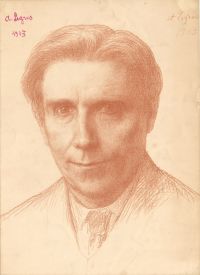
Dagobert

Definition and stakes

Portrait of Eugène Sue Eugène Sue,  The Wandering Jew — Volume 01

“ Dagobert shrugged his shoulders, made a bundle of his linen in his handkerchief, dried his soap, and put it carefully into a little oil-silk bag—then, whistling his favorite air of Tirlemont, moved to depart.
The Prophet frowned; he began to fear that his challenge would not be accepted. He advanced a step or so to encounter Dagobert, placed himself before him, as if to intercept his passage, and, folding his arms, and scanning him from head to foot with bitter insolence, said to him: "So! an old soldier of that arch-robber, Napoleon, is only fit for a washerwoman, and refuses to fight!"
”
Source: Gutenberg

Portrait of Eugène Sue Eugène Sue,  The Wandering Jew — Volume 01

“ In resigning himself thus to play the part of a courtier, Dagobert softened as much as possible his gruff voice, and strove to give to his austere countenance a smiling, agreeable, and flattering expression. "A man like you," he added, with redoubled suavity of manner, "a respectable judge like you, never shuts his ears to one side or the other."
"Ears are not in question, but eyes; and, though mine smart as if I had rubbed them with nettles, I have seen the hand of the brute-tamer, with a frightful wound on it."
”
Source: Gutenberg

Portrait of Eugène Sue Eugène Sue,  The Wandering Jew — Volume 01

“ Never, perhaps, had the soldier given to his orphan charge such a proof of tenderness and devotion. For a man of his character to let himself be insulted with impunity, and refuse to fight—the sacrifice was immense.
"So you are a coward—you are afraid of me—and you confess it?"
At these words Dagobert made, as it were, a pull upon himself—as if a sudden thought had restrained him the moment he was about to rush on the Prophet. Indeed, he had remembered the two maidens, and the fatal hindrance which a duel, whatever might be the result, would occasion to their journey.
”
Source: Gutenberg

Get perspective with Kwize: daily news enlightened by great literature