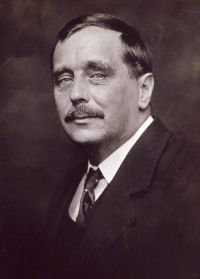
Sinclair Lewis, Babbitt (1922)
“ Never was a Family more insistent on learning one another's movements than were the Bunch. All of them volubly knew, or indignantly desired to know, where all the others had been every minute of the week. ”
The concept of a "bunch" denotes a collective or group, often implying a loose assembly of individuals linked by shared purpose, proximity, or circumstance. Authors have long explored this theme through varied perspectives: Sinclair Lewis portrays a family’s obsessive need for mutual responsibility, while B. M. Bower evokes the fellowship of a cowboy group amid the prairie’s calm.
Thomas Bridges compares human groups to toppled nine-pins, highlighting their fragility, and D. H. Lawrence distinguishes between a temporary gathering and a mob, underscoring the range of collective behavior. These viewpoints collectively reveal "bunch" as a multifaceted phenomenon, oscillating between unity and division, order and disorder.
Sinclair Lewis, Babbitt (1922)
“ Never was a Family more insistent on learning one another's movements than were the Bunch. All of them volubly knew, or indignantly desired to know, where all the others had been every minute of the week. ”
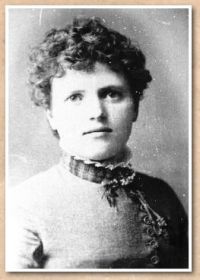 B. M. Bower,
The Lure of the Dim Trails
B. M. Bower,
The Lure of the Dim Trails
“ For the first few days of the trip Thurston was in that frame of mind which makes a man want to ride by himself, with shoulders hunched moodily and eyes staring straight before the nose of his horse. But the sky was soft and seemed to smile down at him, and the clouds loitered in the blue of it and drifted aimlessly with no thought of reaching harbor on the sky-line. From under his horse's feet the prairie sod sent up sweet, earthy odors into his nostrils and the tinkle of the bells in the saddle-bunch behind him made music in his ears—the sort of music a true cowboy loves. ”
active 1759-1775 Thomas Bridges, A Burlesque Translation of Homer
“ You know the gang of nine-pins, soon As the bowl hits, come tumbling down; Then are set up, when that throw's o'er, To tumble as they did before. Just so a race that's always grumbling, The race of mortal rogues, keeps tumbling. ”
“ Every disputable point is settled by a division, a bell rings, there is shouting and running, the members come blundering into the chamber and sort themselves with much loutish shuffling and shoving into the division lobbies. They are counted, as illiterate farmers count sheep ”
Joseph Grego, Rowlandson the Caricaturist; a Selection from His Works…
“ A convivial company is assembled; the effort of every individual's ambition is apparently the downfall of his neighbour by successive toasts; bowl succeeds bowl, and half the assembly are hors de combat. ”
John Trusler, The Works of William Hogarth: In a Series of Engravings
“ Only, here we have an opportunity of remarking, that a group is disgusting when the extremities of it are heavy. A group in some respects should resemble a tree. The heavier part of the foliage (the cup, as the landscape-painter calls it) is always near the middle; the outside branches, which are relieved by the sky, are light and airy. An inattention to this rule has given a heaviness to the group before us. ”
 Georg Ebers,
Joshua — Volume 5
Georg Ebers,
Joshua — Volume 5
“ The multitude became a mighty mob that filled the valley. At last men and women, with joyous faces, appeared bearing full jars and pails in their hands and on their heads, beckoning gaily to their friends, shouting words of cheer, and trying to force their way through the crowd to their relatives ”
“ A collection of men—an accidental gathering—may be just a gathering, drawn by a moment’s curiosity, or it may be an audience drawn to hear something, or it may be a congregation, gathered together in some spirit of earnest desire: or it may be just a crowd, inspired by no one motive. The mass-spirit is complex. At its lowest it is a mob. ”
Charles Neville Buck, The Tempering
“ In that brief pause and scrutiny he recognized the purport of a division, for as each newcomer stepped to the left or the right of the centre aisle he thereby proclaimed himself a Carr or a Gregory—taking shrewd thought of clan-mobilization. Then as a low drone of talk went up from the body of the house and a restless shuffling of feet, the speaker and his reception committee could not escape the realization of an ugly tension; of an undertow of anxiety moving deep beneath the surface affectation of calm. ”
 V. Sackville-West,
Orchard and Vineyard
V. Sackville-West,
Orchard and Vineyard
“ For other men may touch his hand, But none the soul below.SCORN THEY roll, clan by clan, kin by kin, on wide orderly roads, Burghers and citizens all, in a stately procession, Driving before them the wealth of their worldly possession, Cattle, and horses, and pack-mules with sumptuous loads. ”
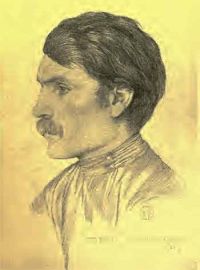 Stephen Graham,
The Way of Martha and the Way of Mary
Stephen Graham,
The Way of Martha and the Way of Mary
“ What a divine disorder! The peasants seem to have an instinctive sense for grouping. No matter how much the crowd moves or how many changes are evolved in it, it is always a beautiful whole, a fair scene, with balance of colour and form and sound. ”
Percival Leigh, Comic Arithmetic
“ Division teaches how to divide a number into two or more equal parts, as in the division of prize-money. [39] Division is of great importance, whether political, ecclesiastical, commercial, civil, or social. Nothing is more likely to destroy your opponents than a split. Divide et impera is the true Machiavelian policy of all governments.Numbers, that is the multitude, are to be divided, in a variety of ways,—by mob orators, or by mob-sneaks, or by parliamentary flounderers, or by mystifying pulpit demagogues. ”
 Richard T. Ely,
French and German Socialism in Modern Times
Richard T. Ely,
French and German Socialism in Modern Times
“ Several series having related tastes and desires unite in a group. A group undertakes some one kind of labor, as the care of fruit-trees, and a series concerns itself with one particular branch of the labor of a group, as the care of apple-trees. ”
E. W. Burgess, Introduction to the Science of Sociology
“ The internal organization of any given [Pg 162] social group will be determined by its external relation to other groups in the society of which it is a part as well as by the relations of individuals within the group to one another. A boys' gang, a girls' clique, a college class, or a neighborhood conforms to this definition quite as much as a labor union, a business enterprise, a political party, or a nation. One advantage of the term "group" lies in the fact that it may be applied to the smallest as well as to the largest forms of human association. ”
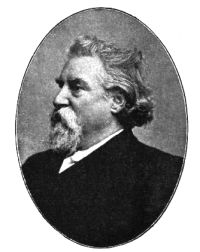 James Chalmers,
Adventures in New Guinea
James Chalmers,
Adventures in New Guinea
“ The excitement is great over the division, and the whole assembly are shouting; those from the hunt recounting the day’s proceedings, acting the shooting of the pig, to the intense delight and amazement of the others. ”
 John Kendrick Bangs,
In Camp With A Tin Soldier
John Kendrick Bangs,
In Camp With A Tin Soldier
“ I've always hated division—particularly division of apples and peaches. There is no meaner sum in any arithmetic in the world [98] than that I used to have to do every time I got an apple when I was your age.""What was the sum?" asked Jimmieboy. ”
Alice Eleanor Jones, The Happy Clown
“ They joined so passionately in the group play, clutching each other with their hot moist hands, panting and grinning into each others' faces. They were always clutching and panting and grinning, in large noisy groups, with large community smiles. ”
A. H. Keane, Man, Past and Present
“ I have myself collected nearly a thousand such names of clans, septs, and fragmentary groups within this domain, and am well aware that the list neither is, nor ever can be, complete, the groups themselves often being unstable quantities in a constant state of fluctuation. ”
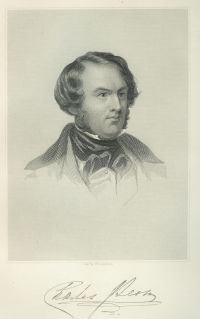 Charles James Lever,
Davenport Dunn, a Man of Our Day…
Charles James Lever,
Davenport Dunn, a Man of Our Day…
“ The corps is a family gathered together like what jockeys call 'a scratch team,'—a wheeler here, and a leader there, with just smartness enough to soar above the level of a dull audience, crammed with the light jest of low comedy, and steered by no higher ambition than a crowded benefit, or a junketing at Greenwich. ”
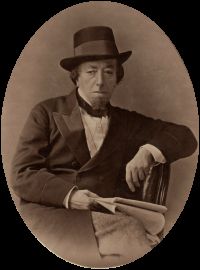 Benjamin Disraeli,
Tancred — Chapter I. A Matter of Importance
(1847)
Benjamin Disraeli,
Tancred — Chapter I. A Matter of Importance
(1847)
“ The manners of the population follow those of their masters. They keep late hours. The banquet and the ball dismiss them to their homes at a time when the trades of ordinary regions move in their last sleep, and dream of opening shutters and decking the windows of their shops. ”
 William McDougall,
The Group Mind: A Sketch of the Principles of Collective Psychology
William McDougall,
The Group Mind: A Sketch of the Principles of Collective Psychology
“ How many of the spectators, who, as members of a crowd, hugely enjoy looking on at a prize-fight or a bull-fight, would shrink from witnessing it as isolated individuals! How many boys will join with a crowd of others in cruelly teasing another boy, an animal, an old woman, or a drunken man, who individually are incapable of such ‘thoughtless’ conduct! ”
 James Champlin Fernald,
English Synonyms and Antonyms
James Champlin Fernald,
English Synonyms and Antonyms
“ Collection, crowd, gathering, group, and multitude have the unorganized and promiscuous character of the assemblage; the other terms come under the general idea of assembly. Congregation is now almost exclusively religious; meeting is often so used, but is less restricted, as we may speak of a meeting of armed men. Gathering refers to a coming together, commonly of numbers, from far and near; as, the gathering of the Scottish clans.Antonyms: COMPEL. Synonyms: To compel one to an act is to secure its performance by the use of irresistible physical or moral force. ”
Thomas Campbell Foster, Popular Science Monthly (1884)
“ The social body, whether we consider the family, or the gathering of families into communities, or the collection of communities into nations, or the multitude of nations which form the population of the earth, may be regarded as an aggregate which should be pervaded by such ideas as are found essential for the comfort and happiness of gatherings casually brought together. ”
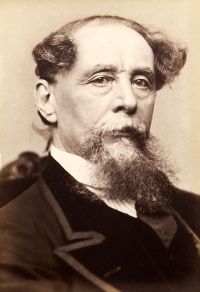 Charles Dickens,
The Uncommercial Traveller
Charles Dickens,
The Uncommercial Traveller
“ Here is the partition at my ear down in the deep on the lee side. Are we ever coming up again together? I think not; the partition and I are so long about it that I really do believe we have overdone it this time. Heavens, what a scoop! What a deep scoop, what a hollow scoop, what a long scoop! Will it ever end, and can we bear the heavy mass of water we have taken on board, and which has let loose all the table furniture in the officers’ mess, and has beaten open the door of the little passage between the purser and me, and is swashing about, even there and even here? ”
F. Marion Crawford, Khaled, A Tale of Arabia
“ Of adventure of the most stirring kind there is, as we have said, abundance. But there is more than this. The characters are drawn with great skill. Every one of the gang of bushrangers is strongly individualised. ”
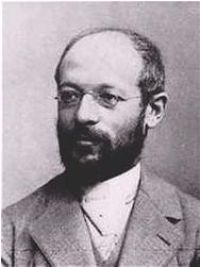 Georg Simmel,
The Persistence of Social Groups
Georg Simmel,
The Persistence of Social Groups
“ A group of smaller number has merely for that reason, and without qualitative superiority, the advantage of easier mobility, of greater rapidity of assemblage, and of more precise determination, as compared with a multitude. ”
“ The bearers of the barrow stumble, utter loud exclamations, step back, go forward again, and, as if they were driven back by an invisible force, seem to succumb under the burden. Meanwhile, the rest of the party laugh heartily and urge on and soothe the human team. ”
 Herbert Spencer,
Popular Science Monthly
(1881)
Herbert Spencer,
Popular Science Monthly
(1881)
“ And there is the chosen head, commonly the man of greatest mark to be obtained, who exercises a recognized power over speakers and audience—the temporary king. Even an informally summoned assemblage soon resolves itself into these divisions more or less distinctly; and when the assemblage becomes a permanent body, as of the men composing a commercial company, or a philanthropic society, or a club, definiteness is quickly given to the three divisions—president or chairman, board or committee, proprietors or members. ”
Charles James Lever,
The O'Donoghue: Tale of Ireland Fifty Years Ago
“ At first a dark moving mass, that seemed to fill the narrow road, was all he could discern, but as this came closer, he could perceive that they marched in companies of divisions, each headed by his leader, who, from time to time, stepped from his place, and observed their order and precision. ”
Henry K. Rowe, Society: Its Origin and Development
“ The Popular Crowd vs. the Organized Group.—In the routine life of a disciplined society there is always to be found at least one of these types. Even the abnormal [23] type of the passionate crowd is not unusual in its milder form. Any unusual event like a fire or a circus will draw scores and hundreds together, and the crowd is always liable to fall into disorder unless officers of the law are in attendance. ”
 William Graham Sumner,
Folkways
William Graham Sumner,
Folkways
“ The size of the groups is determined by the conditions of the struggle for existence. The internal organization of each group corresponds to its size. A group of groups may have some relation to each other (kin, neighborhood, alliance, connubium and commercium) which draws them together and differentiates them from others. Thus a differentiation arises between ourselves, the we-group, or in-group, and everybody else, or the others-groups, out-groups. The insiders in a we-group are in a relation of peace, order, law, government, and industry, to each other. ”
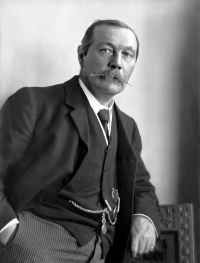 Arthur Conan Doyle,
The Poison Belt
Arthur Conan Doyle,
The Poison Belt
“ Individuals merged into groups, groups into crowds, crowds into a universal phenomenon which one soon accepted as the inevitable detail of every scene. Only here and there, where some particularly brutal or grotesque incident caught the attention, did the mind come back with a sudden shock to the personal and human meaning of it all. ”
Herbert Spencer,
Popular Science Monthly
(1881)
“ To which add that, though at first, like the meeting of the primitive horde or the modern public meeting, one of these permanent associations, voluntarily formed, exhibits a distribution of powers such that the select few and their head are subordinate to the mass ”
Henry Watson Wilbur, The Life and Labors of Elias Hicks
“ Although it was in the midst of harvest, such was the excitement produced amongst the people by the opposition made by those of our members who had gone off from us, and set up separate meetings, that the people at large of other societies flocked to those meetings in such numbers, that our meeting-houses were seldom large enough to contain the assembled multitude ”
 Marah Ellis Ryan,
That Girl Montana
Marah Ellis Ryan,
That Girl Montana
“ A certain gang of partners, who have a certain man to make their clothes and boots and hats, and stamp his name on the inside of them, so that other folks can see, when you take off your coat, or your hat, or your gloves, that they were made at just the right place. ”
William McDougall,
The Group Mind: A Sketch of the Principles of Collective Psychology
“ The peculiarities of simple crowds tend to appear in all group life; but they are modified in proportion as the group is removed in character from a simple crowd, a fortuitous congregation of men of more or less similar tendencies and sentiments. Many crowds are not fortuitous gatherings, but are brought together by the common interest of their members in some object or topic. ”
Wilson's Tales of the Borders and of Scotland…
“ With what despatch are cluster after cluster accumulated into handfuls, and then again into pocketfuls, and then, at last, into cap, hat, or bonnetfuls, till you become a kind of shellicoat, a walking nuttery, a thing of husks and kernels! The voice of your companions is loud and frequent, in the language of inquiry into the state of your success ”
Thomas K. Holmes, The Heart of Canyon Pass
“ They reached the farther bank and stumbled up the sleet-covered strand, standing in a group together for a minute to get their breath and to ease the binding-rope about their bodies. “I reckon I can smell out the path, boys,” said their leader, so they started off again. ”
E. W. Burgess, Introduction to the Science of Sociology
“ Le Bon's classification of social groups into heterogeneous and homogeneous crowds, while interesting and suggestive, is clearly inadequate. Many groups familiar to all of us, as the family, the play-group, the neighborhood, the public, find no place in his system. ”
 David Christie Murray,
Recollections
David Christie Murray,
Recollections
“ It was not at all an uncommon practice for a party of eight to be brought together, lots would be drawn, and four would stand up against four, then two against two, and the survivors of the competition would fight it out between them. ”
Lewis E. Jahns, The History of the American Expedition Fighting the Bolsheviki
“ The evenings are often devoted to besedys—a kind of ladies’ guild meeting, where all assemble and engage in talking over village gossip, playing games and other innocent amusements, or spinning thread from flax. ”
 Alan Seeger,
Poems
(1916)
Alan Seeger,
Poems
(1916)
“ Into a stately banquet hall Where heroes banqueted; And it shall all depend therein Whether you come as slave or lord, If they acclaim you as their kin Or spurn you from their board. So, when the order comes: "Attack!" ”
William McDougall,
The Group Mind: A Sketch of the Principles of Collective Psychology
“ We have discussed the psychology of the simple crowd or unorganised group; and taking an army as an extreme and relatively simple type of the highly organised group, we have used it to illustrate the principal ways in which organisation of the group modifies its collective life, raising it in many respects high above that of the crowd. ”
Edward Lucas White, Andivius Hedulio: Adventures of a Roman Nobleman in the Days of the Empire
“ I knew that every man of both clans, and most of all the head of each clan, would consider nothing except that I had participated in a roadside brawl in which men of their clan had been roughly handled, some of them by me personally, and from which their men had fled in confusion, routed partly by my participation. ”
Warner A. Ross, My Colored Battalion
“ At a glance just now on the surface, in most nations, things look much as before. The same old gang is in control, but lying and allying, brow beating, scheming a little more than was necessary heretofore. ”
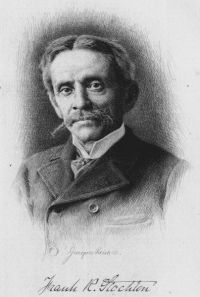 Frank R. Stockton,
Tales out of school
(1875)
Frank R. Stockton,
Tales out of school
(1875)
“ My friends, we can never conquer the giants in an open fight. One of these huge creatures could crush a dozen of us at a time with one foot, and a giant’s club would knock our whole colony higher than a kite. ”