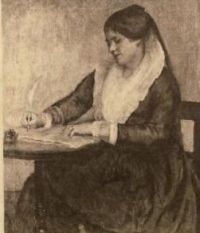
“ Dorothy Wordsworth was just such a friend and comrade to the poet as Mary was to Charles, sharing his passionate devotion to nature as Mary shared her brother's loves, whether for men or books or for the stir and throng of life in the great city. Alike were these two women in being as De Quincey said of Dorothy "the truest, most inevitable and, at the same time, the quickest and readiest in sympathy with either joy or sorrow, with laughter or with tears, with the realities of life, or the larger realities of the poets." ”
Quotes about “Dorothy Wordsworth”
Edmund Lee, Dorothy Wordsworth: The Story of a Sister's Love
“ CHILDHOOD AND EARLY LIFE. Dorothy Wordsworth was the only daughter and third child of John and Anne Wordsworth. She was born on Christmas Day, 1771, at Cockermouth, in Cumberland, being a year and nine months younger than her famous brother, the poet. John Wordsworth, the father, was an attorney-at-law, who had attained considerable success in his profession, being the solicitor of the then Earl of Lonsdale, in an old manor-house belonging to whose family he resided. ”
 Dame Millicent Garrett Fawcett,
Some Eminent Women of Our Times…
Dame Millicent Garrett Fawcett,
Some Eminent Women of Our Times…
“ Wordsworth and his wife tended her with unceasing devotion. One who knew them well wrote of Wordsworth at this time that “There is always something very touching in his way of speaking of his sister. The tones of his voice become very gentle and solemn, and he ceases to have that flow of expression which is so remarkable in him on all other subjects.” The same friend wrote, “Those who know what they (William and Dorothy Wordsworth) were to each other can well understand what it must have been to him to see that soul of life and light obscured.” ”
Edmund Lee, Some Noble Sisters
“ Admirers of Wordsworth will be exceedingly thankful to Mr. Lee for filling this vacancy in the list of notable Englishwomen. It is the story of a life rich in that blended strength and grace of character which made Dorothy Wordsworth loved by women and reverenced by men. We commend the book, to earnest and thoughtful young women especially, as a volume that is intensely interesting and full of noble impulse. WAKEFIELD FREE PRESS.—All admirers of the poet Wordsworth will be pleased to learn that an admirably-written biography of the poet's sister Dorothy, by Edmund Lee, has just been issued. ”
Edmund William Gosse, 1911 Encyclopædia Britannica (1911)
“ Meanwhile, without her brother, but in the company of Joanna Hutchinson, Dorothy Wordsworth had travelled over Scotland in 1822, and had composed a Journal of that tour. Other MSS. exist and have been examined carefully by the editors and biographers of the poets, but the records which we have mentioned and her letters form the principal literary relics of Dorothy Wordsworth. In 1829 she was attacked by very serious illness, and was never again in good health. ”
 John Morley,
Studies in Literature
John Morley,
Studies in Literature
“ The character of Dorothy Wordsworth has long taken its place in the gallery of admirable and devoted women who have inspired the work and the thoughts of great men. "She is a woman, indeed," said Coleridge, "in mind I mean, and heart; for her person is such that if you expected to see a pretty woman, you would think her rather ordinary; if you expected to see an ordinary woman, you would think her pretty." To the solidity, sense, and strong intelligence of the Wordsworth stock she added a grace, a warmth, a liveliness peculiarly her own. ”
Edmund Lee, Dorothy Wordsworth: The Story of a Sister's Love
“ We have a companion picture, but a more happy and pleasant one, in the lives of William and Dorothy Wordsworth.The culture and well-being of a nation depend largely upon the character, purity, and progress of its literature. To no class of writers has the world been more indebted than to its poets—those "rare souls, whose thoughts enrich the blood of the world." ”
Dorothy Wordsworth, Journals of Dorothy Wordsworth (1897)
“ In 1828, Dorothy Wordsworth went to the Isle of Man, accompanied by Mrs. Wordsworth's sister Joanna, to visit her brother Henry Hutchinson. This was a visit, earlier by five years than that which the poet took with his sister to the Isle of Man, before proceeding to Scotland, a tour which gave rise to so many sonnets. Of the later tour she kept no Journal, but of the earlier one some records survive, from which a few extracts have been made. ”
Edmund Lee, Some Noble Sisters
“ Every tourist halting beneath the hoary yews of Grasmere Churchyard, and honouring the graves of the Wordsworth household, should first be versed in the biography of Dorothy Wordsworth and her sweet example of sisterly love. We heartily commend the book. CONTEMPORARY REVIEW.—To Lake literature "Dorothy Wordsworth" is a pleasant addition. AMBLESIDE HERALD.—We can remember no life of the poet which so vividly brings to light the immense influence which the sister exercised over her brother. Addressing those (if any) who are still unacquainted with the life of the Rydal bard, we would say ”
 Maurice Hewlett,
In a Green Shade: A Country Commentary
Maurice Hewlett,
In a Green Shade: A Country Commentary
“ Gordon Wordsworth that what little has been omitted is unimportant. Nothing is unimportant to me, and I wish the whole had been given us; but what we have is enough whereby to trace the development of her extraordinary mind and of her power of self-expression. The latter, undoubtedly, grew out of emotion, which gradually culminated until the day of William Wordsworth's marriage. There it broke, and with it, as if by a determination of the will, there the revelation ceased. A new life began with the coming of Mary Wordsworth to Dove Cottage, a life of which Dorothy records the surface only. ”
Edmund William Gosse, 1911 Encyclopædia Britannica (1911)
“ The value of the records preserved by Dorothy Wordsworth, especially in earlier years, is hardly to be over-estimated by those who desire to form an exact impression of the revival of English poetry. When Wordsworth and Coleridge refashioned imaginative literature at the close of the 18th century, they were daily and hourly accompanied by a feminine presence exquisitely attuned to sympathize with their efforts, and by an intelligence which was able and anxious to move in step with theirs. ”
Edmund Lee, Dorothy Wordsworth: The Story of a Sister's Love
“ During her latest years Miss Wordsworth was unable to read much, but would frequently amuse herself by reciting poetry and other scraps, which, learnt in previous years, she remembered wonderfully well. A casual observer, who might see the placid old lady, of fourscore years, wheeled on the terrace at Rydal Mount, her unwrinkled though somewhat pensive face framed by a full-bordered cap, would have no suggestion of the often vacant mind. ”
Dorothy Wordsworth, Journals of Dorothy Wordsworth…
“ When we had gone a little way we saw before us a young man with a bundle over his shoulder, hung on a stick, bearing a great boy on his back: seeing that they were travellers, we offered to take the boy on the car, to which the man replied that he should be more than thankful, and set him up beside me. They had walked from Glasgow, and that morning from Inverary; the [Pg 33] boy was only six years old, "But," said his father, "he is a stout walker," and a fine fellow he was, smartly dressed in tight clean clothes and a nice round hat: he was going to stay with his grandmother at Dalmally. ”
Dorothy Wordsworth, Recollections of a Tour Made in Scotland A.D. 1803
“ Wordsworth brought no change to Dorothy. She still continued to fill to her brother and his wife the same place which she had filled when her brother was alone, sharing in all the household duties and family interests, and still accompanying him in his rambles when Mrs. Wordsworth was detained at home. The year after the marriage, that is, in the fourth year of the Grasmere residence, after the first son was born, the brother and sister, accompanied by Coleridge, set out on that tour the Journal of which is here published. ”
 Thomas De Quincey,
The Collected Writing of Thomas De Quincey…
Thomas De Quincey,
The Collected Writing of Thomas De Quincey…
“ In short, beyond any person I have known in this world, Miss Wordsworth was the creature of impulse; but, as a woman most thoroughly virtuous and well-principled, as one who could not fail to be kept right by her own excellent heart, and as an intellectual creature from her cradle, with much of her illustrious brother's peculiarity of mind—finally, as one who had been, in effect, educated and trained by that very brother—she won the sympathy and the respectful regard of every man worthy to approach her. Properly, and in a spirit of prophecy, was she named Dorothy ”
Dorothy Wordsworth, Journals of Dorothy Wordsworth (1897)
“ But when we were at the top of the Raise we saw the mountains before us. The sun shone upon them, here and there; and Wytheburn vale, though wild, looked soft. The day went on cheerfully and pleasantly. Now and then a hail shower attacked us; but we kept up a good heart, for Mary is a famous jockey. . . . We reached Greta Hall at about one o'clock. Met Mrs. C. in the field. Derwent in the cradle asleep. Hartley at his dinner. Derwent the image of his father. Hartley well. We wrote to C. Mrs. C. left us at 1/2 past 2. We drank tea by ourselves, the children playing about us. ”
Edmund Lee, Some Noble Sisters
“ The young woman stimulates the youthful poet, and calls back faith to the soul and hope to the despairing life, praises where others blame, with the prophetic eye of love divines the dormant power, and foresees the honoured future. Then follows the life-long companionship, involving for many years devoted service, both intellectual and household. For Dorothy Wordsworth was often the provider of subjects for her brother's poems, with diligent labour copied those poems, at the same time, by her reading and study, making herself his intellectual companion, and presiding over the household. ”
Edmund Lee, Some Noble Sisters
“ Of more refined humanity, thy breath,Dear sister, was a kind of gentler springThat went before my steps. The marriage of Wordsworth, in 1802, did not occasion any waning of sympathy or cessation of intercourse between him and his sister. The circle was then only widened, not broken. Dorothy continued to be an honoured inmate of her brother's home, the sharer of his labours, and companion of his walks and excursions; in speech as well as in silence together garnering scenes of beauty and flowers of thought both for their own future lives and the world's weal. ”
Edmund Lee, Some Noble Sisters
“ The legacy of £900 bequeathed to Wordsworth by a friend whom he had nursed, and who recognised his genius, at length removed the cause which had kept the brother and sister apart. With scanty means, but overflowing love, they faced the world and conquered fate. The late Bishop of Lincoln, alluding to this period, says of Dorothy: "She was endowed with tender sensibility, with an exquisite perception of beauty, with a retentive recollection of what she saw, with a felicitous tact in discerning, and admirable skill in delineating natural objects with graphic accuracy and vivid gracefulness. ”
Dorothy Wordsworth, Journals of Dorothy Wordsworth…
“ Many a fair face may gang before her." We sate by the fire without work for some time, then Mary read a poem of Daniel.... Wm. read Spenser, now and then, a little aloud to us. We were making his waistcoat. We had a note from Mrs. C., with bad news from poor C.—very ill. William went to John's Grove. I went to find him. Moonlight, but it rained.... He had been surprised, and terrified, by a sudden rushing of winds, which seemed to bring earth, sky, and lake together, as if the whole were going to enclose him in. He was glad he was in a high road. ”
 William Wordsworth,
The Poetical Works of William Wordsworth…
William Wordsworth,
The Poetical Works of William Wordsworth…
“ Dorothy Wordsworth alludes to one of these "Fairs" in her Grasmere Journal, September 2, 1800. Her brothers William and John, with Coleridge, were all at Dove Cottage at that time. "They all went to Stickle Tarn. A very fine, warm, sunny, beautiful morning. We walked to the fair. ... It was a lovely moonlight night. We talked much about our house on Helvellyn. The moonlight shone only upon the village. It did not eclipse the village lights; and the sound of dancing and merriment came along the still air. I walked with Coleridge and William up the lane and by the church...." ”
Dorothy Wordsworth, Journals of Dorothy Wordsworth…
“ While lingering by the shore we began to talk with a man who offered to row us to Inch-ta-vannach; but the sky began to darken; and the wind being high, we doubted whether we should venture, therefore made no [Pg 226] engagement; he offered to sell me some thread, pointing to his cottage, and added that many English ladies carried thread away from Luss.Presently after Coleridge joined us, and we determined to go to the island. I was sorry that the man who had been talking with us was not our boatman; William by some chance had engaged another. We had two rowers and a strong boat ”
William Wordsworth,
The Poetical Works of William Wordsworth…
“ In the Fenwick note, Wordsworth tells us that the "earlier half" was written at Stockton-on-Tees "at the close" of 1807, and "proceeded with" at Dove Cottage, after his return to Grasmere, which was in April 1808. But on the 28th February, 1810, Dorothy Wordsworth, writing from Allan Bank to Lady Beaumont, says, "Before my brother turns to any other labour, I hope he will have finished three books of The Recluse. He seldom writes less than 50 lines every day. ”
Dorothy Wordsworth, Journals of Dorothy Wordsworth… (1897)
“ Dorothy Wordsworth's Journal, written at Grasmere (14th May to 21st December 1800) 29 IV. Dorothy Wordsworth's Journal, written at Grasmere (from 10th October 1801 to 29th December 1801) 61 V. Dorothy Wordsworth's Journal, written at Grasmere (from 1st January 1802 to 8th July 1802) 77 VI. Dorothy Wordsworth's Journal, written at Grasmere (9th July 1802 to 11th January 1803) 139 VII. Recollections of a Tour made in Scotland (A.D. 1803) 159 This work was published before January 1, 1929, and is in the public domain worldwide because the author died at least 100 years ago. ”
Dorothy Wordsworth, Journals of Dorothy Wordsworth…
“ EXTRACTS FROM DOROTHY WORDSWORTH'S TOUR IN SCOTLAND, 1822Friday, 14th September 1822.—Cart at the door at nine o'clock with our pretty black-eyed boy, Leonard Backhouse, to drive the old grey horse.... Scene at Castlecary very pretty.... Nothing which we English call comfort within doors, but much better, civility and kindness. Old woman bringing home her son to die; left his wife, she will never see him again. [They seem to have gone by the Forth and Clyde Canal.] Scene at the day's end very pretty. The fiddler below,—his music much better there. A soldier at the boat's head ”
Edmund Lee, Some Noble Sisters
“ The humble cottage and "garden orchard" are not only immortalised in his verse, but were the scene of his loftiest labours. And Dorothy, meanwhile, not only inspired his ardour, fed both thought and pen, but laboured with her hands in the kitchen and at the desk. The following extract from the recently published Recluse (written at this time) not only shows Wordsworth's satisfaction with his choice of residence, but his sustained feeling of his exceeding indebtedness to his sister:— Can the choice mislead,That made the calmest, fairest spot of earth. ”
William Wordsworth,
The Poetical Works of William Wordsworth…
“ From out the pensive shadows where they lie) In the first warmth of their original sunshine, 50Loth should I be to use it: passing sweetAre the domains of tender memory! The spot described in this sequel to Lycoris is, I think, the bower in the rock on Nab Scar, alluded to in Dorothy Wordsworth's Grasmere Journal (see note to The Waterfall and the Eglantine, vol. ii. p. 172) . The description in that Journal, taken in connection with the text of this poem, warrants the suggestion that the "Friend" with whom he had "known such happy hours together" was his own sister Dorothy. ”
Dorothy Wordsworth, Journals of Dorothy Wordsworth (1897)
“ Wordsworth recorded and idealised his tour in a series of poems, named by him "Memorials of a Tour on the Continent, 1820," very few of which were written on the spot; and when, in the after-leisure of Rydal Mount, he set to work upon them, it is evident that he consulted, and made frequent use of, the two family Journals, particularly the one written by his sister. In a letter to Mrs. Clarkson from Coblentz, dated 22nd July, Dorothy said: "Journals we shall have in abundance; for all, except my brother and Mrs. Monkhouse, keep a journal. ”
