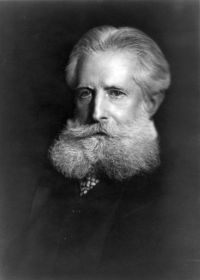
Edmund Clarence Stedman

Definition and stakes

A guide book of art, architecture…

In writing of the Delaware Valley, Edmund Clarence Stedman says: “But here there is no swooning of the languid air, and no seeming always afternoon; it is a morning land with every cliff facing the rising sun; the mist and languor are in the grain fields far below; the hills themselves are of the richest, darkest green; the skies are blue and fiery; the air crisp, oxygenated, American; it is no place for lotus eating, but for drinking water of the fountain of youth, till one feels the zest and thrill of a new life that is not unrestful, yet as far as may be from the lethargy of mere repose.”
Source: Gutenberg

The Poets' Lincoln

Edmund Clarence Stedman was born in Hartford, Connecticut, on the 8th of October, 1833. He entered Yale College at the age of sixteen and distinguished himself in Greek and English Composition. He was the editor of several papers in Connecticut and in 1856 removed to New York City—a larger field for his literary abilities. He was a contributor to Vanity Fair, Putnam's Monthly, Harper's Magazine and other periodicals.
Source: Gutenberg

Portrait of Edmund Clarence Stedman Edmund Clarence Stedman The poems of Edmund Clarence Stedman (1908)

Something, I know not what: perhaps the spirit of eager youth,
That named her a queen of queens at once, and loved her in very truth;
That threw its pearl of pearls at her feet, and offered her, in a breath,
The costliest gift a man can give from his cradle to his death.
The third time that I saw her—this woman called Estelle
She passed her milk-white arm through mine and dazzled me with her spell;
A blissful fever thrilled my veins, and there, in the moonbeams white,
I yielded my soul to the fierce control of that maddening delight!
Source: Wikisource

Get perspective with Kwize: daily news enlightened by great literature