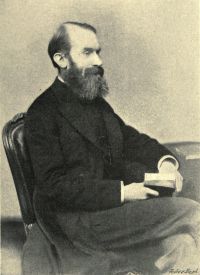
Friedrich Wilhelm von Hitzig

Definition and stakes

Portrait of Ernst Wilhelm Hengstenberg Ernst Wilhelm Hengstenberg,  Christology of the Old Testament…

“ In order to distinguish between condition and consequence,--in order to put sufferings and glorification in the proper relation, he takes his stand between the sufferings and the glorification of the Servant of God, and from that position, that appears to him as being already past which, in reality, was [Pg 328] still future. It is only an interpreter so thoroughly prosaic as Knobel who can advance the assertion: "No prophet occupies, in prophecy, another stand-point than that which in reality be occupies." In this, e.g., Hitzig does not by any means assent to him ”
Source: Gutenberg

Portrait of Franz Delitzsch Franz Delitzsch,  Biblical Commentary Old Testament… (1892)

“ To despise one's own way is equivalent to, to regard it as worth no consideration, as no question of conscience whether one should enter upon this way or that. Hitzig's reading, פּוזר, “he that scattereth his ways,” lets himself be drawn by the manifold objects of sensuality sometimes in one direction and sometimes in another, is supported by Jer 3:13, according to which it must be מפזּר ”
Source: Wikisource

Portrait of Franz Delitzsch Franz Delitzsch,  Biblical Commentary Old Testament… (1892)

“ The judgment contained in the words, “vanity and a striving after the wind,” is confirmed: “That which is crooked cannot become straight; and a deficit cannot be numerable,” i.e., cannot be taken into account (thus Theod., after the Syro-Hex.) , as if as much were present as is actually wanting; for, according to the proverb, “Where there is nothing, nothing further is to be counted.” Hitzig thinks, by that which is crooked and wanting, according to Ecc 7:13, of the divine order of the world: that which is unjust in it, man cannot alter; its wants he cannot complete. ”
Source: Wikisource

Get perspective with Kwize: daily news enlightened by great literature