“ Within the memory of comparatively young men a third of the territory of the United States beyond the Mississippi bore the name of the "Great American Desert." It was a region vast beyond accurate human conception, in extent as great as half of Europe, midribbed with the stupendous, shaggy bulk of the Rocky Mountains, from which it descended in both directions in illimitable rolling plains and rugged mesas, rising here to the height of snow-crowned mountains, and falling there to the ancient salty beds of lost seas, lower than the level of the ocean. ”
Great American Desert
Definition and stakes
Quotes about “Great American Desert”
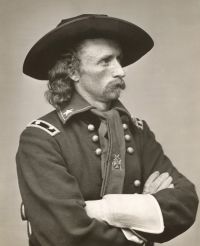
George A. Custer,
My life on the plains
(1874)
“ It was gradually discerned that the Great American Desert did not exist, that it had no abiding place, but that within its supposed limits, and instead of what had been regarded as a sterile and unfruitful tract of land, incapable of sustaining either man or beast, there existed the fairest and richest portion of the national domain, blessed with a climate pure, bracing, and healthful, while its undeveloped soil rivalled if it did not surpass the most productive portions of the Eastern, Middle, or Southern States. ”
James W. Buel, Glimpses of America
“ CASCADE BRIDGE AND SNOW-SHEDS ON THE SIERRAS. After leaving Ogden, the Southern Pacific passes in a half-circle around the northern shores of Salt Lake, and then darts into the Nevada, or Great American Desert, a vast sea of alkali rippled with dry sage-brush; a furnace in summer and a Siberian tundra in winter. Nature has denied to this wretched region any compensation of flower, stream, bird, or even curiosity. It is the very nakedness of bleak desolation, and stretches its cursed length through a distance of 600 miles. ”
Willis George Emerson,
Buell Hampton
“ The entire country became a desolate waste. For a hundred miles in every direction no living vegetation, planted by the hand of man, survived. The hopes, the labors, and the achievements of years were alike swept into the vortex of absolute ruin; and these farmers in the Southwest beheld the Great American Desert, as depicted by the earlier geographers, in all its primitive awfulness. ”
George Wharton James,
The Indians of the Painted Desert Region…
“ Is it not a land of enchantment and dreams, not a place for living men and women, Indians though they be?It is a land of enchantment, but also of stern reality, as those who have marched, unprepared, across its waterless wastes can testify. No fabled land ever surpassed it in its wondrousness, yet a railway runs directly over it, and it is not on some far-away continent, but is close at hand; a portion, indeed, of our own United States.In our schoolboy days we used to read of the Great American Desert. The march of civilization has marched that "desert" out of existence. ”
John M. Burke, "Buffalo Bill" from Prairie to Palace…
“ The vast, comparatively unknown, even called great, American Desert of twenty-five and thirty years ago was peopled only by the descendants of the sturdy pioneers of the then far West—Illinois, Missouri, Arkansas, Iowa, Minnesota, Kansas, etc.—born, raised, and used to hardships and danger; and attracted only the resolute, determined adventurers of the rest of the world, seeking an outlet for pent-up natures imbued with love of daring adventure. ”
Brigham Young,
Discourses of Brigham Young
“ His unsurpassed methods of conquering for human use the Great American Desert, have been adopted to some degree by all who, since his day, have been engaged in the reclamation and settlement of unoccupied lands, especially under a low rainfall. ”
Arthur J. Burdick, The Mystic Mid-Region: The Deserts of the Southwest
“ Strange tales come out of the desert. Every one who has ventured into its vastness, and who has lived to return, has brought reports of experiences and observations fraught with [Pg 6] the deepest interest, which tend to awaken the spirit of adventure in the listener. The most famous of the American deserts are the Great Mojave and the Colorado, the latter lying partly in the United States and partly in Mexico. As trackless as the Sahara, as hot and sandy as the Great Arabian, they contain mysteries which those deserts cannot boast. ”
Mayne Reid,
The Desert Home: The Adventures of a Lost Family in the Wilderness
“ There is another class of men who traverse the Great Desert. For many years there has been a commerce carried on between the oasis of New Mexico and the United States. This commerce employs a considerable amount of capital, and a great number of men—principally Americans. The goods transported in large wagons drawn by mules or oxen; and a train of these wagons is called a “caravan.” Other caravans—Spanish ones—cross the western wing of the Desert, from Sonora to California, and thence to New Mexico. Thus, you see, the American Desert has its caravans as well as the Saära of Africa. ”
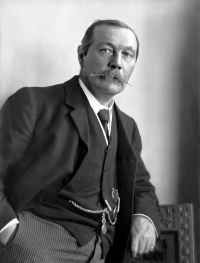
Arthur Conan Doyle,
Beeton's Christmas Annual
(1887)
“ ON THE GREAT ALKALI PLAIN. In the central portion of the great North American Continent there lies an arid and repulsive desert, which for many a long year served as a barrier against the advance of civilisation. From the Sierra Nevada to Nebraska, and from the Yellowstone River in the north to the Colorado upon the south, is a region of desolation and silence. Nor is Nature always in one mood throughout this grim district. ”
Arthur Mangin,
The Desert World
“ However rapid may be the growth of population in North America, however great the rapidity—shall we say the avidity?—of the American squatters in their conquest and appropriation of the soil, the Desert still occupies, principally in “the far West” and the North—that is to say, in the angle comprised between the line of the great lakes and the Rocky Mountains—an area almost equal to the whole of Continental Europe. ”
Zane Grey,
Wanderer of the Wasteland
“ There are also many men, an’ a few women, who just drift or wander or get lost in the desert. An’ out of all these, if they stay in the desert, but few survive. They die or they are killed. The Great American Desert is a vast place an’ it is covered by unmarked graves an’ bleached bones. ”
Angus Buchanan, Sahara (1926)
“ For all time they have stood as over-masters of the Great Desert. Proudly they overlook the far-flung wastes beneath them, where foot-hills die out among black, stony, boulder-strewn plains, and “lakes” of sand, relieved, here and there, by odd-shaped pill-box or church-like kopjes that stand as miniature guardians of the mountains behind them—beyond, right to the faint horizon, nothing but the great dead plains of the desert. ”
Edwin D. McKee,
Ancient Landscapes of the Grand Canyon Region
“ The lure of a desert with its drifting sands, its scattered oases, and its broad extent has ever been great. Today in the Southwest, cut off from the moist ocean breezes of the west by the lofty Sierra Nevadas and further isolated by the Rocky Mountains to the east, is America’s great desert region. Here the winds and the rains are constantly at work tearing down and sculpturing the great land masses, while in places the wind is piling up the sand and debris to form dunes and new lands. ”
James Richardson,
Travels in the Great Desert of Sahara…
“ Their appearance is strikingly different, being wooded and bristling on the sides, shooting up in craggy heights, hoary and white on the uppermost peaks and ridges, as if bitten by the cold and frost, and bared by the bleak winds of the sea. The Great Desert ranges, on the contrary, are naked as nakedness can be, dull, dreary, and dead, smoothed over as velvet, of black and purple hues, and look more like mountains which children might paint than the sterile realities of Old Sahara. ”
James Fowler Rusling, Across America; Or, The Great West and the Pacific Coast
“ Here we struck the southern California or great Colorado Desert, and thence on to Yuma—one hundred and fifty miles—we might as well have been adrift on the Great Sahara itself. Until we reached this point, the country consisted chiefly of arid plains, it is true; but broken, more or less, into ravines and valleys, with some semblance of life, or at least capacity for supporting life hereafter, should sufficient intelligence and labor ever drift that way. But as we approached the Desert, all this ceased, and the very genius of desolation seemed to brood over the landscape. ”
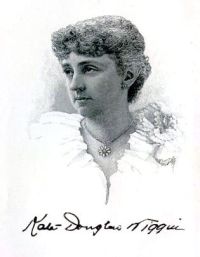
Kate Douglas Smith Wiggin,
A Summer in a Canyon: A California Story
“ Those who went by the Great Desert west of the Colorado found a stretch of burning salt plains, of shifting hills of sand, with bones of animals and men scattered along the trails; of terrible and ghastly odours rising in the hot air from the bodies of hundreds of mules, and human creatures too, that lay half-buried in the glaring white sand. ”
Charles Dudley Warner,
The Works of Charles Dudley Warner
“ Hence these deserts, that at first seem to be a disadvantage to the land, are the great conditions of its climate, and are of far more value than if they were like the prairies of Illinois. Fortunately they will remain deserts forever. Some parts will in time be reclaimed by the waters of the Colorado River, but wet spots of a few hundred thousand acres would be too trifling to affect general results, for millions of acres of burning desert would forever defy all attempts at irrigation or settlement. ”
George Frederick Augustus Ruxton,
In the Old West
“ It has been said that from the south-western extremity of the Great Salt Lake a vast desert extends for hundreds of miles, unbroken by the slightest vegetation, destitute of game and water, and presenting a cheerless expanse of sandy plain or rugged mountain, thinly covered with dwarf pine or cedar, the only evidence of vegetable life. ”
Arthur Mangin,
The Desert World
“ Prairies which, in their general aspect, resemble those of the Missouri and the Mississippi, are found to the east and west of the American Desert, in Arrisona, in Texas, in California, and various provinces of Mexico. Vegetation, however, nevertheless differs according to the conditions of each region, and the alternatives of deluging rains and extreme dryness become more and more conspicuous as we approach the Equator. ”
Mary Austin, The Land of Little Rain
“ THE LAND OF LITTLE RAIN East away from the Sierras, south from Panamint and Amargosa, east and south many an uncounted mile, is the Country of Lost Borders. Ute, Paiute, Mojave, and Shoshone inhabit its frontiers, and as far into the heart of it as a man dare go. Not the law, but the land sets the limit. Desert is the name it wears upon the maps, but the Indian's is the better word. Desert is a loose term to indicate land that supports no man; whether the land can be bitted and broken to that purpose is not proven. Void of life it never is, however dry the air and villainous the soil. ”
Harold W. Fairbanks, The Western United States: A Geographical Reader
“ The crossing of the Great Basin was dreaded by the early emigrants on their way to the Pacific coast. In many cases the locations of the few springs and water-courses were unknown, and the journey over the vast barren stretches was fraught with danger. Stand upon a mountain in the desert some clear day in summer and you will see range after range, with intervening sandy wastes, stretching away to the horizon. The air below is tremulous with heat, and every living thing that can move has sought the shade of some rock or cliff. ”
Various, The Atlantic Monthly, Volume 13…
“ From Salt Lake City to Washoe and the Sierra Nevada Mountains, the road lies through the most horrible desert conceivable by the mind of man. For the sand of the Sahara we find substituted an impalpable powder of alkali, white as the driven snow, stretching for ninety miles at a time in one uninterrupted dazzling sheet, which supports not even that last obstinate vidette of vegetation, the wild-sage brush. Its springs are far between, and, without a single exception, mere receptacles of a salt, potash, and sulphur hell-broth, which no man would drink, save in extremis. ”
Jackson Gregory,
The Desert Valley
“ Over many wide regions of the south-western desert country of Arizona and New Mexico lies an eternal spell of silence and mystery. Across the sand-ridges come many foreign things, both animate and inanimate, which are engulfed in its immensity, which frequently disappear for all time from the sight of men, blotted out like a bird which flies free from a lighted room into the outside darkness. As though in compensation for that which it has taken, the desert from time to time allows new marvels, riven from its vitals, to emerge. ”
Grant Allen,
Falling in Love; With Other Essays on More Exact Branches of Science
“ In Mexico, again, where the twin ranges draw closer together, desert conditions once more supervene. But it is in central Australia that the causes which lead to the desert state are, perhaps on the whole, best exemplified. There, ranges of high mountains extend almost all round the coasts, and so completely intercept the rainfall which ought to fertilise the great central plain that the rivers are almost all short and local, and one thirsty waste spreads for miles and miles together over the whole unexplored interior of the continent. ”
Mosaic of New Mexico's Scenery…
“ The jet traveler approaching from the west beholds the greatest, most spectacular panorama of all, the true wasteland of the desert, with vast blocks uplifted from out of earth’s crust, plateaus dissected by giant empty canyons whose walls are seared to utter nudity by ages of the most intense sunshine on our continent. Here the architecture of nature is all designed on a gigantic scale, and the climate exhibits influences of a mighty ocean, of towering mountain chains, and the range of wandering planetary winds which created the desert. ”
Willis Drummond, Report on the lands of the arid region of the United States… (1879)
“ In very low altitudes and latitudes the grasses are so scant as to be of no value; here the true deserts are found. These conditions obtain in southern California, southern Nevada, southern Arizona, and southern New Mexico, where broad reaches of land are naked of vegetation, but in ascending to the higher lands the grass steadily improves. Northward the deserts soon disappear, and the grass becomes more and more luxuriant to our northern boundary. In addition to the desert lands mentioned, other large deductions must be made from the area of the pasturage lands. ”
Ellsworth Huntington,
The Red Man's Continent: A Chronicle of Aboriginal America
(1919)
“ Next comes the cactus desert extending from Arizona far south into Mexico. One of the notable features of the desert is the extreme heat of certain portions. Close to the Nevada border in southern California, Death Valley, 250 feet below sea-level, is the hottest place in America. There alone among the American regions familiar to the writer does one have that feeling of intense, overpowering aridity which prevails so often in the deserts of Arabia and Central Asia. ”
Robert DeCourcy Ward,
Practical Exercises in Elementary Meteorology
“ Districts which have a rainfall too small for successful agriculture, but are not by any means deserts, are often excellent grazing lands, as in the case of parts of Texas, Nebraska, and Kansas in the United States, and the Argentine Republic in South America. Where there is very little rainfall deserts are found. Cities are not built in deserts, because there are no occupations to attract large numbers of men. The inhabitants of the desert are wandering tribes, which move from place to place in search of water and food for themselves and their animals. ”
“ The remains of these ancient civilizations—the pueblo-dwellers, the cliff-and cave-dwellers—are found scattered everywhere throughout Arizona and New Mexico, and in such numbers that archæologists have only begun to explore them.No part of the United States, indeed, has had a more thrilling and eventful history. While denominated a desert "not worth good blood,"—in the words of the historian,—it has been a center of contention for centuries, overwhelmed by one tide of conquest after another. ”
Robert Kerr, A General History and Collection of Voyages and Travels - Volume 18
“ As the sovereigns of the northern shores of Africa were, from various causes and circumstances, always in implacable hostility with one another, and as, besides this obstacle to advances into Africa from this side, it was well known that the Great Desert spread itself an almost impassable barrier to any very great progress by the north into the interior, it was not to be expected that any attempts to penetrate this quarter of the globe by this route would be made. ”