“ In my way, as in a glass, darkly, I do strive my best to believe, though perhaps my belief is hardly more in its way than Ernest Le Breton’s unbelieving. I do want to think that this great universe we see around us isn’t all a mistake and an abortion. I want to find a mind and an order and a purpose in it; and, perhaps because I want it, I make myself believe that I have really found it. In that hope and belief, with the ultimate object of helping on whatever is best and truest in the world, I took orders. But I feel now that it was an error for me. I’m not the right man to make a parson. ”
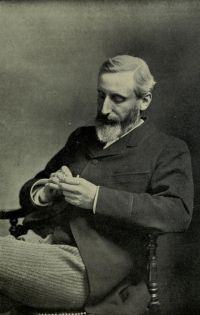
Grant Allen
Biographical details

Grant Allen (1848–1899), a Canadian-born British science writer, novelist, and atheist, was a pivotal voice in 19th-century intellectual discourse. His work connected science with literature, promoting evolutionary theory while examining social norms through novels like The Woman Who Did and The British Barbarians.
A pioneer in science fiction and feminist storytelling, Allen also wrote under female pseudonyms, challenging societal conventions. His interdisciplinary approach—covering biology, philosophy, and detective fiction—left a lasting impact, influencing figures from H.G. Wells to Arthur Conan Doyle, and establishing his position as a radical thinker of his time.
Quotes by Grant Allen
“ Then a great shout went up from all round to heaven, “He has killed him! He has killed him! We have a new-made god! Tu-Kila-Kila is dead! Long live Tu-Kila-Kila!” Felix drew back for a moment, panting and breathless, and wiped his wet brow with his sleeve, his brain all whirling. At his feet, the savage lay stretched, like a log. Felix gazed at the blood-bespattered face remorsefully. It is an awful thing, even in a just quarrel, to feel that you have really taken a human life! The responsibility is enough to appall the bravest of us. ”
 Grant Allen,
The Woman Who Did
Grant Allen,
The Woman Who Did
“ Her cheeks were glowing now with something like the shame of the woman who feels her love is lightly rejected. “Is that final?” she asked, drawing herself up as she sat, and facing him proudly. “No, no, it’s not final,” Alan answered, feeling the woman’s influence course through body and blood to his quivering fingertips. Magical touches stirred him. “How can it be final, Herminia, when you look at me like that? How can it be final, when you’re so gracious, so graceful, so beautiful? Oh, my child, I am a man; don’t play too hard on those fiercest chords in my nature.” ”
“ Trevennack was the first to speak. His voice had an earnest and solemn ring in it, like a reproving angel’s. “How can you tell what precious life may be passing below?” he said, with stern emphasis, fixing Le Neve with his reproachful eye. “The stone might fall short. It might drop out of sight. You might kill whomsoever it struck, unseen. And then”—he drank in a deep breath, gasping—“you would know you were a murderer.” Walter Tyrrel drew himself up at the words like one stung. “No, no! not a murderer!” he cried; “not quite as bad as a murderer! It wouldn’t be murder, surely. ”
Grant Allen,
Hilda Wade — Chapter VII: The Episode of the Stone That Looked About It
(1900)
“ We made our way still onward across the open plain without one word towards Salisbury. The mare was giving out. She strode with a will; but her flanks were white with froth; her breath came short; foam flew from her nostrils.As we mounted the next ridge, still distancing our pursuers, I saw suddenly, on its crest, defined against the livid red sky like a silhouette, two more mounted black men!"It's all up, Hilda!" I cried, losing heart at last. "They are on both sides of us now! The mare is spent; we are surrounded!" ”
Grant Allen,
The British Barbarians
“ O Frida, you can't imagine what things—for I know they hide them from you: cruelties of lust and neglect and shame such as you couldn't even dream of; women dying of foul disease, in want and dirt deliberately forced upon them by the will of your society; destined beforehand for death, a hateful lingering death—a death more disgusting than aught you can conceive—in order that the rest of you may be safely tabooed, each a maid intact, for the man who weds her. It's the hatefullest taboo of all the hateful taboos I've ever seen on my wanderings, the unworthiest of a pure or moral community. ”
Grant Allen,
Linnet: A Romance
“ Linnet, he knew, had grown fond of him in those few days; when he asked her once how it was she liked Franz Lindner less now than formerly, she looked up at him with an arch smile, and, after a second’s pause, made the frank avowal: “Perhaps it’s because now . . . I think Englishmen nicer.” At the moment his heart had come up in his mouth with pleasure, as will happen with all of us when a pretty woman lets us see for ourselves she really likes us. But he must go all the same: for Linnet’s sake—he must go: if illusion there were, he must at once disillusion her. ”
Grant Allen,
Hilda Wade, a Woman with Tenacity of Purpose
“ I gazed at her as she spoke, with a feeling akin to awe. “It must destroy the plot-interest of life for you, Hilda,” I cried—out there in the vast void of that wild African plateau—“to foresee so well what each person will do—how each will act under such given circumstances.” She pulled a bent of grass and plucked off its dry spikelets one by one. “Perhaps so,” she answered, after a meditative pause; “though, of course, all natures are not equally simple. Only with great souls can you be sure beforehand like that, for good or for evil. ”
Grant Allen,
The White Man's Foot
“ My broken leg thrilled through with pain. But I was safe—safe. I was standing by her side on the Floor of the Strangers. The lava sank down again with a hideous sob, as if disappointed of its living prey. I gazed around me for the priest and his acolytes. Not a sign or a mark of them anywhere was to be seen. I stood alone with Kea by the brink of the precipice. The rest had melted away to their hidden lairs as if by magic.I was rescued, indeed, but by the skin of my teeth. Such peril leaves one unmanned as one escapes it. ”
Grant Allen,
Post-Prandial Philosophy
“ Thus nurtured and trained, she will be a fit mate for a free man, a fit mother for free children, a fit citizen for a free and equal community.Her life, too, will be her own. She will know no law but her higher instincts. No man will be able to buy or to cajole her. And in order that she may possess this freedom to perfection, that she may be no husband's slave, no father's obedient and trembling daughter, I can see but one way: the whole body of men in common must support in perfect liberty the whole body of women. The collective guarantee must protect them against individual tyranny. ”
“ I don't like the men I meet in town; they all talk to us as if we were dolls or babies. I don't want to marry a man who says to himself, as Surrey says already, 'Ah, I shall look out for some rich girl or other and make her a countess, if she's a good girl, and if she suits me.' I'd rather have a man like Mr. Vardon than any of the men we ever meet in London.""But, my darling," said Lady Surrey, quite alarmed at Gladys' too serious tone, "surely there are gentlemen quite as clever and quite as intellectual as Mr. Vardon." ”
Grant Allen,
Babylon, Volume 2
“ But at Rome it was all so different. There was such a great society of artists! Every man's studio was open to his fellows; a lively running fire of candid criticism went on continually about every work completed or in progress. To live in such an atmosphere of art, to move amongst it and talk about it all day long, to feast his eyes upon the grand antiques and glorious Michael Angelos of the Vatican—all this was to Colin Churchill as near an approach to unmixed happiness as it is given to human beings to know in this nether world of very mixed experiences. If only he had had Minna with him! ”
Grant Allen,
Babylon, Volume 3
“ How small and narrow and petty we men are, after all! In my dejection at my own disappointment, I have quite overlooked poor Hiram. Love may be all that the poets say about it—I don't know, I can't say—how should I, a lonely wild man of the woods, who know not the ways of women? But one thing I do know: it's a terrible absorbing and self-centring passion. A man thinks only of him and her, and forgets all the rest of the world entirely, as though he were a solitary savage wooing in the gloom his solitary squaw. ”
Grant Allen,
Miss Cayley's Adventures — 9. The Adventure of the Magnificent Maharajah
(1899)
“ I shut my eyes. When I opened them again, I saw a swimming picture of the great sullen beast, loosing his hold on the elephant. I saw his brindled face; I saw his white tusks. But his gleaming pupils burned bright no longer. His jaw was full towards me: I had shot him between the eyes. He fell, slowly, with blood streaming from his nostrils, and his tongue lolling out. His muscles relaxed; his huge limbs grew limp. In a minute, he lay stretched at full length on the ground, with his head on one side, a grand, terrible picture.My mahout flung up his hands in wonder and amazement. ”
Grant Allen,
An African Millionaire
(1897)
“ Regard me, my dear sir, as a microbe of millionaires, a parasite upon capitalists. You know the old rhyme: Great fleas have little fleas upon their backs to bite 'em, And these again have lesser fleas, and so ad infinitum! Well, that’s just how I view myself. You are a capitalist and a millionaire. In your large way you prey upon society. You deal in Corners, Options, Concessions, Syndicates. You drain the world dry of its blood and its money. You possess, like the mosquito, a beautiful instrument of suction—Founders' Shares—with which you absorb the surplus wealth of the community. ”
Grant Allen,
Miss Cayley's Adventures
“ It was a strange and rambling old Hindoo hill-fort, high perched on a scarped crag, like Edinburgh Castle, and accessible only on one side, up a gigantic staircase, guarded on either hand by huge sculptured elephants cut in the living sandstone. Below clustered the town, an intricate mass of tangled alleys. I had never seen anything so picturesque or so dirty in my life; as for Elsie, she was divided between admiration for its beauty and terror at the big-whiskered and white-turbaned attendants.'What sort of rooms shall we have?' I whispered to our moral guarantee, Mrs. Balmossie. ”
Grant Allen,
What's Bred in the Bone
“ And if ever Cyril feels inclined to criticise what you’ve done, you can answer him back, ‘I know your heart as you know mine. In my place, I know you’d have acted as I did.’” “Cyril and I are not absolutely identical,” Guy answered slowly, his eyes still fixed on Montague Nevitt’s. “Sometimes I feel he does things I wouldn’t do.” “He has more initiative than you,” Nevitt answered, as if carelessly, though with deep design in his heart. “He acts where you debate. You’re often afraid to take a serious step. Cyril never hesitates. You draw back and falter; Cyril goes straight ahead. ”
“ Whenever I think of you, dear Father—you, who are so infinitely nobler, and better, and truer, and more really a gentleman than any other than I ever knew in my life—whenever I think of you, coming secretly up to Oxford as if you were ashamed of yourself, and visiting your own son by stealth in his rooms in college as if you were a dun coming to ask him for money, instead of the person whom he delights to honour—whenever I think of it, Father, it makes my cheeks burn with shame, and I loathe myself for ever allowing you so to bemean your own frank, true, noble nature. ”
Grant Allen,
Hilda Wade — Chapter IV: The Episode of the Man Who Would Not Commit Suicide
(1900)
“ He dashed his hand down impatiently. "I have a better way for the children. I will save them still. . . . Hubert, you are not afraid to speak to a murderer?""Dear Hugo—I know all; and to know all is to forgive all."He grasped my hand once more. "Know all!" he cried, with a despairing gesture. "Oh, no; no one knows all but myself; not even the children. But the children know much; they will forgive me. Lina knows something; she will forgive me. You know a little; you forgive me. The world can never know. It will brand my darlings as a murderer's children." ”
Grant Allen,
Hilda Wade — Chapter VI: The Episode of the Letter with the Basingstoke Postmark
(1900)
“ I folded her in my arms, there, on the rusty-red South African desert. "Then, Hilda dear," I murmured, "you will consent to marry me?"The words brought her back to herself. She unfolded my arms with slow reluctance. "No, dearest," she said, earnestly, with a face where pride fought hard against love. "That is why, above all things, I did not want you to follow me. I love you; I trust you: you love me; you trust me. But I never will marry anyone till I have succeeded in clearing my father's memory. I know he did not do it; I know Sebastian did. But that is not enough. ”
Grant Allen,
The Woman Who Did
“ But Alan Merrick, having let slip the golden moment when nature prompts every growing youth to fling himself with pure devotion at the feet of the first good angel who happens to cross his path and attract his worship, had now outlived the early flush of pure passion, and was thinking only of “comfortably settling himself.” In one word, when a man is young, he asks himself with a thrill what he can do to make happy this sweet soul he loves; when he has let that critical moment flow by him unseized, he asks only, in cold blood, what woman will most agreeably make life run smooth for him. ”
“ The white-faced Korong is a very great deity! He is indeed the true Tu-Kila-Kila. These gods have come for him. They are very mighty. Thunder and lightning and waterspouts are theirs. The waves do as they bid. The sea obeys them. They are here to take away our Tu-Kila-Kila from our midst. And what will then become of the island of Boupari? Will it not sink in the waves of the sea and disappear? Will not the sun in heaven grow dark, and the moon cease to shed its benign light on the earth, when Tu-Kila-Kila the Great returns at last to his own far country? ”
Grant Allen,
Hilda Wade — Chapter VII: The Episode of the Stone That Looked About It
(1900)
“ The Matabele are his pawns. He wanted to aim a blow at me; and this was the way he chose to aim it.""Do you think he is capable of that?" I cried. For, in spite of all, I had still a sort of lingering respect for Sebastian. "It seems so reckless—like the worst of anarchists—when he strikes at one head, to involve so many irrelevant lives in one common destruction."Hilda's face was like a drowned man's."To Sebastian," she answered, shuddering, "the End is all; the Means are unessential. Who wills the End, wills the Means; that is the sum and substance of his philosophy of life. ”
Grant Allen,
Post-Prandial Philosophy
“ Why should it be calmly taken for granted by the world that if you have some new and true thing to tell humanity (which humanity, of course, will toss back in your face with contumely and violence) you are bound to blurt it out, with childish unreserve, regardless of consequences to yourself and to those who depend upon you? Why demand of genius or exceptional ability a gratuitous sacrifice which you would deprecate as wrong and unjust to others in the ordinary citizen? For the genius, too, is a man, and has his feelings. ”
Grant Allen,
Linnet: A Romance
“ True love doesn’t ask any end beyond itself: it is amply satisfied with being loved and loving.And Will? Well, Will had a poet’s nature, and the poet lives in the passing emotion. Only a man of moods can set moods before us. Like Linnet herself, Will thought little of the future when Linnet was beside him. He meant her no harm, as he said truly to Florian; but he meant her no good either: he meant nothing at all but to walk by her side, and hold her hand in his, and feel his heart beat hard, and her finger-touch thrill through him. ”
Grant Allen,
Babylon, Volume 3
“ And Colin never even knew that the question had for one moment so much as once occurred to her. 'I may have one more kiss before you go, little woman,' Colin said to her tenderly, as she was on the point of leaving. Minna's eyes glistened brightly. 'One more kiss, you know, dear, for old times' sake, Minna.' Minna's eyes filled with tears, and she could hardly brush them away without his perceiving it. It was only for old times' sake, then, for old times' sake, not for love and the future. Oh, Colin, Colin, how bitter! how bitter! ”
Grant Allen,
Babylon, Volume 2
“ To every intelligent young American, indeed, the first glimpse of England is something more than a mere introduction to a new country; it is as though the sun had gone back upon the dial of history, and had carried one bodily from the democratic modern order of tilings into the midst of an older semifeudal and vastly more heterogeneous state of society. But to Hiram Winthrop in particular, that journey by the London and North-Western Line from Liverpool to Euston was, as it were, a new spiritual birth, a first transference into the one world for which alone he was congenitally fitted. ”
Grant Allen,
The British Barbarians
“ It almost seemed to her as if Bertram's kiss had released her by magic, at once and for ever, from the taboos of her nation. She had slipped out from home unperceived, that night, in fear and trembling, with many sinkings of heart and dire misgivings, while Robert and Phil were downstairs in the smoking-room; she had slunk round, crouching low, to Miss Blake's lodgings: and she had terrified her soul on the way with a good woman's doubts and a good woman's fears as to the wrongfulness of her attempt to say good-bye to the friend she might now no longer mix with. ”
Grant Allen,
The White Man's Foot
“ The moment of totality was rapidly approaching. Kea, warned by a word from her uncle, stood up in her bridal dress and faced the awful flood of surging lava. Kalaua, by her side, began once more to drone out in long notes his monotonous chant. He flung a handful of taro, with a solemn incantation, into the mouth of the volcano. "See, Pélé," he cried, "we bring thee thy daughter-in-law. See, Maloka, we bring thee thy chosen bride. At the stroke of midnight, at the appointed hour, thou hast put out the lamp in heaven, the moon. This is thy signal: we mortals obey it. ”
“ The dear old Progenitor can’t be with us many years longer; and when he is gone there will be nothing left me but to watch over little Miss Butterfly and her Don Quixote of a future husband. A man can’t work and slave and compose sonatas for himself alone—the idea’s disgusting, piggish, worthy only of Herbert Le Breton; I must do what I can for the little queen, and for her balloon-navigating Utopian Ernest. Thank heaven, no law prevents you from loving in your own heart the one woman whom you have once loved, no matter who may chance to marry her. ”
Grant Allen,
Hilda Wade, a Woman with Tenacity of Purpose
“ Hilda's voice was tenderer and softer than usual as she answered: “No, not for my own ends alone, and not for your undoing, but to give you one last chance of unburdening your conscience. Some men are too small to be capable of remorse; their little souls have no room for such a feeling. You are great enough to feel it and to try to crush it down. But you CANNOT crush it down; it crops up in spite of you. You have tried to bury it in your soul, and you have failed. It is your remorse that has driven you to make so many attempts against the only living souls who knew and understood. ”
Grant Allen,
The Woman Who Did
“ Herminia replied, in a very earnest mood. “I have wrought it all out in my mind beforehand—covenanted with my soul that for women’s sake I would be a free woman. Alan, whoever would be free must himself strike the blow. I know what you will say—what every man would say to the woman he loved under similar circumstances—‘Why should you be the victim? Why should you be the martyr? Bask in the sun yourself; leave this doom to some other.’ But, Alan, I can’t. I feel I must face it. Unless one woman begins, there will be no beginning.” ”
Grant Allen,
Linnet: A Romance
“ There are many who can see no more in Milan than this: they know it only as the most go-ahead and modernised of Italian cities. Linnet knew better. To her it was the town of Leonardo and his disciples, of the great marble pile whose infinite detail escapes and eludes the most observant eye, of the vast and stately opera house where Otello and Carmen first unfolded their wonders of sight and sound to her ecstatic senses. Wiser in her generation, she accepted it aright as the vestibule and ante-chamber of artistic Italy. ”
Grant Allen,
The British Barbarians
“ Frida allowed the caress passively. There was a robust frankness about his love-making that seemed to rob it of all taint or tinge of evil. Then he caught her bodily in his arms like a man who has never associated the purest and noblest of human passions with any lower thought, any baser personality. He had not taken his first lessons in the art of love from the wearied lips of joyless courtesans whom his own kind had debased and unsexed and degraded out of all semblance of womanhood. He bent over the woman of his choice and kissed her with chaste warmth. ”
Grant Allen,
The White Man's Foot
“ When once one has made up one's mind to face death, in whatever form, the sooner one can get the wrench over the better. To be roasted alive is bad enough in all conscience; but to be roasted alive by intermittent stages is a thing to make even a soldier or a man of science shrink back appalled from the ghastly prospect.In my agony, I looked up once more at the sheer precipice. As I looked, I saw yet another person had come down to join the group by the edge. My heart bounded with a faint throb of hope. It was Kea, Kea, pretty, gentle Kea. ”
“ The King of Water bent his head a second time. “I am a great god,” he answered, “before all others save you: but for you, Tu-Kila-Kila, I haste to do your bidding. If any man disobey you, my billows shall rise and overwhelm him in the sea. I am a great god. I claim each year many drowned victims.” “But not so many as me,” Tu-Kila-Kila interposed, his hand playing on his knife with a faint air of impatience. “But not so many as you,” the minor god added, in haste, as if to appease his rising anger. “Fire and Water ever speed to do your bidding.” ”
Grant Allen,
Babylon, Volume 3
“ And indeed, in that one moment, the whole truth about Minna and Colin, never before even suspected by her, had flashed suddenly across Gwen's mind with the most startling vividness. She saw it all now, as clear as daylight. How could she ever have been foolish enough for a moment not to have understood it? Colin Churchill didn't make love to her for the very best of all possible reasons, because he was already in love with another person: and that other person was nobody else but the little governess with the old-fashioned bonnet. ”
Grant Allen,
The Woman Who Did
“ And yet, once more, when he respected her so much for the sacrifice she was willing to make for humanity, would it be right for him to stand in her way, to deter her from realising her own highest nature? She was Herminia just because she lived in that world of high hopes, just because she had the courage and the nobility to dare this great thing. Would it be right of him to bring her down from that pedestal whereon she stood so austere, and urge upon her that she should debase herself to be as any other woman—even as Ethel Waterton? For the Watertons had brought him there to propose to Ethel. ”
Common terms
Works by Grant Allen
Post-Prandial PhilosophyThe Woman Who DidPhilistiaStrange StoriesScience in ArcadyHilda Wade, a Woman with Tenacity of PurposeBiographies of Working MenCharles DarwinMoorland IdyllsThe Evolutionist at LargePopular Science MonthlyThe British BarbariansWhat's Bred in the BoneThe Great TabooMiss Cayley's AdventuresParisThe White Man's FootAnglo-Saxon BritainMichael's CragRecalled to LifeWednesday the Tenth, A Tale of the South PacificAn African MillionaireCities of BelgiumThe Dynamiter's SweetheartThe Strand MagazineThe Pirate of Cliveden ReachFalling in Love; With Other Essays on More Exact Branches of ScienceLinnet: A RomanceBabylon, Volume 2Babylon, Volume 3Blood Royal: A NovelBabylon, Volume 1Hilda Wade — Chapter VI: The Episode of the Letter with the Basingstoke PostmarkHilda Wade — Chapter III: The Episode of the Wife Who Did Her DutyHilda Wade — Chapter IX: The Episode of the Lady Who Was Very ExclusiveHilda Wade — Chapter V: The Episode of the Needle That Did Not MatchHilda Wade — Chapter XI: The Episode of the Officer Who Understood PerfectlyHilda Wade — Chapter X: The Episode of the Guide Who Knew the CountryHilda Wade — Chapter I: The Episode of the Patient Who Disappointed Her DoctorHilda Wade — Chapter IV: The Episode of the Man Who Would Not Commit SuicideHilda Wade — Chapter VIII: The Episode of the European with the Kaffir HeartHilda Wade — Chapter XII: The Episode of the Dead Man Who SpokeHilda Wade — Chapter II: The Episode of the Gentleman Who Had Failed for EverythingIndex of the Project Gutenberg Works of Grant AllenHilda Wade — Chapter VII: The Episode of the Stone That Looked About It
Similar authors



Related articles
Snail vs. slug: The ultimate evolutionary trade-off of shell versus freedom
An analysis of the phylum Mollusca reveals how a single anatomical feature—the shell—created two distinct terrestrial survival strategies: the snail's armored defense, designed for endurance, and the slug's naked opportunism, allowing for greater freedom and specialization in moist environments.
Grant Allen, J. W. Horsley, Theodore Wood
The unceasing battle: The gardener as warrior against chaos and the tyranny of weeds
An analysis of classical texts reveals that cultivation is a perpetual war waged against biological opportunism and environmental determinism. The constant labor of the gardener to suppress weeds is a spiritual exercise in imposing moral and aesthetic order on nature's chaos.
Charles Dudley Warner, Edward Payson Roe, Grant Allen
