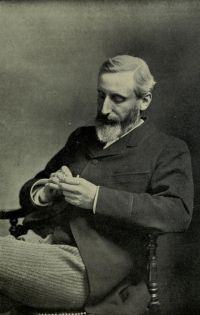
Grant Allen

Grant Allen

Summary

Portrait of Grant Allen Grant Allen The Dynamiter's Sweetheart (1894)

From her childhood upward, to be sure, Essie had drawn pictures for her own delight with a plain lead pencil; drawn the ducks, and the lambs, and the wild orange-lilies that ran riot in the woods; drawn them instinctively, without teaching of any sort, for pure, pure love of them. But these early Italian pictures, then seen for the first time, crossing her simple horizon on the hills of Vermont, roused a fresh fierce thrill in that eager little breast of hers. She had heard of art, from a distance, as a thing glorious and beautiful, which sprang far from New England.
Source: Wikisource

Portrait of Grant Allen Grant Allen The Dynamiter's Sweetheart (1894)

Here we have to fight a hard battle against the strong. We must use such poor arms as tyrants leave us. All is fair in war, and it is open war now between the bourgeoisie and the Friends of Liberty. They would kill us if they could; we will kill them in return for it. You see, it is all a fair field and no favor."
"But, Stanislas," Essie cried, "you don't mean to say you approve of these wretches who maim and destroy innocent women and children? If their bombs only blew up tyrants—I don't know about that; you see, I'm a woman, and I never pretend to understand politics.
Source: Wikisource

Portrait of Grant Allen Grant Allen The Dynamiter's Sweetheart (1894)

What wonder that Essie Lothrop fell in love with him? All men are human; still more, all women. He was so handsome, so clever, so fiery, so incomprehensible, so utterly unlike the young men in New England. That very incomprehensibility was a point in his favor; it appealed to woman's love of the mysterious and the infinite. Besides, Alphonse was right. Strange to say, Laminski meant it all for the good motive.
Source: Wikisource

Get perspective with Kwize: daily news enlightened by great literature