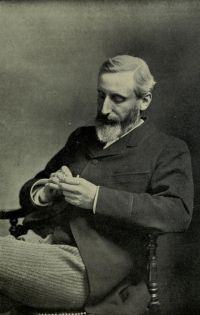
Grant Allen

Grant Allen

Summary

Portrait of Grant Allen Grant Allen Cities of Belgium

Only with Hubert and Jan van Eyck (about 1360-1440) does the distinctively Flemish taste begin to show itself—the taste for delicate and minute workmanship, linked with a peculiar realistic idealism, more dainty than German work, more literal than Italian. It is an art that bases itself upon truth of imitation and perfection of finish: its chief æsthetic beauty is its jewel-like colour and its wealth of decorative adjuncts. The subsequent development of Flemish painting—the painting that pleased a clique of opulent commercial patrons—we shall trace in detail in the various cities.
Source: Gutenberg

Portrait of Grant Allen Grant Allen Cities of Belgium

This altar-piece, for an altar of Our Lady, is a magnificent specimen of the master’s rich and luminous colouring. The crimson robe of the Christ, the blue and lilac harmony on the Madonna, and the faint yellow of the Father’s robe, are admirably contrasted. So are the darkness of the lower clouds and the luminosity of the upper region, recalling Titian’s famous Assumption at Venice. The little boy angels are sweet and characteristic. Here you may begin to appreciate the force, the dash, the lavish wealth of Rubens.
Source: Gutenberg

Portrait of Grant Allen Grant Allen Cities of Belgium

His sturdy Flemish nature, again, comes out in the full and fleshy figures, the florid cheeks, and the abundant fair hair of his female characters. All scenes alike, however sacred, are for him just opportunities for the display of sensuous personal charm, enlivened by rich costume or wealthy accessories. Yet in his large romantic way he is doing for cosmopolitan mercantile Antwerp in the 17th century what Van Eyck and Memling did for cosmopolitan Ghent and Bruges in the 15th.
Source: Gutenberg

Get perspective with Kwize: daily news enlightened by great literature