Hawaiki

Definition and stakes

J. H. Kerry-Nicholls,  The King Country; or, Explorations in New Zealand

“ The Maoris of the present day refer to Hawaiki as the fatherland of their race, and hence the proverb: I kune mai i Hawaiki te kune kai te kune tangata, "the seed of our coming is from Hawaiki, the seed of man"; but of the locality of this place, beside the belief that it was an island somewhere in the broad waters of the Pacific, absolutely nothing beyond conjecture is known. ”
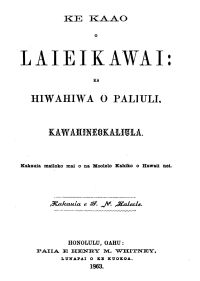
Source: Gutenberg

David Paul Gooding,  Picturesque New Zealand (1913)

“ Whence came the Maoris? From Hawaiki, they say. But where is Hawaiki? There are many Hawaikis. All the myriad islands of Polynesia, from Easter Island to Ponape, from Hawaii to New Zealand, say that Hawaiki, or its equivalent in the various Polynesian dialects, was their original home; but their ideas respecting the exact location of this ancestral abode are somewhat vague. According to S. Percy Smith, at least seven Hawaikis are known, among them Hawaii, Samoa, Tahiti, and neighboring islands, and Rarotonga. Mr. Smith believes the Hawaiki of the Maoris to be Tahiti and adjoining islands. ”
Source: Wikisource

Stephenson Percy Smith,  Hawaiki The Original Home of the Maori (1904)

“ The Moriori traditions are very precise in many respects. They say that they arrived at the Chatham Islands (Re-kohu) from Hawaiki; but as they have retained the common name of New Zealand, Aotea-roa, in their traditions, besides another old name of the North Island, Huku-rangi, and moreover knew the old name of the north end of the South Island, Aropaoa, there seems little doubt that they went to the Chathams from New Zealand, the more so, as we now know that this country was also called Hawaiki, i.e., Hawaiki-tautau. ”
Source: Wikisource

Get perspective with Kwize: daily news enlightened by great literature