“ I have often admired the intrepid fashion in which a woman will put her conscience at a moral hedge, while a man of no finer spiritual fibre will be straining his eyes to find a hole through which he can crawl. “McKinley is not opposed to Blaine, is he?” she asked the man. “The Republican party has no name that is more loved than that of James G. Blaine,” said the man, gravely. “That’s so, that’s so!” the old partisan assented eagerly; “to my mind he’s the logical candidate.” The Canton man nodded, and asked if he had ever seen Blaine. ”
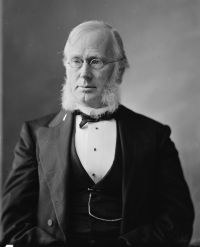
James G. Blaine
Definition and stakes
James G. Blaine (1830–1893) was a prominent American statesman and Republican politician, renowned for his roles as Speaker of the House, U.S. Senator, and Secretary of State under three presidents. His career spanned advocacy for civil rights, tariff reform, and increased international involvement, particularly in Latin America.
Authors like Robert Green Ingersoll praised his rhetorical skill, while Blaine’s own writings, such as Twenty Years of Congress, highlight his legislative impact. Marietta Holley’s fiction depicts him as a principled leader, and historical records underscore his diplomatic foresight. Blaine’s legacy lies in connecting domestic reform with an emerging assertive foreign policy, shaping the course of 19th-century American politics.
Quotes about “James G. Blaine”
Robert Green Ingersoll,
The Ghosts, and Other Lectures
“ Like an armed warrior, like a plumed knight, James G. Blaine marched down the halls of the American Congress and threw his shining lance full and fair against the brazen foreheads of the defamers of his country and the maligners of his honor. ”
James Gillespie Blaine, Twenty Years of Congress, Volume 2
“ The Forty-first Congress was the second to organize under the new law —March 4th 1869. (1) In the House James G. Blaine of Maine was elected Speaker, receiving 135 votes to 57 cast for Michael C. Kerr of Indiana. Of the two hundred and forty-three representatives on the roll, only ninety-eight had served in the preceding Congress. Among the one hundred and forty-five new members were some men who afterwards became widely and favorably known to the country. ”
Marietta Holley,
Sweet Cicely — or Josiah Allen as a Politician
“ And there was a gentleman a settin' at the end of the room a readin'. I like James G. Blaines'es looks middlin' well. Although, like myself, he don't set up for a professional beauty. It seems as if some of the strength of the mountain pines round his old home is a holdin' up his backbone, and some of the bracin' air of the pine woods of Maine has blowed into James'es intellect, and braced it. ”
James Gillespie Blaine, Twenty Years of Congress, Volume 2
“ The Democratic National Convention met at Baltimore on the 9th of July. The intervening two months had demonstrated that it could do nothing but follow the Cincinnati Convention. The delegations were distinctly representative. New York sent Governor Hoffman, General Slocum, S. S. Cox, Clarkson N. Potter, and John Kelly. Among the Pennsylvania delegates were William A. Wallace, Samuel J. Randall, and Lewis Cassidy. Henry B. Payne came from Ohio; Thomas F. Bayard from Delaware; Montgomery Blair from Maryland; Henry G. Davis from West Virginia; Senator Casserly and Ex-Senator Gwin from California ”
James Gillespie Blaine, Twenty Years of Congress, Volume 2
“ He remained there as a citizen of the State and was active and influential during the period of reconstruction. In 1868 he was elected Governor, and at the close of his term was chosen United States senator. He is a man of character,—quiet and undemonstrative in manner, but with extraordinary qualities of firmness and endurance.The House of Representatives was organized without delay or obstruction. Mr. Blaine was re-elected Speaker,—receiving 126 votes to 92 cast for George W. Morgan of Ohio, who had been nominated as the Democratic candidate. ”
E. K. Cressey, Pine to Potomac (1884)
“ Blaine, if she wanted him to move from the table, would say, “James! James!” and again, “James!” like enough half a dozen times before he would hear, and she pleasant and careful of him all the time. She has had mind and heart to know his worth, and has needed no one to tell her that teaching school in Kentucky has paid her a handsome dividend and is full of promise for the future. He has made no move but what she has seconded the motion. Her life is in his, and not a thing independent and apart from it. ”
1911 Encyclopædia Britannica, Volume 4… (1911)
“ He was chosen speaker of the House in 1869 and served three terms. The House was the fit arena for his political and parliamentary ability. He was a ready and powerful debater, full of resource, and dexterous in controversy. The tempestuous politics of the war and reconstruction period suited his aggressive nature and constructive talent. The measures for the rehabilitation of the states that had seceded from the Union occupied the chief attention of Congress for several years, and Blaine bore a leading part in framing and discussing them. ”
James Gillespie Blaine, Twenty Years of Congress, Volume 2
“ Born and educated in New York, he was an editor in Wisconsin, a merchant in Missouri, a miner on the Pacific slope, an editor in San Francisco, a member of the California Legislature, a delegate in the Constitutional Convention of Nevada, reporter of the Supreme Court of that State, elected to Congress—all before he was thirty years of age. The singular variety of his career could hardly be paralleled outside of the United States. If his industry had been equal to his natural gifts he would have been one of the first orators in the country. ”
James Gillespie Blaine, Twenty Years of Congress, Volume 2
“ He was bred to the law, and as a young man took deep interest in political affairs, earnestly attaching himself to the fortunes of Mr. Clay in his contest against General Jackson, and having the great advantage of Mr. Webster's personal friendship. He had served in both branches of the New-York Legislature, was a representative from New-York City in the Twenty-eighth Congress, was chosen Governor of his State in 1848, and in 1851 succeeded Daniel S. Dickinson in the United-States Senate, where he served for a full term as the colleague of Mr. Seward. ”
Various, McClure's Magazine, Vol. 6, No…
“ They were sure the force of the celebrity of General Sherman in a campaign had been overestimated by Blaine, who had the caprice and high color in his imagination that produce schemes too fine for success. In a word, Sherman and Lincoln were not practical politicians. Blaine's idea was not politics, but poetry. What they wanted was the magnetism and magic of Blaine. The country was at any rate safely in the hands of the Republican party. They had nearly lost the election because they had not nominated Blaine eight years before, and won with Garfield because he was a Blaine man. ”
John Clark Ridpath,
The Life and Work of James A. Garfield…
“ Although Blaine was beyond question running on his personal merits, yet the fact that he was a leading candidate, but without a majority, destined him to fall a prey to his competitors. In the great political arena, when one gladiator is about to triumph over his divided rivals, the latter unite against him, that all may die together, and by giving to an unknown the palm of victory save themselves from the humiliation of a rival’s triumph. ”
James Gillespie Blaine, Twenty Years of Congress, Vol. 1
“ Through a checkered career in civil life, he had enlarged his knowledge of the country, his acquaintance with men, his experience in affairs. He had been a banker in California, a lawyer in Kansas, President of a college in Louisiana, and, when the war began, he was about to take charge of a railroad in Missouri. It would be difficult, if not impossible to find a man who has so thorough, so minute a knowledge of every State and Territory of the Union. ”
James Gillespie Blaine, Twenty Years of Congress, Volume 2
“ He boasts himself incapable of attachment to party, and in that respect radically differs from the great body of his American fellow-citizens. He cannot even comprehend that exalted sentiment of honorable association in public life which holds together successive generations of men,—a sentiment which in the United States causes the Democrat to reverence the memory of Jefferson and Jackson and Douglas, which causes his opponent to glory in the achievements of Hamilton and Clay and Lincoln ”
James Gillespie Blaine, Twenty Years of Congress, Volume 2
“ Few men could have resisted so long and so bravely. An iron will sustained him and enabled him through years of suffering to assume a leading part in the legislation of the country and in directing the policy of the Republican party.Governor Morton was succeeded by Daniel W. Voorhees, already widely known by his service of ten years in the House. Mr. Voorhees was a Democrat of the most pronounced partisan type, but always secured the personal good will of his political opponents in Congress.—M. C. Butler of South Carolina entered the Senate on the 2d of December, 1877. ”
James Gillespie Blaine, Twenty Years of Congress, Volume 2
“ The banners of the States were caught up and massed in a waving circle around the head of the predestined and now chosen candidate. The scene of enthusiasm and exultation long delayed the final announcement, which gave Garfield 399 votes, Grant 306, Blaine 42, Washburne 5, Sherman 3. The nomination was immediately made unanimous on motion of Mr. Conkling. For Vice-President Elihu B. Washburne, Marshall Jewell, Thomas Settle, Horace Maynard, Chester A. Arthur, and Edmund J. Davis were placed in nomination, and General Arthur was chosen on the first ballot by a vote of 468 to 193 for Mr. ”
John Clark Ridpath,
The Life and Work of James A. Garfield…
“ Mr. Joy was not the kind of a man to arouse the enthusiasm of an audience, and when he had closed, Mr. Pixley, of California, seconded the nomination. These speeches were a great disappointment to the Blaine men. They still remembered Ingersoll’s famous “plumed knight” speech for Blaine at Cincinnati, in 1876. To remedy matters, Mr. William P. Frye, of Maine, obtained the floor by consent, and delivered the following brief, but brilliant little speech, which, in a measure, retrieved the mistake already made. ”
James Gillespie Blaine, Twenty Years of Congress, Vol. 1
“ He was a native of Virginia, a representative in Congress from Tennessee, and Governor of that State before he was thirty-five. He was the intimate and trusted friend of Jackson. Having resigned his governorship on account of domestic trouble, he fled from civilized life, joined the Indians of the Western plains, roved with them for years, adopted their habits, and was made chief of a tribe. Returning to association with white men, he emigrated to Texas and led the revolt against Mexico, fought battles and was victorious, organized a new republic and was made its President. ”
James Gillespie Blaine, Twenty Years of Congress, Vol. 1
“ Hitherto New York and the South had been in alliance, and their joint decrees were the rule of action inside the Democratic party. They were now separated and hostile, and the trial of strength that ensued was one of the most interesting political contests ever witnessed in the country. The Democratic masses had so long followed Southern lead that they were bewildered by this new and unexpected development. From the organization of the Federal Government to that hour, a period of fifty-six years, Mr. Van Buren was the only Northern man whom the Democracy had supported for the Presidency ”
James Gillespie Blaine, Twenty Years of Congress, Volume 2
“ They were in a minority, but among them was a large proportion of able men—men of experience and great skill in debate. It is seldom that the opposition party has such a list of champions as appeared on the Democratic side of the House in the Forty-first Congress. Beck of Kentucky, Randall and Woodward of Pennsylvania, Marshall of Illinois, Brooks, Wood, Potter, Slocum, and Cox, of New York, Kerr, Niblack, Voorhees, and Holman of Indiana, Eldridge of Wisconsin, Van Trump and Morgan of Ohio, unitedly presented a strong array of Parliamentary ability. ”
James Gillespie Blaine, Twenty Years of Congress, Vol. 1
“ The generous instincts of the people condemned an attempt to destroy the honorable fame of a public man by what they considered to be an act of spiteful persecution. It was the opinion of John Bell, who of all men had the best opportunity for impartial judgment in the premises, that the vote of himself and his fellow Whigs on the resolution was an indirect but potential cause of Mr. Polk's nomination and election to the Presidency. It gave him prominence as a friend of Jackson, and made him available as a candidate against Van Buren for the Democratic nomination. ”
James Gillespie Blaine, Twenty Years of Congress, Vol. 1
“ But the Barnburners declined thus to compromise a principle. On a question of bread, the half-loaf is preferable to starvation, but when political honor and deep personal feeling are involved, so material an adjustment is not practicable. The Barnburners retired from the convention, disclaimed all responsibility for its conclusions, and proceeded in due time to organize against the ticket of Cass and Butler. The Hunkers, left in the convention as the sole representatives of the New-York Democracy, were startled at the situation and declined to vote. ”
James Gillespie Blaine, Twenty Years of Congress, Vol. 1
“ In the Senate he soon acquired the rank to which his thorough training and intelligence, his graceful speech, his ardent patriotism, his stainless life entitled him. No man has ever enjoyed, among his associates of all parties, a more profound confidence, a more cordial respect, a warmer degree of affection. UNITED-STATES SENATORS. John P. Hale of New Hampshire was still pursuing the career which he had begun as an early advocate of the anti-slavery cause, and in which he had twice overthrown the power of the Democratic party in New Hampshire.—Henry Wilson was the colleague of Mr. ”
James Gillespie Blaine, Twenty Years of Congress, Vol. 1
“ The accession of General Grant to the command of all our armies, and the forward movement both in the East and in the West, inspired faith in the speedy and complete triumph of the Union cause. Many eminent men were included in the roll of delegates to the Convention. Not less than five of the leading War Governors were chosen to participate in its councils. Vermont sent Solomon Foot who had stood faithful in the Senate during the struggles before the war. Massachusetts had commissioned her eloquent Governor John A. Andrew; the delegation from New York embraced Henry J. Raymond ”
Various, The Bay State Monthly — Volume 2…
“ Assuredly no man, be he friend or foe, can point to a single instance in Mr. Blaine's long and varied political career, in which he has betrayed his political trust or failed to respond to the demands of his political professions. ”
James Gillespie Blaine, Twenty Years of Congress, Vol. 1
“ In the North, conservative men felt that no compromise could acquire weight or sanction or sacredness, if one that had stood for a whole generation could be brushed aside by partisan caprice or by the demands of sectional necessity. The popular fury was further stimulated by the fact that from the territory included in the Louisiana purchase, three slave States had been added to the Union, and as yet only one free State ”
James Gillespie Blaine, Twenty Years of Congress, Volume 2
“ Seward had reached the age of sixty-five years, and he surely could not consent to undo the entire work of his mature manhood. Consistency, it is true, is not the highest trait of statesmanship. Crises often arise in the conduct of National affairs when cherished opinions must be sacrificed and new departures taken. But this necessity can never apply to that class of political questions closely and inseparably allied with moral obligation. Mr. Seward had himself taught the nation that conflict on questions involving the rights of human nature is irrepressible. ”
James Gillespie Blaine, Twenty Years of Congress, Volume 2
“ The radicalism to which he now contemptuously indicated his opposition was that which looked to the broadening of human rights, to philanthropy, to charity, and to good deeds. Every intelligent Republican saw that the attempt which the President was now making with his provisional governors to secure a partial franchise to the colored man, was really only a petition to the States to act in a certain manner upon a subject over which, by his own proclamation, their power of control was declared to be absolute. ”
E. K. Cressey, Pine to Potomac (1884)
“ He could swim across to Brownsville, discarding both ferry and bridge.He went nutting with the boys, as is their wont when autumn days are on the woods, and Nature, glorified with a thousand tints of foliage, is, in the poet’s sombre language, “in the sere and yellow leaf.” Black walnuts, butternuts, shellbarks, hickory nuts, and chestnuts rewarded their search, and gladdened winter evenings with their cheer. [54] There was nothing unnatural about young Blaine. He was no prodigy; no marvel, except of industry and constant training. ”
James Gillespie Blaine, Twenty Years of Congress, Vol. 1
“ Clay held the advantage of a rare eloquence; but Jackson had a splendid military record, which spoke to the hearts of the people more effectively than words. Members for twenty years of the same party, they differed slightly, if at all, in political principles when the contest began; but Jackson enjoyed the prestige of a more lineal heirship to the creed of Jefferson, Madison, and Monroe; while Clay, by his imprudence in becoming secretary of State, incurred not only the odium of the "bargain and sale," but a share of the general unpopularity which at that time attached to the name of Adams. ”