“ Then Kakuhihewa told them the whole story of the light seen in the mountains, and of the wishes of Kalelealuaka and the Sloven. Then up spoke the soldiers, and said: “Death! This man is worthy to be put to death; but as for the other one, let him live.” “Hold,” said the King, “not so fast! Before condemning him to death, I will call together the wise men, priests, wizards, and soothsayers; perchance they will find that this is the man to overcome Kualii in battle.” ”
Kakuhihewa
Definition and stakes
The theme of “Kakuhihewa” has been addressed by authors such as W. D. Westervelt, S. N. Haleole and Nathaniel Bright Emerson. It is often associated with terms like Oahu, Lonoikamakahiki, people, Maui and Waikiki.
Quotes about “Kakuhihewa”
W. D. Westervelt, Legends of Old Honolulu (Mythology…
“ At that time Kakuhihewa learned who the young man was, and was glad that he had not treated him uncivilly in any way and so lost his wonderful aid. He was very, very thankful for his victory over the king of Maui. He ordered his servants to find Kauilani, but they could not. He was fully lost. Wailuku, the wife of Maui-nui, asked Kakuhihewa what he intended to do with them. He replied: “I will not kill. I am for life. I do not know how to make a man. I do not want [243] death. If you had won, you should have your desire. ”
W. D. Westervelt, Legends of Old Honolulu (Mythology…
“ Kakuhihewa was kind, and yet this offence of Kapoi was serious in the eyes of the people in view of their ancient customs and ideas. Kakuhihewa had made a law for his temple which he was building at Waikiki. He had established his tabu over all the people and had made the decree that, if any chief or man should build a temple with a tabu on it and should lift that tabu before the tabu on the king’s temple should be over, that chief or man should pay the penalty of death as a rebel. ”
Fornander collection of Hawaiian antiquities and folk-lore… (1917)
“ When Kakuhihewa heard this, he issued a call for everybody to come together, no man, woman or child to remain at home, excepting those who when they fell down were unable to get up again, and those who were so sick that they could not walk. After everybody had come together, the farmer proceeded to look for his man by looking at their arms ”
Fornander collection of Hawaiian antiquities and folk-lore… (1917)
“ Kakuhihewa then said to Lonoikamakahiki: “Say, King of Hawaii, since we have at last found a subject for another contest—the matter of the arrival of Hauna tomorrow—let us, therefore, have one.” Lonoikamakahiki replied: “What have you to offer as your wager? A good contest can only be made when one has something to place as a wager.” Kakuhihewa said: “Why not let Oahu be offered as against Hawaii?” Lonoikamakahiki made answer: “When you know that I have already won Oahu you come and again offer it for a wager.” Kakuhihewa said: “You must put away such thoughts, King of Hawaii. ”
Fornander collection of Hawaiian antiquities and folk-lore… (1917)
“ MOKUNA VI. Ka Hoopapa Alua ana, Akolu, Aha, ame ka Lima, ame ka Hiki ana Mai o Kaikilani. After this defeat of Kakuhihewa by Lonoikamakahiki, Lanahuimihaku and his companion then said to Kakuhihewa: “Say, Kakuhihewa, since we have been beaten by the king of Hawaii in this contest, let this be his victory. Our idea is this: we think it a good plan that we go out fishing. It is more than possible that the king of Hawaii can be enticed to follow us out, and if he does, and he gets excited over the sport, he will surely ask us for hook, line and bait ”
Fornander collection of Hawaiian antiquities and folk-lore… (1917)
“ Mahope iho o keia mau mea, kupu ae la ko Lonoikamakahiki manao lealea i ka lawaia, alaila, olelo aku la o Lonoikamakahiki ia Kakuhihewa: “E ke alii o Oahu! Homai hoi kau wahi makau, i wahi aho mai me ka maunu, a i paka mai no.” I aku o Kakuhihewa: “I hea no hoi kou makaukau hele pu mai oe, o ka makou ka kau mea i manao ai, i anei kou lako?” I aku ke kahu o Loli: “E kuu alii! A, hilahila oe; kai noa o ka’u ia e olelo aku ana ia oe, aole kaua e holo mai i kai nei; a nolaila, pepehiia iho wau.” ”
W. D. Westervelt, Legends of Old Honolulu (Mythology…
“ When the brother and sister returned they told the grandparents about Kakuhihewa’s trouble and the power of the rooster of the king of Maui to assume several bodies. Kauilani told them that the Maui king was so sure of winning that he had collected a great pile of wood wherewith to heat an oven in which to cook Kakuhihewa’s body. The grandmother said: “That great bird is one of our own family, and has very great power, but Lepe-a-moa has much greater power if you two work together. He must not see her until she goes out to fight with him.” ”
W. D. Westervelt, Legends of Old Honolulu (Mythology…
“ For many days the young people and their grandparents dwelt happily together. In later years the young chief and his sister saved King Kakuhihewa in a remarkable manner. As a result, the king gave his favorite daughter to Kauilani as his wife, and Lepe-a-moa cared for their children. ”
“ Then the lame marshal came and stood before the King and said: “Your bones shall rest in peace, Kalani. You had better send now and summon your son-in-law to come and stand before me; for he is the man.” Then Kakuhihewa arose and went himself to the house of his son-in-law, and called to his daughters that he had come to get their husband to go and stand before Maliuhaaino. Then Kalelealuaka lifted up the mats of his bed and took out the feather cloaks and the helmets and arrayed his two wives, and Kaluhe, and himself. ”
Fornander collection of Hawaiian antiquities and folk-lore…
“ Thus the line of Kalehenui-a-Maweke, culminating in Kaakaualani, the wife of Kakuhihewa, corresponds exactly with the line of Mulielialii-a-Maweke ending in Kakuhihewa. Thus the line of Keaunui-a-Maweke, through Nuakea, Kalahumoku, Moku-a-Hualeiakea, to the children and grandchildren of Umi-a-Liloa in Hawaii, the uncontested contemporaries of Kakuhihewa, is equally full and correct. I am therefore inclined to consider the Nanaulu line, including its branches, not only as the most correct, but as the main trunk of Hawaiian genealogy. ”
“ Now, Kakuhihewa’s two swiftest runners (kukini) were Keakealani and Kuhelemoana. They were so fleet that they could compass Oahu six times in a forenoon, or twelve times in a whole day. These two were sent to call together all the men of the King’s domain. The men of Waianae came that same day and stood in review on the sandy plains of Puuloa. But among them all was not one who bore the marks sought for. Then came the men of Kona, [105] of Waialua, and of Koolau, but the man was not found. ”
Fornander collection of Hawaiian antiquities and folk-lore… (1917)
“ A hiki ka huakai ma waho o ka hale o laua nei, eono poe kanaka ka puni o ka hale me ka makaukau i na mea make. Ia wa ala mai o Kalelealuaka me kana laau [469] palau a uhau iho la i ka hale, kaawale ae la elua mahele me ka lele liilii i o i anei. Olelo mai ka luna o na kanaka: “Aole ka makou huakai he kaua a he make; i kii mai nei makou ia oe e iho i kai o Ewa, ma ke kauoha a ke ’lii a Kakuhihewa. Eia hoi ka manele la kau mai iluna.” Before their arrival at Ewa, Kakuhihewa had in the meantime prepared with his own hands everything as advised by the priest, as already set forth in this story. ”
Fornander collection of Hawaiian antiquities and folk-lore… (1917)
“ I mai o Kepakailiula: “Owau.” I aku lakou nei: “I kii mai nei makou ia oe, e holo kakou i Oahu, pela mai ko makuakane o Kakuhihewa, e komo i ka aina.” Ae mai ke ’lii, holo lakou nei; o Kepakailiula, o na wahine elua, o na makuakane elua me ka laua wahine. A hiki lakou i Oahu, a pae ma Waikiki, malaila o Kakuhihewa kahi i noho ai. Haawi mai o Kakuhihewa ia Oahu a puni, ia Kepakailiula. Hoonoho iho la ia i na makuakane i mau alii no Oahu nei; o luna, o lalo, o uka, o kai, o ka moa kona a me Kakuhihewa. Noho iho la laua he mau alii. ”
W. D. Westervelt, Legends of Old Honolulu (Mythology…
“ At this time Kakuhihewa was entertaining his sister and her husband, Maui-nui, who was king of the island of Maui. According to custom, the days were devoted to sports and gambling. Maui-nui had a kupua, a rooster, which was one of the ancestors of Kauilani’s family, but was very cruel and destructive. He could assume a different bird form for each magic power he possessed. This, with his miraculous human powers, made him superior to all the roosters which had ever been his antagonists in cock-fighting. ”
Fornander collection of Hawaiian antiquities and folk-lore… (1917)
“ You have nothing more to learn.” Hele mai la o Kanewahineikiaoha a nini i ka wai, ia Kalonaikahailaau, a pohala ae la, alaila, olelo aku la ia Kawelo, penei: “O ka hahau ana iho la no ia o ka laau, aohe wahi i koe ia oe.” Some little time after this, Kawelo sent Kanewahineikiaoha, Kamalama, Kalaumeki and Kauluiki, to go to Puuloa and ask of Kakuhihewa, who was king of Oahu at the time, for the use of a canoe. Upon the arrival of the messengers at Puuloa, Kakuhihewa asked of them: “What do you want?” Kanewahineikiaoha replied: “We have come for a double canoe for us.” ”
“ Thus they lived for perhaps thirty days (he mau anabulu) , when a messenger arrived, announcing that Kualii was making war at Moanalua. The soldiers of Kakuhihewa quickly made themselves ready, and among them Keinohoomanawanui went out to battle. The lame marshal had started for the scene the night before. On the morning of the day of battle, Kalelealuaka said to his wives that he had a great hankering for some shrimps and moss, which must be gathered in a particular way, and that nothing else would please his appetite. ”
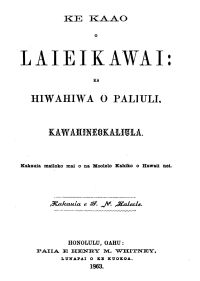 S. N. Haleole,
The Hawaiian Romance Of Laieikawai
S. N. Haleole,
The Hawaiian Romance Of Laieikawai
“ He then makes Kukuipahu king over Maui and goes on to Oahu, where Kakuhihewa hastens to make peace. One day when Makolea is out surf riding, messengers of the king of Kauai, Kaikipaananea, steal her away and she becomes this king's wife. Kepakailiula follows her to Kauai and defeats the king in boxing. One more contest is prepared; the king has two riddles, the failure to answer which will mean death. Only one man knows the answers, Kukaea, the public crier, and he is an outcast who has lived on nothing but filth air his life. ”
S. N. Haleole,
The Hawaiian Romance Of Laieikawai
“ KALELEALUAKA Kakuhihewa, king of Ewa, on Oahu, and Pueonui, king from Moanalua to Makapuu, are at war with each other. Kalelealuaka, son of Opelemoemoe, the sleeper, lives with his companion, Keinohoomanawanui, at Oahunui. He is a dreamer; that is, a man who wants everything without working for it. One night the two chant their wishes. His companion desires a good meal and success in his daily avocations, but Kalelealuaka wishes for the king's food served by the king himself, and the king's daughter for his wife. ”
W. D. Westervelt, Legends of Old Honolulu (Mythology…
“ They scratched dirt over them and befouled them. Such an attack was irresistible—Kakuhihewa’s men fled, and Kapoi was set free. Kakuhihewa said to Kapoi: “Your god has mana (miraculous power) greater than my god. Your god is a true god.” Kapoi was saved. The owl was worshipped as a god. The place of that battle was Kukaeunahio-ka-pueo (The-confused-noise-of-owls-rising-in-masses) . [138] 1 This place is now the site of the Castle Home. ↑ 2 Another legend says that the battle was between the little people and Kualii, a noted chief of Oahu, of comparatively recent date. ”
Fornander collection of Hawaiian antiquities and folk-lore… (1917)
“ Na Kakuhihewa no e mama a wali, e hoka a loko o ke kanoa, e hoohee a loko o na apu; nana no e hooinu i na waha o kaua, ona kaua, moe i ka ona awa a huli ae; nana no e lawe mai i na kaikamahine ana a ma na aoao o kaua hoomoe: oia ka’u kuko la i lohe oe.” “Kahaha, make kaua; kai no paha ma na mea e ae kaua e kuko ai, eia ka o ke ’lii kau kuko; ina pela kou manao mamake kaua,” pela aku o Keinohoomanawanui. Pela ko laua hana mau ana a hala ke anahulu o na po a me na po helelei, oia he mau po keu. O anahulu a me helelei. Anahulu, he umi ia. Helelei, he keu mawaho o ka umi ”
Fornander collection of Hawaiian antiquities and folk-lore… (1917)
“ If we whose bones are older cannot throw him, how much less are the chances of yourself, a mere youngster.” Kawelo, however, paid no heed to the remarks made by his brothers, but stood there facing the strong man. At this show of bravery the strong man said to Kawelo: “If I should call out, ‘Kahewahewa, it is raining’,7 then we begin.” Kawelo then replied in a mocking way: “Kanepuaa, he is biting, wait awhile, wait awhile. Don’t cut the land of Kahewahewa, it is raining.”8 While Kawelo was having his say, the strong man of Kakuhihewa was awarded the privilege of taking the first hold ”
Fornander collection of Hawaiian antiquities and folk-lore… (1917)
“ Ma na mea a pau a Aikanaka e olelo mai ai, malaila laua e hoolohe ai, ina he kui lei, a he mea e ae paha, aole a laua hoole, he ae wale no. While Kawelo and his grandparents were living at Wailua with Aikanaka and the others, Kawelo’s older brothers, together with their grandparents, left Kauai and came to live in Waikiki, Oahu. Kakuhihewa was the king of Oahu at this time. There was living with Kakuhihewa, a very strong man who was a famous wrestler. This man used to meet the older brothers of Kawelo in several wrestling bouts but they never could throw him down. ”
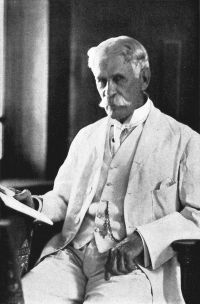 Nathaniel Bright Emerson,
Unwritten Literature of Hawaii…
Nathaniel Bright Emerson,
Unwritten Literature of Hawaii…
“ It treats of an armed conflict between Kauahoa and his cousin Kawelo, a hero from Oahu, which took place on Kauai. Kauahoa was a retainer and soldier of Ai-kanaka, a king of Kauai. The period was in the reign of King Kakuhihewa, of Oahu. Kawelo invaded Kauai with an armed force and made a proposition to Kauahoa which involved treachery to Kauahoa’s liege-lord Ai-kanaka. Kauahoa’s answer to this proposition is given in verse 28; Hu’e a kaua, moe i ke awakea!—“Strike home, then sleep at midday!” The sleep at midday was the sleep of death. ”
W. D. Westervelt, Legends of Old Honolulu (Mythology…
“ This meant that the poverty-stricken chief, as a last resort, would wager his body against some of the property lost. If defeated, his life might be taken and his body sent to the most noted heiau (temple) of his opponent and placed on an altar as a human sacrifice, or the body would be burned or cooked in a fire oven and thrown into the sea. [230] Kakuhihewa and Maui-nui had been passing many days in this sport. When the Maui king was afraid the game might be given up, he would let some of the ordinary chickens fight, or would select the weakest from his flock. ”
Fornander collection of Hawaiian antiquities and folk-lore… (1917)
“ It will be the means by which the man could be recognized.” O Pueonui ua pio kona aoao, a ua pau loa kona aina ia Kakuhihewa, ua manao hoi o Kakuhihewa na Keinohoomanawanui keia pio o Pueonui, a me keia make o na kanaka. No ke kanaka mahiai. Hoole oia ia Keinohoomanawanui: “Aole nana keia make o Pueonui, he kanaka e wale no ke kanaka nana e luku nei, aia a kokoke e ao [471] hele keia kanaka. He kanaka mama loa, aohe lua, me ka laau palau i ka lima, a i ka hoi ana mai me ka mahiole a me ka ahuula, ua pahu ia e a’u i ka ihe, a paa ka upe o ka ihe i loko o ka lima. ”
Fornander collection of Hawaiian antiquities and folk-lore… (1917)
“ Ke nahu nei! Alia! Alia i oki ka aina o Kahewahewa, he ua!” Ia Kawelo e olelo ana peia, lilo iho la ka olelo mua i ke kanaka ikaika o Kakuhihewa, a i ke kulai ana, aneane no e hina o Kawelo, a no ka ikaika no o Kawelo, aole i hina. Ia manawa hoomakaukau o Kawelo i kana olelo hooulu, a i ko Kawelo kulai ana hina iho la ia ia a kau iho la o Kawelo maluna, a uwa ae la na kanaka a pau loa. When the older brothers of Kawelo saw how the strong man was thrown by their younger brother they were ashamed, and they returned home weeping and tried to deceive their grandparents. ”
 James George Frazer,
The Belief in Immortality and the Worship of the Dead…
James George Frazer,
The Belief in Immortality and the Worship of the Dead…
“ Now Kapihe was priest to the latter god, and professed to have received a revelation, in accordance with which he informed King Kamehameha that, when the monarch should depart this life, the god Kuahairo would carry his spirit to the sky and afterwards accompany it back to earth again, whereupon his body would be restored to life and youth; that he would have his wives again and resume his government in Hawaii; that at the same time the existing generation would see and know their parents and ancestors, and that all the people who had died would rise again from the dead. ”
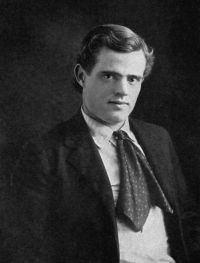 Jack London,
Island Tales / On the Makaloa Mat
Jack London,
Island Tales / On the Makaloa Mat
“ For to the king, in theory, belongs all property of his people; and with Kalakaua, when it came to the old things, theory and practice were one.“From him my father, Kanau, got the collecting bee in his bonnet, and Hiwilani was likewise infected. But father was modern to his finger-tips. He believed neither in the gods of the kahunas” (priests) “nor of the missionaries. He didn’t believe in anything except sugar stocks, horse-breeding, and that his grandfather had been a fool in not collecting a few Isaac Davises and John Youngs and brass carronades before he went to war with Kamehameha. ”
