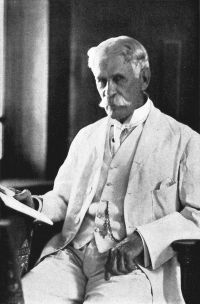
Nathaniel Bright Emerson

Nathaniel Bright Emerson

Summary

Portrait of Nathaniel Bright Emerson Nathaniel Bright Emerson Unwritten Literature of Hawaii…

The hall-mark of Hawaiian music is rhythm, for the Hawaiians belong to that class of people who can not move hand or foot or perform any action except they do it rhythmically. Not alone in poetry and music and the dance do we find this recurring accent of pleasure, but in every action of life it seems to enter as a timekeeper and regulator, whether it be the movement of a fingerful of poi to the mouth or the swing of a kahili through the incense-laden air at the burial of a chief.
Source: Gutenberg

Portrait of Nathaniel Bright Emerson Nathaniel Bright Emerson Unwritten Literature of Hawaii…

He did not starve in a fool’s paradise, a neglected object of man’s superstitious regard, as in Constantinople; nor did he vie with kings and queens in the length and purity of his pedigree, as in England; but in Hawaii he entered with full heart of sympathy into all of man’s enterprises, and at his death bequeathed his body a sacrifice to men and gods. It was fitting that the Hawaiian poet should celebrate the dog and his altogether virtuous and altruistic services to mankind. The hula ilío may be considered as part of Hawaii’s tribute to man’s most faithful friend, the dog.
Source: Gutenberg

Portrait of Nathaniel Bright Emerson Nathaniel Bright Emerson Unwritten Literature of Hawaii…

Hawaiian mythology figured Pele, the goddess of the volcano, as a creature of passion, capable of many metamorphoses; now a wrinkled hag, asleep in a cave on a rough lava bed, with banked fires and only an occasional blue flame playing about her as symbols of her power; now a creature of terror, riding on a chariot of flame and carrying destruction; and now as a young woman of seductive beauty, as when she sought passionate relations with the handsome prince, Lohiau; but in disposition always jealous, fickle, vengeful.
Source: Gutenberg

Get perspective with Kwize: daily news enlightened by great literature