“ The name of a low caste of Hindus in Southern India, constituting one of the most numerous castes, if not the most numerous, in the Tamil country. The word in its present shape means properly 'a drummer.' Tamil parai is the large drum, beaten at certain festivals, and the hereditary beaters of it are called (sing.) paraiyan, (pl.) paraiyar. [Dr. Oppert's theory (Orig. Inhabitants, 32 seq.) that the word is a form of Pahaṛiyā, 'a mountaineer' is not probable.] ”
Quotes about “Paraiyar”
Fanny Emily Penny, On the Coromandel Coast (1908)
“ Although the term Pariah indicates an outcaste, the class in the present day is split up into many divisions, each jealously maintaining certain caste rules to which they really have no right. The Pariah servants of the European's house will not eat with the horsekeepers and grass-cutters, and the horsekeepers will not eat with the sweepers. As to which is superior or inferior, it is impossible to say. All are outcastes, and the least honourable calling is that of the sweeper. ”
Robert H. Elliot, Gold, Sport, and Coffee Planting in Mysore
“ The Pariah, it is true, does not reap all the advantages from his altered circumstances that might be expected in other countries, but it is a mistake to suppose that wealth does not tell in India as it does elsewhere. [43] The well-to-do Pariah (and in the Nuggur division of Mysore I am told there are many such) receives that respect which is invariably paid to those who have much substance. He no longer stands respectfully without the veranda of a farmer of ordinary position, but takes his seat in the veranda itself, and on terms of perfect equality. ”
The Blue Fairy Book — The Story of Prince Ahmed and the Fairy Paribanou (1889)
“ The Fairy Paribanou, who had her eyes fixed upon the pretended sick woman all the time that the Prince was talking to her, ordered two of her women who followed her to take her from the two men that held her, and carry her into an apartment of the palace, and take as much care of her as herself. Whilst the two women executed the Fairy’s commands, she went up to Prince Ahmed, and, whispering him in the ear, said: ‘Prince, this woman is not so sick as she pretends to be; and I am very much mistaken if she is not an impostor, who will be the cause of a great trouble to you. ”
The Blue Fairy Book — The Story of Prince Ahmed and the Fairy Paribanou (1889)
“ He presently considered that the Princess Nouronnihar could never be his, and that the Fairy Paribanou excelled her infinitely in beauty, agreeableness, wit, and, as much as he could conjecture by the magnificence of the palace, in immense riches. He blessed the moment that he thought of seeking after his arrow a second time, and, yielding to his love; ‘Madam,’ replied he, ‘should I all my life have the happiness of being your slave, and the admirer of the many charms which ravish my soul, I should think myself the most blest of men. ”
1911 Encyclopædia Britannica, Volume 20… (1911)
“ In 1901 the total number of Paraiyans in all India was 21⁄4 millions, almost confined to the south of Madras. In the Telugu country their place is taken by the Malas, in the Kanarese country by the Holeyas and in the Deccan by the Mahars. Some of their privileges and duties seem to show that they represent the original owners of the land, subjected by a conquering race. The Pariahs supplied a notable proportion of Clive's sepoys, and are still enlisted in the Madras sappers and miners. They have always acted as domestic servants to Europeans. ”
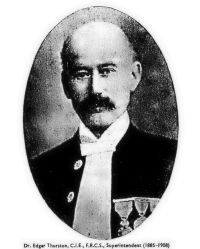 Edgar Thurston,
Castes and Tribes of Southern India
(1909)
Edgar Thurston,
Castes and Tribes of Southern India
(1909)
“ In some documents signed by Paraiyans, the words "If I fail to fulfil the conditions of our agreement, I shall go to Vinnamangalam " are inserted. In all enquiries by the police, the council, or the Dēsāyi Chetti, the Paraiyan only tells what in his opinion it is expedient to tell. But evidence given after burning a piece of camphor is said to be reliable. The attainment of puberty by girls is a subject of greedy curiosity to most of the women in a Paraiya village. ”
R. V. Russell, The Tribes and Castes of the Central Provinces of India…
“ A man can divorce his wife if she is of bad character, or if she is supposed to be under an unfavourable star, or if her children die in infancy. A divorced woman can marry again as if she were a widow. 7. Religion and festivalsThe Parjas worship the class of divinities of the hills and forests usually revered among primitive tribes, as well as Dānteshwari, the tutelary goddess of Bastar. On the day that sowing begins they offer a fowl to the field, first placing some grains of rice before it. If the fowl eats the rice they prognosticate a good harvest, and if not the reverse. ”
 B. M. Bower,
The Parowan Bonanza
B. M. Bower,
The Parowan Bonanza
“ LUELLA ENTERTAINSBill stood on the south veranda and looked down upon the town, where smoke was rising lazily from bent stovepipe and brick chimney—the supper fires of Parowan's inhabitants—and away across the desert beyond, where the Funeral Mountains stood shoulder deep in purple shadows, the peaks smiling yet in rosetinted afterglow."Home!" he said between his teeth. "I made a mistake. I've only built a house. I'm a damned fool. It takes two to make a home." ”
Edgar Thurston,
Castes and Tribes of Southern India
(1909)
“ The Christian missionaries, to their undying honour be it said, have, as a rule, persevered in breaking through the time-honoured custom of treating the Paraiya as dirt, and have admitted him to equal rights and privileges in their schools and churches, and, whatever may be the present position of the Paraiya community in regard to education, intelligence, and ability to hold a place for themselves, they owe it almost wholly to the Christian men and women who have given up their lives to win souls for their great Master. ”
The Blue Fairy Book — The Story of Prince Ahmed and the Fairy Paribanou (1889)
“ However, Paribanou saved her the trouble, and said to her: ‘Good woman, I am glad I had an opportunity to oblige you, and to see you are able to pursue your journey. I won’t detain you, but perhaps you may not be displeased to see my palace; follow my women, and they will show it you.’ Then the magician went back and related to the Sultan of the Indies all that had happened, and how very rich Prince Ahmed was since his marriage with the Fairy, richer than all the kings in the world, and how there was danger that he should come and take the throne from his father. ”
Edgar Thurston,
Castes and Tribes of Southern India…
“ Paraiyans of Malabar, Cochin and Travancore.—For the following note on the Paraiyans or Paraiyas of Cochin I am indebted to Mr. L. K. Anantha Krishna Aiyar.69 Paraiyas belong to a very low caste of the agrestic serfs of Cochin, next to Pulayas in order of social precedence. They will eat at the hands of all castes, save Ullādans, Nāyādis, and Pulayas. But orthodox Pulayas have to bathe five times, and let blood flow, in order to be purified from pollution if they touch a Paraiya. In rural parts, a Paraiya’s hut may be seen far away on the hill-side. ”
The Blue Fairy Book — The Story of Prince Ahmed and the Fairy Paribanou (1889)
“ If Prince Ahmed had not known that Schaibar was Paribanou’s brother, he would not have been able to have looked at him without fear, but, knowing first who he was, he stood by the Fairy without the least concern Schaibar, as he came forwards, looked at the Prince earnestly enough to have chilled his blood in his veins, and asked Paribanou, when he first accosted her, who that man was. To which she replied: ‘He is my husband, brother. His name is Ahmed; he is son to the Sultan of the Indies. ”
 Meadows Taylor,
Tara: A Mahratta Tale
Meadows Taylor,
Tara: A Mahratta Tale
“ The King started as the man covertly declared his name, and the covering fell from his face."Thou Pahar Singh, the Lion of Allund?" he said."Even so, monarch," returned the chief. "Ha! ha! The man whom thy slaves—cowards—tell thee they pursue. Aha! they dare not. Pahar Singh is monarch of his own wilds; no royal troops dare to come near them. But keep thine own counsel, and now listen. Thou mayst need me yet, and I may do thee good service. Two thousand good hearts and stout arms, such as thy money cannot hire, [138] serve Pahar Singh. Swear to keep faith with me, and I will be true. ”
Edgar Thurston,
Castes and Tribes of Southern India
(1909)
“ PARAIYANS. in the Paraiya hamlet, or under a margosa (Melia Azadirachta) tree, or sheltered by a wattle hut, or even by a small brick temple. This temple is universally known as the Amman Koil. More usually, one particular mother is worshipped at the Paraiya shrine. She is then called the grāma dēvata, or village goddess, of the particular hamlet. The names of these goddesses are legion. Each village claims that its own mother is not the same as that of the next village, but all are supposed to be sisters. ”
 James George Frazer,
The Golden Bough
(1922)
James George Frazer,
The Golden Bough
(1922)
“ The people of Bengal say, 'We are faithful to the throne; whoever fills the throne we are obedient and true to it.'" A custom of the same sort formerly prevailed in the little kingdom of Passier, on the northern coast of Sumatra. The old Portuguese historian De Barros, who informs us of it, remarks with surprise that no wise man would wish to be king of Passier, since the monarch was not allowed by his subjects to live long. From time to time a sort of fury seized the people, and they marched through the streets of the city chanting with loud voices the fatal words, "The king must die!" ”
Robert H. Elliot, Gold, Sport, and Coffee Planting in Mysore
“ With this caution, I may then observe that, from information I have received, I have ample reason to believe that in the interior of Mysore there are many families of Pariahs who are as well off, in point of cattle, cash and land, as the average of the farmer caste, notwithstanding that the forefathers of these Pariahs were merely the servants of the farmer tribe. ”
The Blue Fairy Book — The Story of Prince Ahmed and the Fairy Paribanou (1889)
“ You are undoubtedly sensible that your religion teaches you to believe that the world is inhabited by genies as well as men. I am the daughter of one of the most powerful and distinguished genies, and my name is Paribanou. The only thing that I have to add is, that you seemed to me worthy of a more happy fate than that of possessing the Princess Nouronnihar; and, that you might attain to it, I was present when you drew your arrow, and foresaw it would not go beyond Prince Houssain’s. ”
Edgar Thurston,
Castes and Tribes of Southern India
(1909)
“ The Paraiyas imbibe freely, and toddy is the drink most scrupulously prescribed for those who are under a vow. Like the Pulayas, the Paraiyas work in the rice fields and cocoanut gardens, and are employed in hill cultivation, and the manufacture of wicker baskets. The sun god is their principal deity, and in his name all solemn oaths are uttered. It is believed that the Brāhman who originally became a Paraiya cursed Brahma. To remove the evil effects of the curse, the sun gave to his descendants as objects of worship forty-eight thousand gods and eight special deities. ”
 Swami Vivekananda,
The Complete Works of Swami Vivekananda…
Swami Vivekananda,
The Complete Works of Swami Vivekananda…
“ The Pariahs number several millions in the whole of India and are a sect of people so low that some of our books say that if a Brahmin coming out from his house sees the face of a Pariah, he has to fast that day and recite certain prayers before he becomes holy again. ”
The Blue Fairy Book — The Story of Prince Ahmed and the Fairy Paribanou (1889)
“ The Fairy Paribanou was at that time very hard at work, and, as she had several clews of thread by her, she took up one, and, presenting it to Prince Ahmed, said: ‘First take this clew of thread. I’ll tell you presently the use of it. In the second place, you must have two horses: one you must ride yourself, and the other you must lead, which must be loaded with a sheep cut into four quarters, that must be killed to-day. ”
The Blue Fairy Book — The Story of Prince Ahmed and the Fairy Paribanou (1889)
“ Prince Ahmed, who did not believe that there was such a man in the world as his father described, would gladly have excused himself; but the Sultan persisted in his demand, and told him the Fairy could do more incredible things. The next day the Prince returned to his dear Paribanou, to whom he told his father’s new demand, which, he said, he looked upon to be a thing more impossible than the two first; ‘for,’ added he, ‘I cannot imagine there can be such a man in the world ”
Robert H. Elliot, Gold, Sport, and Coffee Planting in Mysore
“ Is it in this nineteenth century that we are to try and din into people's ears that the upper classes in India were at the top of the social scale, and the Pariah at the bottom, centuries before caste, in its present shape, ever existed, and that the relative position of the two races would continue with little change if caste was to be abolished to-morrow morning? ”
Meadows Taylor,
Tara: A Mahratta Tale
“ Pahar Singh knows the men he wants, and will take his own people and some of the Abyssinians inside. If needs be, we can meet in the temple, but there must be no question in regard to this arrangement, which even the Peer ratifies.""Surely, my lord," said the priest, "it is the fittest in all respects; and Pahar Singh, considering that he is an infidel and robber, seems a man of some propriety of manner, and is doing our lord the King good service.""Dost thou remember the cry, 'Ulla dilâyâ to léonga!' and the tall Kullunder who brought the Wuzeer's papers to the Durbar?" asked the Khan ”
Edgar Thurston,
Castes and Tribes of Southern India…
“ I have laid stress on this, because all native officials, and every one that has written about the country (with the above exception) , always talk of the term Parjā as if it signified a caste. There is no doubt, however, that by far the greater number of these Parjās are akin to the Khonds of the Ganjam Māliahs. They are thrifty, hard-working cultivators, undisturbed by the intestine broils which their cousins in the north engage in, and they bear in their breasts an inalienable reverence for their soil, the value of which they are rapidly becoming acquainted with. ”
 Randall Parrish,
When Wilderness Was King
Randall Parrish,
When Wilderness Was King
“ The Indian looked from one to the other of us in the growing darkness, and made a gesture of contempt."The real Great White Father wears a red coat, and is friend to the Pottawattomie," he said with dignity. "He no lie, no shut Indian out of Fort, no steal furs, no throw rum in river. Who this man, White Chief? He no soldier,—he long-knife.""Yes, he is a frontiersman, and came to the Fort yesterday with Wau-me-nuk, bringing word of greeting from the Great Father to the Pottawattomies. He goes now with me to council. May we pass on to your camp?" ”
“ In a recent communication from this venerable man he writes: 'My brother (Col. C. Elliot, C.B.) found them at Raipur, to be an important and respectable class of cultivators. The Pariahs have a sacerdotal order amongst themselves.' [The view taken in the Madras Gloss. is that "they are distinctly Dravidian without fusion, as the Hinduized castes are Dravidian with fusion."] The mistaken use of pariah, as synonymous with out-caste, has spread in English parlance over all India. Thus the lamented Prof. Blochmann, in his School Geography of India: "Outcasts are called pariahs." ”
Various, Continental Monthly, Vol. III, No IV, April 1863
“ The reader has probably learned to consider the Hindu Pariah as a merely wretched outcast, ignorant, vulgar, and oppressed. Such is not, however, exactly their status. Whatever their social rank may be, the Pariahs—the undoubted ancestors of the gypsies—are the authors in India of a great mass of philosophy and literature, embracing nearly all that land has ever produced which is tinctured with independence or wit. ”
 Visvanatha Kanakasabhai Pillai,
The Tamils Eighteen Hundred Years Ago
(1979)
Visvanatha Kanakasabhai Pillai,
The Tamils Eighteen Hundred Years Ago
(1979)
“ Upon leaving Ela-bakara or the Ruddy mountain the country which succeeds is under the government of Pandion: it is called Paralia (Purali) and lies almost directly north and south it reaches to Kolkhoi (Korkai) in the vicinity of the pearl-fishery and Pandion is sovereign of the whole. ”
The Blue Fairy Book — The Story of Prince Ahmed and the Fairy Paribanou (1889)
“ Several choruses of beautiful women richly dressed, and whose voices were ravishing, began a concert, accompanied with all sorts of the most harmonious instruments; and when they were set down at table the Fairy Paribanou took care to help Prince Ahmed with the most delicate meats, which she named as she invited him to eat of them, and which the Prince found to be so exquisitely nice that he commended them with exaggeration, and said that the entertainment far surpassed those of men. ”
