“ She caught Piquette by the hand and held her."I cannot be less noble than you, Madame. Forgive me.""It is Jeem 'Orton who should forgive.""I have done him a great wrong—and you. And I must do him another great wrong. You have said that only God could keep you from the man you love. God has kept me from Jim Horton. I cannot see him again.""But you cannot stay here, Madame," put in Piquette earnestly. ”
Piquette
Definition and stakes
The theme of “Piquette” has been addressed by authors such as Paul de Kock and Alexandre Dumas. It is often associated with terms like Mr., Sam, Samuel, Wardle and Moira.
Quotes about “Piquette”
“ But Piquette had not lived in the streets of Paris all these years for nothing. A few months of warfare would not change a man's soul. What was this strangeness? What had come over him? He had packed her home in a fiacre, just when she was becoming most interested in this extraordinary transformation. She had never before suffered from pique, and it annoyed her that he shouldn't have been more eager to resume their ancient fellowship. Who was this unshaven fellow with the slouch hat and worn clothing who had so great a claim upon his attention? ”
“ Jim Horton, from embarrassment at the astonishing confession, began to understand its motive and sat silent, Piquette's hand in his, aware of the bond of sympathy between them."It's a queer world, Piquette," he said at last, with a dry laugh. "I care for somebody I can't have—you care for me—why, God knows. I've made a fine mess of things and will probably go on making a mess of things—her life, mine, yours—when you and I might have hit it off from the beginning." ”
“ They had just guessed what Piquette had done with the birth certificate and there seemed not the slightest hope that the man on the portico could have failed to see his figure below the thin screen of winter foliage. ”
“ Thus it was that the next day found Jim Horton and Piquette together in a compartment of the Marseilles Express on their way to the Riviera. Jim had managed to get reservations in a train which was now running regularly, and then, after advising Piquette, had returned to his lodgings in the Rue Jean Paul, meeting her at the Gare de Lyon at noon. Piquette seemed to have thought of everything that he had forgotten, and greeted him with an air of gayety which did much to restore his drooping spirits. ”
“ He knows de law. He will kill you, mon Jeem.""I'm not afraid. I've got to go, Piquette——""No. You s'all not. An' leave me here alone——?""There's nothing to be frightened about on a train full of people——"He managed to reach the door with Piquette clinging to him and peered out into the corridor. A guard was approaching. ”
“ A light showed beyond a transom on the second floor, the odor of a cigarette was wafted to them, and the sound of a voice softly singing. There was no other studio-apartment on the third floor but Moira's, and they mounted the steps softly on tiptoe, peering upward into the obscurity for signs of illumination that would proclaim occupancy. But they could see no light but the reflection of the cold starlit sky which came through a window on the stair and outlined the rail and baluster."Is dere no light?" asked Piquette in a voice which in spite of itself seemed no more than a whisper. ”
“ He knows noding.""Then why——?""Because," said Piquette, rising with some dignity, "because it pleases me, Madame. What Jeem 'Orton wish'—is my wish too. 'E love you. Eh bien! What 'e is to me does not matter."Moira stared at her dully. She could not believe."If you do not on'erstan' me, Madame," Piquette continued, "it is because you do not wish to on'erstan', because all de sacrifice 'e make for you is in vain. You listen to deir lies, become a partner in a crime to get money which does not belong to you——""How do you know this?""'Arry 'Orton—your 'usband—tol' me de trut'.""Harry!" ”
“ She gave the clothing her approval and then shrugged."An' now, mon Jeem, you will be going away, n'est ce pas?""Is it not better, Piquette? I have not the honor of Monsieur de Vautrin's acquaintance.""Oh, ça!" she said with a quick gesture. "Il est bête. He would never know."Jim Horton put his hands on her shoulders and made her look in his eyes."That's not the way, Piquette. You are too fine not to see. I can't be an object of your charity any longer—because it's his charity. I owe you my life. I want to pay—but not like this. ”
“ And then, "Our friend Tricot has a long memory. He is not a man who forgets. If you will look at him you will see that this chance meeting is much to his liking."Piquette did not dare to look."It seems," the Irishman went on, "that the betrayal of the secrets of the small society to which you belong is a grave offense.""I've betrayed no secrets," said Piquette, finding her voice. "No one knows of the affair of the Rue Charron——""Except Monsieur Horton, who will tell it when he is less busy——""No. He will tell nothing——""Tricot is not willing to take that chance. Eh, Tricot?" ”
 Paul de Kock,
Frédérique, vol. 2
Paul de Kock,
Frédérique, vol. 2
“ I found no concierge at the number indicated; but a neighbor told me that Madame Piquette lived on the fifth floor. Fichtre! the flights increased in number! If I should have to visit all Rosette's aunts, how high should I have to ascend, at that rate? But I hoped that I should find that intangible niece this time.I rang at Madame Piquette's door. A woman appeared who was fully sixty years of age, but who wore a cap overladen with flowers and pink ribbons. Where will not coquetry build its nest? ”
“ It has worried me all day—an American—a soldier. One cannot tell what would happen if the police——"Piquette understood at once. Her fingers closed again over the arm of Pochard."What have you done with him?"Pochard bent forward, whispering. "He lies in the house in the Rue Charron by the river. A knock on the head—c'est tout—and chloroform."Piquette was silent, staring at the wall. Then she fixed her wide gaze on the conspirator."Bah! You are a fool, Pochard!" she shot at him. "They will catch you sure. How much?""Two thousand francs." ”
“ But before I was hurt, I had planned to find out all the facts of this conspiracy and tell both Harry's wife and the Duc de Vautrin. You have given me the facts. Do you want me to use them?"Piquette was silent a moment, regarding him with a smile."Well, mon ami, 'as anyt'ing 'appen' to make you change your mind?"He looked up at her in wonder."Piquette, I thought——" he began. But she broke in lightly."You s'all do what you wish, but it is a difficult game you play an' dangereux. You do not know Monsieur Quinlevin. ”
“ You 'ave already almos' enough been shot and beaten, mon vieux.""And yet here I am quite comfortable in your best chair, and none the worse—thanks to you, Piquette.""But you cannot always be so lucky. I would be ver' onhappy if you were kill', mon Jeem.""Would you, Piquette?" he said, taking her hand impulsively and kissing it gently."An' den it is too late to be onhappy——," she sighed and put her other hand over his. "Oh, mon Jeem, life is so short, so sweet. It is not right to take a chance of dying before one's time." ”
“ You are always le grand serieux. It was what I noticed at Javet's. You will love much, but you will never lie jus' to make a woman 'appy. And me—you will forget, Jeem 'Orton.""Never," he said stoutly, "never, Piquette. You're the bravest, squarest woman in the world."She laughed again. "Allons! For dat—I shall kees you, mon ami."And she did, with a friendly frankness, upon the mouth.It was a very pleasant sanctuary, this, into which fortune had thrown him, but deep in his heart Jim Horton knew that Piquette had read him truly. ”
“ I know de eyes of men. 'E on'y love once, Jeem 'Orton—an' you t'ink 'e make love to me. I would give myself to 'im, but what Jeem 'Orton give' to me is much more sweet, more beautiful. 'E kees me on de brow, Madame, like I was a chil', when I would give 'im my body." Piquette stopped, and then, gently, "A woman like me, Madame, can on'y worship a man like dat."Moira was leaning against the bed rail, her head bent, her eyes searching out Piquette's very soul. ”
“ But firs' let me tell you dat what Monsieur Quinlevin 'as tol' you about us is a lie—all lies.""You forget, Madame," said Moira, "that I have seen."Piquette smiled."Because I go to sleep wit' my 'ead on 'is shoulder. An' what is dat? For shame, Madame. Jeem 'Orton care' not'ing for me. I bring 'im out of de 'ouse in de Rue Charron—I nurse 'im in my apartment. You t'ink 'e make love to me when 'e t'ink of you?"Piquette laughed scornfully."What kind of woman are you to see de love in de eyes of an hones' man an' not remember it, for de greates' t'ing dat come' in a woman's life? 'Is eyes! ”
“ Piquette pleaded desperately. "You will spoil all de good you do. What does it matter if you fin' 'er or not if you lose de paper to Quinlevin again? You mus' go away now before it is too late an' make Quinlevin powerless to 'urt 'er again.. Den, mon Jeem, when 'er future is safe, you s'all fin' 'er. What does it matter now? In time she will come to you. I know. You s'all fin' 'er. An' I, Piquette, will 'elp you."She felt his arm relax and knew that she had won. He stared for a long moment toward the open door into Nora's room, then turned with a quick gasp of decision. ”
“ He paused, frowning at the ash of his cigarette."What else could she do?" he asked quietly. "I asked nothing—expected nothing of her.""Then you cannot be disappoint'!" said Piquette dryly. "She is not worth de trouble. You run a risk of being kill', to save 'er from 'er 'usban' who is a vaut rien, you offer 'er de bes' you 'ave an' she send you away alone into de darkness. You t'ink she loves you. Saperlotte! What she knows of love! If I love a man I would go wit' 'im to de end of de worl', no matter what 'e is." ”
 Alexandre Dumas,
The three musketeers
(1844)
Alexandre Dumas,
The three musketeers
(1844)
“ “Because he plainly perceives that his piquette* stands in need of being enlivened by a mixture of good wine.”*A watered liquor, made from the second pressing of the grape. ”
“ Gabriel recalled, with startling distinctness, that night on his employer’s porch, when the old man declared with such terrible emphasis that no person could do a better deed than to pull out all the stakes and throw them into the brook. And there was Abner Pickett now, sitting on the front bench, head and shoulders above the crowd, piercing him through with those clear blue eyes. ”
“ It brought them to Fisher’s Eddy an hour before midnight. There, where Abner Pickett was known by every one, he had no trouble in procuring a team and a driver who was willing to make the attempt to get up through the drifted roads to Pickett’s Gap. It never once occurred to the persistent old man that it would be wiser, safer, and far more comfortable, both for him and Dannie, to remain at the village until morning. ”
“ He turned aside to consult with his foreman. Nicholson, the engineer, observing the situation from a distance, hurried back with his men. The laborers had already congregated about their employer. Abner Pickett, with grim determination stamped upon every line of his face and every muscle of his body, still sat upon the wall holding his gun in readiness for action. Dannie, white faced and fearful, but with never a thought of desertion, sat beside his grandfather, while Gabriel, standing near by, gripped two cobblestones tightly in his hands. ”
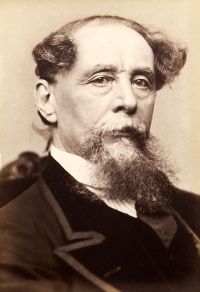 Charles Dickens,
The Pickwick Papers (Gutenberg edition…
Charles Dickens,
The Pickwick Papers (Gutenberg edition…
“ Pickwick.‘Ah, my dear Sir,’ said little Mr. Perker, bustling up from his chair. ‘Well, my dear sir, and what’s the news about your matter, eh? Anything more about our friends in Freeman’s Court? They’ve not been sleeping, I know that. Ah, they’re very smart fellows; very smart, indeed.’As the little man concluded, he took an emphatic pinch of snuff, as a tribute to the smartness of Messrs. Dodson and Fogg.‘They are great scoundrels,’ said Mr. Pickwick. ”
Gouverneur Morris, Aladdin O'Brien
“ Only Longstreet demurred and protested against the charge. When Pickett asked him for the order to advance he turned away his head sorrowfully and would not speak. Then Pickett, that great leader of men, who was one half daring and one half magnetism and all hero, said proudly: “I shall go forward, sir.” And turned to his lovers. ”
Charles Dickens,
The Pickwick Papers
(1836)
“ My dear Sir, consider.’ ‘I will consider,’ replied the old gentleman. ‘I have nothing to say just now. I am a man of business, Mr. Pickwick. I never commit myself hastily in any affair, and from what I see of this, I by no means like the appearance of it. A thousand pounds is not much, Mr. Pickwick.’ ‘You’re very right, Sir,’ interposed Ben Allen, just awake enough to know that he had spent his thousand pounds without the smallest difficulty. ‘You’re an intelligent man. ”
“ Gabriel left the chair in which he was sitting next his employer, and went down and seated himself on the porch steps. Abner Pickett took his pipe from his mouth, and, grasping it firmly in the fingers of his right hand, looked questioningly from one member of the group to another.“Well,” he said at last, “why don’t somebody speak? Are you all struck dumb? What is it about the railroad, Dannie?”“Why, Gran’pap, they—the surveyors you know—they—they—”“Well?”“Whacked their stakes in regardless—” broke in Gabriel, in his intense anxiety to help Dannie out. ”
Charles Dickens,
The Pickwick Papers
“ Weller, senior, turning suddenly to Mr. Pickwick, said— ‘Wery queer life is a pike-keeper’s, sir.’ ‘A what?’ said Mr. Pickwick. ‘A pike-keeper.’ ‘What do you mean by a pike-keeper?’ inquired Mr. Peter Magnus. ‘The old ‘un means a turnpike-keeper, gen’l’m’n,’ observed Mr. Samuel Weller, in explanation. ‘Oh,’ said Mr. Pickwick, ‘I see. Yes; very curious life. Very uncomfortable.’ ‘They’re all on ‘em men as has met vith some disappointment in life,’ said Mr. Weller, senior. ”
Charles Dickens,
The Posthumous Papers of the Pickwick Club…
“ Pickwick was no sluggard; and he sprang like an ardent warrior from his tent—bedstead.“Pleasant, pleasant country,” sighed the enthusiastic gentleman, as he opened his lattice window. “Who could live to gaze from day to day on bricks and slates, who had once felt the influence of a scene like this? Who could continue to exist, where there are no cows but the cows on the chimney-pots; nothing redolent of Pan but pan-tiles; no crop but stone-crop? Who could bear to drag out a life in such a spot? ”
Charles Dickens,
The Pickwick Papers
(1836)
“ An hostler stood near, holding by the bridle another immense horse—apparently a near relative of the animal in the chaise—ready saddled for Mr. Winkle. ‘Bless my soul!’ said Mr. Pickwick, as they stood upon the pavement while the coats were being put in. ‘Bless my soul! who’s to drive? I never thought of that.’ ‘Oh! you, of course,’ said Mr. Tupman. ‘Of course,’ said Mr. Snodgrass. ‘I!’ exclaimed Mr. Pickwick. ‘Not the slightest fear, Sir,’ interposed the hostler. ‘Warrant him quiet, Sir; a hinfant in arms might drive him.’ ‘He don’t shy, does he?’ inquired Mr. Pickwick. ”
Charles Dickens,
The Posthumous Papers of the Pickwick Club
(1837)
“ Pickwick had leisure to examine his costume and appearance. He was about the middle height, but the thinness of his body, and the length of his legs, gave him the appearance of being much taller. The green coat had been a smart dress garment in the days of swallow-tails, but had evidently in those times adorned a much shorter man than the stranger, for the soiled and faded sleeves scarcely reached to his wrists. ”
La Salle Corbell Pickett, What Happened to Me
“ I tried to defend myself and set forth the greater advantages of the infantry service."Pickett is lucky," he replied, "in having such a champion. I am in love with him myself and agree with you perfectly, for Pickett can do anything. When I see him dance I think he ought to be a dancing-master. When I see him ride I think he ought to be a cavalry leader. [Pg 123] When he whistles I think he ought to be a bird. When he sings it seems that he ought to be an opera star. When I see him lead a charge I feel that he ought to spend his life on the battlefield. ”
