Victorinus of Pettau

Definition and stakes

J. H. Kurtz Church History, Volume 1 (of 3…

Gentes. This treatise betrays everywhere defective understanding of the Christian truth; but he is more successful in combating the old religion than in defending the new. The bishop Victorinus of Pettau (Petavium in Styria) , who died a martyr during the Diocletian persecution in A.D. 303, wrote commentaries on the Old and New Testament books that are no longer extant. Only a fragment De fabrica mundi on Gen. i. and Scholia on the Apocalypse have been preserved.
Source: Gutenberg

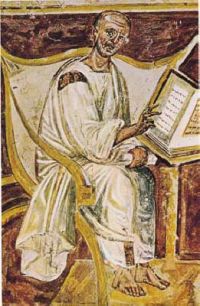
Portrait of Augustine of Hippo Augustine of Hippo The Confessions of Saint Augustine…

Finally, when the hour arrived for him to make a public profession of his faith--which at Rome those who are about to enter into thy grace make from a platform in the full sight of the faithful people, in a set form of words learned by heart--the presbyters offered Victorinus the chance to make his profession more privately, for this was the custom for some who were likely to be afraid through bashfulness. But Victorinus chose rather to profess his salvation in the presence of the holy congregation. For there was no salvation in the rhetoric which he taught: yet he had professed that openly.
Source: Wikisource

Dean Dudley History of the First Council of Nice (1880)

You, who are joined the whole in one, are the holy spirit,
The primal one, one from himself arisen, the one prior to one, God.
This Victorinus, according to St. Jerome, was the "vice-consul of the African nation," and taught rhetoric, principally at Rome under Constantine. In his extreme old age, he received the faith of Christ, which was not long prior to A.D. 362. He wrote books against the doctrines of the Manichæans, and commentaries on the apostolical Scriptures. He held a controversy with the Arian, Candidus, on the divine generation of the Word
Source: Wikisource

Get perspective with Kwize: daily news enlightened by great literature