Eutropius

Biographical details

Eutropius,  Abridgement of Roman History — Book VI (1886<!-- translation -->)

“ XXIV On his return to Rome the year after, Caesar made himself a fourth time consul, and immediately proceeded to Spain, where the sons of Pompey, Cnaeus, and Sextus, had again raised a formidable war. Many engagements took place, the last near the city of Munda, in which Caesar was so nearly defeated, that, upon his forces giving way, he felt inclined to kill himself, lest, after such great glory in war, he should fall, at the age of fifty-six, into the hands of young men. At length, having rallied his troops, he gained the victory; the elder son of Pompey was slain, the younger fled. ”
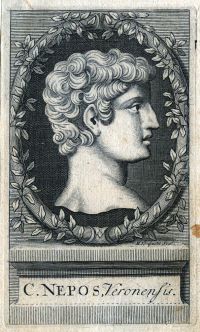
Source: Wikisource

Eutropius,  Abridgement of Roman History — Book VII (1886<!-- translation -->)

“ XIV To him succeeded NERO, who greatly resembled his uncle Caligula, and both disgraced and weakened the Roman empire; he indulged in such extraordinary luxury and extravagance, that, after the example of Caius Caligula, he even bathed in hot and cold perfumes, and fished with golden nets, which he drew up with cords of purple silk. He put to death a very great number of the senate. To all good men he was an enemy. ”
Source: Wikisource

Eutropius,  Abridgement of Roman History — Book IV (1886<!-- translation -->)

“ The terms granted to the Macedonians and Illyrians were these, "that they might remain free, on paying half the tribute which they had been accustomed to pay to their kings;" that it might be seen that the Roman people contended with a view to equity and not to covetousness: and these terms Paulus proclaimed in an assembly of a vast concourse of people, entertaining the ambassadors of several states, who had come to pay their respects to him, with a most sumptuous feast; saying that "it ought to be possible for the same individual to be victorious in war and elegant in his entertainments." ”
Source: Wikisource

Get perspective with Kwize: daily news enlightened by great literature