
“ Vizard stared at him. “You meet my virago? Why, I thought you disapproved her entirely.” “No, no; only the idea of a female doctor, not the lady herself. Besides, it is a rule with me, my dear fellow, never to let myself disapprove my friends' friends.” “That is a bright idea, and you are a good fellow,” said Vizard. “Go and meet the pest, by all means, and bring her here to luncheon. After luncheon we will drive her up to the farm and ensconce her.” Edward Severne had this advantage over most impostors, that he was masculine or feminine as occasion required. ”
Quotes about “Vizard”
“ After he had got the money, Severne's conversational powers relaxed—short answers—long reveries. Vizard observed, stopped short, and eyed him. “I remember something at Oxford, and I am afraid you are a gambler; if you are, you won't be good for much till you have lost that three hundred. It will be a dull evening for me without you: I know what I'll do—I'll take my hen-party to the opera at Homburg. There are stalls to be got here. ”
“ I have only to send them to London, and I can get the money back by Thursday: but you want me to start on Tuesday.” “That is enough,” said Vizard, wearily, “I will be your banker, and—” “You are a good fellow!” said Severne warmly. “No, no; I am a weak fellow, and an injudicious one. But it is the old story: when a friend asks you what he thinks a favor, the right thing is to grant it at once. He doesn't want your advice; he wants the one thing he asks for. ”
“ Beautiful women with money won't stand neglect, Mr. Severne; and why should they? They are not like poor me; they have got the game in their hands.” The train stopped. Vizard's party drove to the opera, and Severne ordered a cab to The Golden Star, meaning to stop it and get out; but, looking at his watch, he found it wanted half an hour to gambling time, so he settled to have a cup of coffee first, and a cigar. With this view he let the man drive him to The Golden Star. ”
“ But the convalescent period is always one of danger, especially from chills to the body, and excitements to the brain. At no period are more patients thrown away for want of vigilance. Now I can guard against chills and other bodily things, but not against excitements—unless you co-operate. The fact is, we must agree to avoid speaking about Mr. Severne. We must be on our guard. We must parry; we must evade; we must be deaf, stupid, slippery; but no Severne—for five or six days more, at all events.” Thus forewarned, Vizard, in due course, paid his second visit to Ina Klosking. ”
 Charles Dudley Warner,
The People for Whom Shakespeare Wrote
Charles Dudley Warner,
The People for Whom Shakespeare Wrote
“ Van Meteren, a Netherlander, 1575, speaks also of the astonishing change or changeableness in English fashions, but says the women are well dressed and modest, and they go about the streets without any covering of mantle, hood, or veil; only the married women wear a hat in the street and in the house; the unmarried go without a hat; but ladies of distinction have lately learned to cover their faces with silken masks or vizards, and to wear feathers. ”
André Ferdinand Herold, The Life of Buddha — 12. The Story of Visvantara (1927)
“ The king was obliged to give his consent. 'When my son hears of his exile,' thought Sanjaya, 'he will take it to heart.' But this was not the case. Visvantara simply said, 'I shall leave tomorrow, father, and I shall take none of my treasures with me.' Then he went to look for Madri, his princess. 'Madri,' said he, 'I must leave the city; my father has exiled me to a cruel desert, where it will be hard to find a livelihood. Do not come with me, O beloved; too great are the hardships you will have to endure. You will have to leave the children behind, and they will die of loneliness. ”
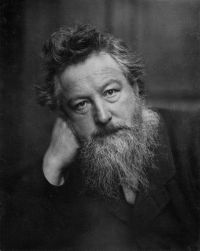 William Morris,
The Story of Sigurd the Volsung and the Fall of the Niblungs
William Morris,
The Story of Sigurd the Volsung and the Fall of the Niblungs
“ Each man to love and cherish his brother's hope and will; Each man to avenge his brother when the Norns his fate fulfill: And now are they foster-brethren, and in such wise have they sworn As the God-born Goths of aforetime, when the world was newly born. But among the folk of the Niblungs goes forth the tale of the same, And men deem the tidings a glory and the garland of their fame. So is Sigurd yet with the Niblungs, and he loveth Gudrun his wife, And wendeth afield with the brethren to the days of the dooming of life ”
Johanna Spyri, Vinzi: A Story of the Swiss Alps
“ Jos comforted Vinzi.Faz proceeded to the house, followed by the others. The mother was waiting at the table, patiently enduring the dreadful sounds Russli made with his pipe.“You pipe like a cat that is half strangled,” Faz cried upon entering.“You must not make fun of him right away,” said the mother. “He does not play so badly for a little boy. He was just telling me something nice about you, Faz. He said that you did [129] not beat him all day, and that he never cried at all.”“He only gets hit if he deserves it,” said Faz. “He behaved well today because Vinzi was amusing him. ”
André Ferdinand Herold, The Life of Buddha — 12. The Story of Visvantara (1927)
“ Please enter.' In the great hall, Visvantara and Madri sat on thrones of gold; at their feet, the children played on heavy rugs, and the old man presented them with many beautiful robes. Exquisite food was then served to them, and they appeased their hunger. But Visvantara was lost in thought. Suddenly, he rose from his seat, and he said to the old man, 'My lord, I am disobeying my father's commands. He banished me from Jayatura, where he is king, and he ordered me to spend the rest of my life in the desert. ”
Johanna Spyri, A little Swiss boy (1926)
“ Ask your Cousin Lorenz what he has to say about it and bring me the answer tomorrow morning. If he has no objection, we can play a little every morning."Shaking hands with each boy and saying a kind word to him, Father Silvanus opened the door. Once outside, the trio went merrily down the mountain, but Vinzi moved along as though in a dream and left the lively conversation to Jos and Vereli. He could hear nothing but the kind words of Father Silvanus: "Would it give you pleasure to learn to play my instrument?" Give pleasure? It would be happiness beyond his conception. ”
André Ferdinand Herold, The Life of Buddha — 12. The Story of Visvantara (1927)
“ And your lips will be parched; your feet will be hurt by the sharp stones; the sun will burn your cheeks. Oh, my children, we were always able to spare you the hardships we had to endure. We carried you across the fearful desert; you did not suffer then, but now, what will you suffer?' She was still weeping when another brahman came through the forest. He was an old man and walked with great difficulty. He stared at the princess with watery eyes, then he addressed Prince Visvantara. 'My lord, as you see, I am old and feeble. ”
William Morris,
The Story of Sigurd the Volsung
“ Who have come to the Glittering Heath, and wrought that deed to its end? For hither comes Regin the Master from the skirts of the field of death. Afoot he went o'er the desert, and he came unto Sigurd and stared At the golden gear of the man, and the Wrath yet bloody and bared, And the light locks raised by the wind, and the eyes beginning to smile, And the lovely lips of the Volsung, and the brow that knew no guile; And he murmured under his breath while his eyes grew white with wrath: "O who art thou, and wherefore, and why art thou in the path?" ”
André Ferdinand Herold, The Life of Buddha — 12. The Story of Visvantara (1927)
“ All hope has fled, and I shall return to my home as poor as when I left!' He wept. 'Do not weep,' said Visvantara; 'I am the man you seek. You have not met me in vain. Madri, Jalin, Krishnajina, get down from the chariot! It is no longer mine: I have given it to this old man.' The brahman was overjoyed. The four exiles continued on their way. They were now on foot, and when the children were tired, Visvantara would carry Jalin, and Madri Krishnajina. A few days later, they saw a third brahman approaching. He was going to Jayatura to see Prince Visvantara and ask him for alms. ”
André Ferdinand Herold, The Life of Buddha — 12. The Story of Visvantara (1927)
“ He was a little, frail old man, with white hair and yellow teeth. 'Traveller,' he said to the prince, 'is this the road to Jayatura?' 'Yes,' replied the prince, 'but why are you going to Jayatura?' 'The king of that city has a son, Prince Visvantara,' said the brahman. 'Visvantara, according to the stories I have heard, is extremely charitable; he saved the kingdom of Kalinga from famine, and whatever is asked of him is never refused. I shall go to Visvantara, and I know he will not deny my request.' 'If you go to Jayatura,' said the prince, 'you will not see Visvantara ”
Walter Francis, Vizagapatam (1907)
“ Jafar Ali, Faujdar of Chicacole, called in the Maráthas to aid him against the Rája of Vizianagram and the French, the then Páchipenta zamindar Vírappa Rázu (who, according to Orme, had been dispossessed by Vizianagram) showed the Maráthas the way across the hills and down the Páchipenta track and was afterwards in consequence imprisoned for life in the Vizianagram fort. At his death in 1789 a small maintenance was allowed his son Mallappa Rázu, and this man was restored to the estate after the death of the Rája of Vizianagram (p. 53) in 1794. ”
William Morris,
The Story of Sigurd the Volsung and the Fall of the Niblungs
“ Within the door and without it, the slayer slain by the slain; For the cast of the sword of Sigurd had smitten his body atwain While yet his cry of onset through the echoing chambers went. Woe's me! how the house of the Niblungs by another cry was rent, The wakening wail of Gudrun, as she shrank in the river of blood From the breast of the mighty Sigurd: he heard it and understood, And rose up on the sword of Guttorm, and turned from the country of death, And spake words of loving-kindness as he strove for life and breath: "Wail not, O child of the Niblungs! ”
André Ferdinand Herold, The Life of Buddha — 12. The Story of Visvantara (1927)
“ Now, this woman is young; she seems quite strong. Let me take her for a servant. She will help me to get up; she will put me to bed; she will watch over me while I sleep. Give me this woman, my lord; you will be doing a good deed, a saintly deed, that will be praised throughout the world.' Visvantara had listened attentively; he was pensive. He looked at Madri. 'Beloved, you heard what the brahman said; what would you answer?' She replied, 'Since you have given away our children: Jalin, the best-beloved, and darling Krishnajina, you can give me to this brahman ”
André Ferdinand Herold, The Life of Buddha — 12. The Story of Visvantara (1927)
“ At that time King Sanjaya was reigning in the city of Jayatura. His wife's name was Phusati, and they had a son, Visvantara. When he came of age, Visvantara married Madri, a princess of rare beauty. She bore him two children: a son, Jalin, and a daughter, Krishnajina. Visvantara owned a white elephant that had the marvellous power to make the rain fall at will. Now, the distant kingdom of Kalinga was visited by a terrible drought. The grass withered; the trees bore no fruit; men and beasts died of hunger and of thirst. ”
William Morris,
The Story of Sigurd the Volsung and the Fall of the Niblungs
“ There is many a fond desire, and each day born anew; And the land of the Volsungs to conquer, and many a people's praise: And for me there is rest it maybe, and the peaceful end of days. We have come to the garth and the gate; to the hall-door now shall we win, Shall we go to look on the high-seat and see what sitteth therein?" "Yea, and what else?" said Sigurd, "was thy tale but mockeries, And have I been drifted hither on a wind of empty lies?" "It was sooth, it was sooth," said Regin, "and more might I have told Had I heart and space to remember the deeds of the days of old." ”
William Morris,
The Story of Sigurd the Volsung
“ With the words she spake on Hindfell, when they plighted troth of love. Lo, Sigurd fair on the high-seat by the white-armed Gudrun's side, In the midst of the Cloudy People, in the dwelling of their pride! His face is exceeding glorious and awful to behold; For of all his sorrow he knoweth and his hope smit dead and cold: The will of the Norns is accomplished, and, lo, they wend on their ways, And leave the mighty Sigurd to deal with the latter days: The Gods look down from heaven, and the lonely King they see, And sorrow over his sorrow, and rejoice in his majesty. ”
Frank Owen, Weird Tales (1924)
“ Visrain confessed to me that he loved her. "She is the most adorably perfect girl I have ever known," he told me. "And I am the most miserable of men. No doubt as long as my personality is in your body, I could go in and win her. But I hate deception and I wouldn't want to do anything that was unfair to you, for already, I think, I have caused you trouble enough." But despite his words to the contrary, Visrain did make love to Vera Gray and she seemed to be far more attracted to him then she had ever been to me. ”
William Morris,
The Story of Sigurd the Volsung and the Fall of the Niblungs
“ And its children built and departed, and its King-folk conquered and went, As over the crystal image his all-wise face was bent: For all his desire was dead, and he lived as a God shall live, Whom the prayers of the world hath forgotten, and to whom no hand may give. But there stood the mighty Volsung, and leaned on the hidden Wrath; As the earliest sun's uprising o'er the sea-plain draws a path Whereby men sail to the Eastward and the dawn of another day, So the image of King Sigurd on the gleaming pavement lay. ”
The Book of the Thousand Nights and One Night…
“ The Vizier bade him welcome to Bassora and dismounting, embraced him and made him sit down by his side and said to him, "O my son, whence comest thou and what dost thou seek?" "O my lord." answered Noureddin, "I come from the city of Cairo;" and told him his story from beginning to end, saying, "I am resolved not to return home, till I have seen all the towns and countries of the world." When the Vizier heard this, he said to him, "O my son, follow not the promptings of thy soul, lest they bring thee into peril; for indeed the lands are waste and I fear the issues of Fortune for thee." ”
William Morris,
The Story of Sigurd the Volsung and the Fall of the Niblungs
“ And Sigurd donned his war-gear nor his eyes would Regin meet. A clear streak widened in heaven low down above the earth; And above it lay the cloud-flecks, and the sun, anigh its birth, Unseen, their hosts was staining with the very hue of blood, And ruddy by Greyfell's shoulder the Son of Sigmund stood. Then spake the Master of Masters: "What is thine hope this morn That thou dightest thee, O Sigurd, to ride this world forlorn?" "What needeth hope," said Sigurd, "when the heart of the Volsungs turns To the light of the Glittering Heath, and the house where the Waster burns? ”
William Morris,
The Story of Sigurd the Volsung
“ His heart was merry with victory and ever he thought of Hindfell and of Lymdale and the love of Brynhild. The people waxed joyful, and the hangings whereon glowed figures of the gods were stirred with their song and shouting till Giuki called on Sigurd to take the harp and sing of deeds agone. Then all men hearkened, hushed and happy, while Sigurd struck the strings and sang of his mighty kin, of Volsung, of Signy, and of Sigmund, their deeds and noble deaths. ”
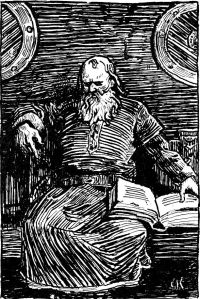 Snorri Sturluson,
Heimskringla — Ynglinga Saga
Snorri Sturluson,
Heimskringla — Ynglinga Saga
“ He married the daughter of Aude the Rich, and gave her as her bride-gift three large farms, and a gold ornament. They had two sons, Gisle and Ond; but Visbur left her and took another wife, whereupon she went home to her father with her two sons. Visbur had a son who was called Domald, and his stepmother used witchcraft to give him ill-luck. ”
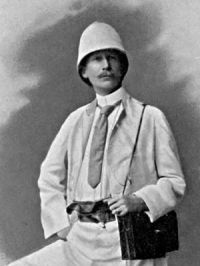 George Chetwynd Griffith,
Olga Romanoff
George Chetwynd Griffith,
Olga Romanoff
“ Alan’s hand instinctively sprang to the hilt of his rapier, and in another moment the Vizier’s life would have paid for the insult, but when the blade was half out of its sheath his self-control returned, and he thrust it back again, saying—“You are an old man and an ambassador, so you are safe. You shall live so that you may some day find out for yourself where the truth in this matter lies. Who knows but that the Syren may before long put you or your master under her spell. If she does you will drink something from her hand, and when you have drunk it you will have no will but hers ”
