“ Ina also founded Wells, but as a collegiate church of secular canons, not as the cathedral of a diocese. It was not until 909 that Somerset had a bishop all to itself, who was styled the Bishop of the Somersaetas, with his seat at Wells (the first appointed being Aethelm.) In 1088, in accordance with the policy of removing bishoprics from localities of little importance, the see was transferred from Wells to Bath, the bishop (John de Villula) at the same time becoming the abbot of the monastery. In 1192 Bishop Savaric procured for the see the rich abbey of Glastonbury, and became its abbot ”
Quotes about “Wells, Somerset”
“ Wells Cathedral contains some splendid Transitional work, of which there are also specimens at Clutton. Complete churches of the Early English and Decorated periods are few, but many buildings preserve specimens of these styles in combination with work of a later date. The W. front of Wells is a beautiful example of E.E., and windows of this period occur at E. Stoke, Bathampton, Chedzoy, Martock, Keynsham, Somerton. There are E.E. arcades at St Cuthbert's, Wells, and further illustrations of E.E. work are furnished by Compton Bishop, Creech St Michael, Stoke St Gregory, etc. ”
William Hunt, Dictionary of National Biography… (1888)
“ Again, the story of Ini in connection with a foundation at Wells is associated with the false notions that that king was the founder of the Somerset bishopric, and that the see was originally placed at Congresbury, and with the extremely probable notion that Ini really did set up a collegiate church of some kind at Wells, the existence of which accounts for that place being chosen for the see when the bishopric was founded by Edward the Elder. ”
 Leslie Stephen,
Dictionary of National Biography…
(1895)
“ By his wife Grace, daughter and heiress of Hugh Halswell of Wells, Somerset (who died in 1675, and was buried at Newton St. Cyres on 19 July) , he had issue five sons and three daughters, the eldest son being born in 1627. ”
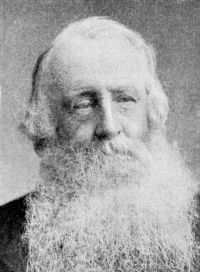 Edward A. Freeman,
History of the Cathedral Church of Wells
“ The inhabitants were doubtless still mainly of the old British stock, no longer dealt with as wild beasts or as irreclaimable [Pg 18] enemies, but allowed to sit down as subjects, though as subjects of an inferior class, under the rule of the West-Saxon King. [49] But English influence was fast spreading; between the days of Ine and the days of Eadward the tongue and laws and manners of the conquerors had spread themselves, and, by the time of the second foundation of Wells, Somersetshire must have been mainly an English land. ”
1911 Encyclopædia Britannica, Volume 28… (1911)
“ After many struggles between the secular clergy of Wells and the regulars of Bath, it was finally arranged in 1139 that the bishop should take the title of "bishop of Bath and Wills," and should for the future be elected by delegates appointed partly by the monks of Bath and partly by the canons of Wells. The foundation attached to the cathedral church of Wells consisted of a college of secular canons of St Augustine, governed by a dean, sub-dean, chancellor and other officials. The diocese covers the greater part of Somerset. The importance of the city is almost wholly ecclesiastical ”
“ S. from Wells. It has a station on the S. & D. line from Evercreech to Bridgwater. The site of Glastonbury is almost as conspicuous in a Somerset landscape as its name is in Somerset history. Its huge conical tor, crowned by a tower, rises like a gigantic sugar-loaf from the surrounding plain, and is visible to half the county. The neighbourhood is a happy hunting-ground for the antiquary, and one of the "regulation" sights for the casual tourist. No one can be said to have "done" Somerset who has not seen Glastonbury. ”
“ Wells has one other church which merits more than a passing attention. St Cuthbert's is a Perp. building of generous dimensions. It possesses an exceedingly fine tower of the best Somerset type—massive and graceful—belonging to the same class as the towers of Wrington and Evercreech, but spoilt by a want of proportion between the upper and lower stages. The interior of the church is spacious and imposing, and contains a good panelled roof. The E.E. capitals of the piers and some old roof marks suggest that it was originally an E.E. cruciform fabric, altered by Perp. ”
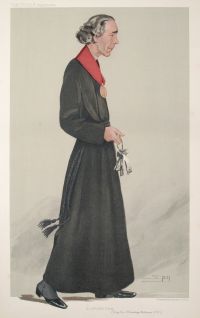 Joseph Armitage Robinson,
Somerset Historical Essays
(1921)
“ On 27 February 1167 the bishopric of Hereford fell vacant, and John Cumin was placed by the king in charge of the temporalities, for which he accounts until 1173. In the Pipe Rolls of 1169-70 and the two following years he holds pleas as an itinerant justice, together with Reginald de Warren, in the counties of Hants, Wilts, Somerset and Devon. The first entry under Somerset is a fine imposed on the dean of Wells, for a servant of the king whom he had imprisoned. ”
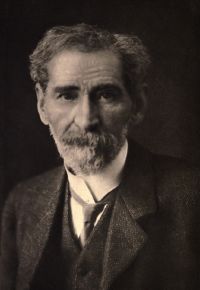
“ The inland-cliff breeding daws that inhabit the valley of the Somerset Axe alone probably greatly outnumber all the daws in Middlesex, or Surrey, or Essex.Finally, besides the cliffs and woods, there are the old towns and villages—small towns and villages with churches that are almost like cathedrals. No county in England is richer in noble churches, and no kind of building seems more attractive to the "ecclesiastical daw" than the great Perpendicular tower of the Glastonbury type, which is so common here.Of the old towns which the bird loves and inhabits in numbers, Wells comes first. ”
Joseph Armitage Robinson,
Somerset Historical Essays
(1921)
“ Robert however is frequently styled archdeacon of Wells, and Thomas occurs by himself as archdeacon of Bath in 1165. We have reached the period in which the king makes promising young men archdeacons in consideration of services rendered or to be rendered in the administration of royal affairs. Somerset will be found to provide conspicuous instances of this practice in the years which follow. Some of the archdeacons will be absentees, who are hardly ever in their archdeaconries and must have done their work by deputy. ”
“ Wrington, a large and compact village 10 m. S.W. of Bristol. A light railway connects it with Yatton. In size and arrangement it is practically a little town, and is surrounded by some very pretty country. The glory of Wrington is its church, which possesses one of the finest towers in Somerset. It is a stately and harmonious composition, with long and graceful belfry windows, and bears a strong family likeness to the towers of Evercreech and St Cuthbert's, Wells. The church as a whole is worthy of its tower, though the chancel is, as usual, low and undignified. ”
Joseph Armitage Robinson,
Somerset Historical Essays
(1921)
“ Simon was abroad with K. Richard when he died, April 1199; and he continued to serve in the chancery of K. John. He followed the king everywhere in Normandy, and he was frequently with him as he restlessly moved from place to place in England. Only two Wells documents bear a trace of him. In one he attests a charter of Archbishop Hubert to the abbey of Bee, whose abbot held a stall in the cathedral church of Wells: [7] the other belongs to the city of Wells, being a confirmation of its privileges given by K. John, Sept. 1201, 'by the hand', most appropriately, 'of Simon archdeacon of Wells ' ”
“ Its career has been a series of vicissitudes. Though Bath takes precedence of Wells in the official title of the see, it has seldom been the predominant partner. John de Villula, with the intention of making the city the bishop's seat, built here a church so spacious that the nave alone would swallow up the existing building. Of this Norm. church there still survive (1) bases of clustered pillars under a grating in N. aisle of choir, (2) a single pillar in same aisle, (3) round arch and pillar in vestry, S. of choir, (4) bases of pillars at exterior of E. end. ”
 William Dean Howells,
Certain delightful English towns…
“ AFTERNOONS IN WELLS AND BRISTOL EVEN the local guide-book, which is necessarily optimistic, owns that the railroad service between Bath and Wells leaves something to be desired. The distance is twenty miles, and you can make it by the Great Western in something over two hours, but if you are pressed for time, the Somerset and Dorset line will carry you in two. As we were nationally in a hurry, though personally we had time to spare, we went and came by this line, mostly in a sort of vague rain, which favored the blossoming of the primroses along the railroad bank. ”
“ The road to Wells runs through a beautiful valley, which, by some sinister inspiration, has been chosen as the site of the town sewage works. Shepton Mallet Cross Shepton Montague, a village 2 m. S. from Bruton. The church stands by the side of the railway some distance away from the houses. It is a Perp. building, with a tower on the S. side (cp. Stanton Drew) . The interior contains piscinas in chancel and on S. wall, and a circular Norm. font. In the churchyard is the base of a cross. Shipham, a village on the Mendips 2 m. E. from Winscombe (G.W.R.) . The church is modern. ”
“ The railway termini on the north side of London have been kept as remote as Eastry had kept the railway-station from Wimblehurst, they stop on the very outskirts of the estates, but from the south, the South Eastern railway had butted its great stupid rusty iron head of Charing Cross station, that great head that came smashing down in 1905—clean across the river, between Somerset House and Whitehall. The south side had no protecting estate. ”
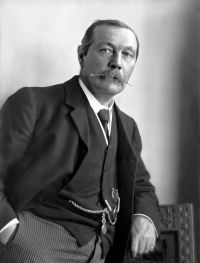 Arthur Conan Doyle,
Micah Clarke
“ With him I rode for some time, and learned that the whole of North Somerset, as well as south, was now in open revolt, and that Wells, Shepton Mallet, and Glastonbury were held by armed volunteers for King Monmouth. The royal forces had all retired west, or east, until help should come. As I rode through the villages I marked the blue flag upon the church towers, and the rustics drilling upon the green, without any sign of trooper or dragoon to uphold the authority of the Stuarts. ”
“ Castle Cary and Harptree were taken by Stephen, but he seems to have regarded Dunster (defended by William of Mohun) as impregnable. In Tudor times Somerset witnessed the attempt made on the throne by Perkin Warbeck in 1497, who was supported by Lord Audley of Nether Stowey and other Somerset gentlemen. The pretender advanced from Devonshire to seize Taunton; but when Henry VII. entered Somerset, passing in his progress through Bath, Wells (where he stayed with the Dean) , and Glastonbury, to Taunton, Warbeck lost heart and fled. When captured and brought into Henry's presence he was spared ”
“ The old Roman lead mines are 21⁄2 m. away on the road to Charterhouse. (4) The "Lamb's Lair" cavern (now unexplorable) lies 2 m. to the N. near the Bristol road. (5) Nine Barrows, to find which take the Wells road; 1⁄2 m. to the S. is another solitary inn, and opposite are the barrows. Catcott, a village on the Poldens, 3 m. S. of Edington Station. The church is quaint; note, in particular, the old oak seats, and the odd means by which they can be lengthened. There is an old octagonal font. ”
Thomas Frederick Tout , Dictionary of National Biography… (1885)
“ Early in the reign of Edward VI Barlow commended himself to the Duke of Somerset by preaching against images. Accordingly, in 1548, he was translated to the bishopric of Bath and Wells. On 20 May of the same year he sold to the duke seven manors, together with the palace at Wells, and certain other estates and profits of jurisdiction belonging to the see, for, it is said, 2,000l. ”
Christina Blackie, Geographical etymology: a dictionary of place-names giving their derivations (1887)
“ Quillebœuf (well town) , in Normandy; Roeskilde (the fountain of King Roe) , in Denmark; Salzwedel (salt well) ; Hohenwedel (high well) ; Tideswell, in Derbyshire—probably from a personal name, as there is a Tideslow in the neighbourhood; Wells, in Norfolk (a place into which the tide flows) ; Wells, in Somerset, named from a holy fountain dedicated to St. Andrew; Motherwell, in Lanarkshire, named from a well dedicated to the Virgin Mary; Amwell, in Hants, corrupt. from Emma’s [162] well; Holywell, in Wales, named from St. Winifred’s well—in Welsh it is called Treffynnon (the town of the well) ”
Frederic Boase, Modern English biography, volume 2… (1892)
“ B.A. 1804, M.A. 1806, B.D. and D.D. 1819, master of the schools 1809, public examiner 1811–12, vice [81] chancellor 1824–28; V. of Evercreech, Somerset 1822–40; preb. of Wells cath. 1824–45; R. of Dinder, Somerset 1824–46; dean of Wells 4 June 1845 to death; one of the 6 doctors who condemned Pusey’s sermon in 1843; founder of the modern greatness of Balliol college. d. Balliol college, Oxford 6 March 1854. bur. Wells 13 March; by his will founded 2 exhibitions of £100 at Balliol. G.M. xli 425–6 (1854) ; G. V. Cox’s Recollections of Oxford 2 ed. (1870) 209–11; The Month, Jany. 1866 pp. 50–9. ”
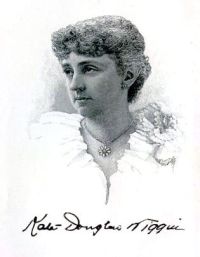 Kate Douglas Smith Wiggin,
Ladies-In-Waiting
“ There was never such a summer of enchanting weather as that particular summer in Wells. The whole population of Somersetshire, save those who had crops requiring rain, were in a heaven of delight from morning till night. Miss Tommy Tucker was very busy with some girl pupils, and as accompanist for oratorio practice; but there were blissful hours when she “studied” the cathedral with Fergus Appleton, watching him sketch the stately Central Tower, or the Lady Chapel, or the Chain Gate. ”
William Dean Howells,
Certain delightful English towns…
“ I think every one ought to earn a living, and when past it ought to be pensioned by the state, and let live in comfort after his own fancy; but failing this ideal, I wish the rich with us would multiply foundations after the good old English fashion, in which the pensioners, though they dwelt much in common, could keep a semblance of family life and personal independence.Of course Wells, as its name says, was once a watering-place, though never of so much resort as Bath; but now its healing springs bubble or ooze forth in forgottenness, with not a leper or even a rheumatic to avail of them. ”
Edric Holmes, Wanderings in Wessex
“ The great highway from Honiton to Yeovil becomes, as it passes through the last town in South Somerset, a spacious and dignified High Street with two or three beautiful old houses, among a large number of other picturesque dwellings which would sustain the reputation of Chard even without their aid. First is the one-time Court House of the Manor, opposite the Town Hall. Part of the building is called Waterloo House. It was built during the last quarter of the sixteenth century. A very beautiful and spacious room with two mullioned windows and a fine moulded ceiling graces the interior. ”
 H. G. Wells,
Ann Veronica
(1909)
“ The world, she discovered, with these matters barred had no particular place for her at all, nothing for her to do, except a functionless existence varied by calls, tennis, selected novels, walks, and dusting in her father's house. She thought study would be better. She was a clever girl, the best of her year in the High School, and she made a valiant fight for Somerville or Newnham but her father had met and argued with a Somerville girl at a friend's dinner-table and he thought that sort of thing unsexed a woman. ”
“ He seemed a stranger to all present, and his eye roved about for the charming hostess Steele had told him of."We'll reach Miss Van Allen presently." Steele laughed, in answer to the glance, "if, indeed, we dare interrupt her game. Let's make progress slowly.""No hurry," returned Somers, affably, beaming on Cassie Weldon and meeting Ariadne Gale's receptive smile. "I'm anchored here for the moment. Miss Weldon? Ah, yes, I've heard you sing. Voice like a lark—like a lark." ”
Edward A. Freeman,
History of the Cathedral Church of Wells
“ Here in the West we must call the ordinary English style of Ely and Salisbury foreign, and the French-looking style of Wells and Llandaff we must call native or local. Our local Somersetshire and South-Welsh style has a good deal of the earlier Romanesque leaven hanging about it; its mouldings and the clustering of its pillars are much less free; the abaci or [Pg 76] tops of the capitals are square or octagonal instead of round; it makes no use of those detached shafts, often of marble, which are so abundantly found in the west front. ”
