Cricket batting

Definition and stakes

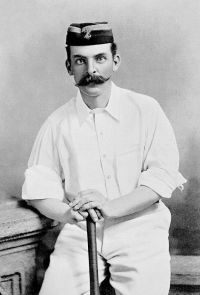
Portrait of Allan Gibson Steel Allan Gibson Steel,  Cricket (1888)

“ Batting may be called the most enjoyable feature of the great and glorious game of cricket. A man even in full training invariably feels the effect of fatigue after bowling sixty or seventy overs, and fieldsmen go through the same experience during a long outing. But it may with truth be said that the keen pleasure which is realised by every cricketer worthy of the name, while he is actually at the wickets, prevents him from feeling fatigue as an inconvenience until the innings is over. ”
Source: Wikisource

1911 Encyclopædia Britannica, Volume 7… (1911)

“ Batting and bowling have in fact developed together, a new form of attack requiring a new form of defence. One of the first principles a young batsman has to learn is to play with a “a straight bat” when defending his wicket against straight balls. This means that the whole blade of the bat should be equally opposite to the line on which the ball is travelling towards him, in order that the ball, to whatever height it may bound from the ground, may meet the bat unless it rises altogether over the batsman’s hands ”
Source: Wikisource

Portrait of Allan Gibson Steel Allan Gibson Steel,  Cricket (1888)

“ We yield to nobody in our enthusiasm for the game of cricket, but we are certainly in favour of judicious reform in the laws which govern the game; and we can scarcely help supposing that the opponents of all change are either oblivious of the enormous alteration that has taken place in cricket in consequence of the improvement of grounds, or else their attention is principally devoted to batting, and this causes them to think a little too much of the joys of hitting. No doubt they revel in the hot days, perfect wickets, and loose bowling that bring about the supremacy of batting. ”
Source: Wikisource

Get perspective with Kwize: daily news enlightened by great literature