Military capacity

Definition and stakes

Richard Joseph Beamish,  History of the World War

“ The source of supply of all replacements for the various elements of the army, without regard to their origin, was drafted men; and the titles had no significance whatever and were a source of possible disturbance from the standpoint of military efficiency. There was, in fact, no actual difference between these divisions with respect to efficiency—all have done high-grade work from whatever source drawn. All have shown courage and capacity for quick absorption of the fundamentals of modern military training and irresistible dash and force in actual fighting. ”
Source: Gutenberg

baron de Antoine Henri Jomini,  The Art of War

“ Irregular troops supported by disciplined troops may be of the greatest value, in destroying convoys, intercepting communication, &c., and may—as in the case of the French in 1812—make a retreat very disastrous.
ARTICLE XIII. Military Institutions.
One of the most important points of the military policy of a state is the nature of its military institutions. A good army commanded by a general of ordinary capacity may accomplish great feats; a bad army with a good general may do equally well
”
Source: Gutenberg

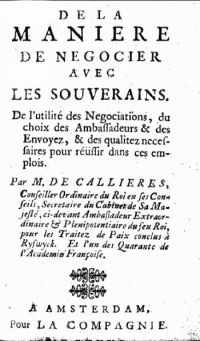
Portrait of François de Callières François de Callières,  The Practice of Diplomacy (1919)

“ He must also inform himself exactly of the state of the military forces both on land and sea, of the number and strength of fortified places, whether they are always kept in a high state of efficiency and well supplied with ammunition, of the condition of the sea-ports, of his vessels of war, and of his arsenals, of the number of troops which he can put into the field at once, both of cavalry and of infantry, without stripping his fortresses bare of their garrisons. ”
Source: Wikisource

Get perspective with Kwize: daily news enlightened by great literature