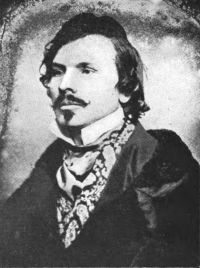
“ The ranchero leads a free, easy life, burthened with few cares. He is the finest rider in the world, following his cattle on horseback, and never makes even the shortest journey on foot. He plays upon the bandolin, sings an Andalusian ditty, and is fond of chingarito (mezcal whisky) and the “fandango.”Such is the ranchero of the tierra caliente around Vera Cruz, and such is he in all other parts of Mexico, from its northern limits to the Isthmus.But in the tierra caliente you may also see the rich planter of cotton, or sugar-cane, or cocoa (cacao) , or the vanilla bean. ”
Ranchero
Definition and stakes
The theme of “ranchero” has been addressed by authors such as Mayne Reid, Gabriel Ferry, E. Gould Buffum, Andy Adams and Brantz Mayer. It is often associated with terms like cattle, rancho, ranch, horse and Mexico.
Quotes about “ranchero”
“ Such are the movables of a “rancho” in the tierra caliente.You may see the ranchero by the door, or attending to his small, wiry, and spirited horse, outside. The man himself is either of Spanish blood or a “mestizo” (half-breed) . He is rarely a pure Indian, who is most commonly a peon or labourer, and who can hardly be termed a “ranchero” in its proper sense.The ranchero is picturesque—his costume exceedingly so. His complexion is swarthy, his hair is black, and his teeth are ivory white. He is often moustached, but rarely takes the trouble to trim or keep these ornaments in order. ”
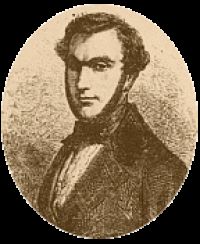 Gabriel Ferry,
Vagabond life in Mexico
(1856)
Gabriel Ferry,
Vagabond life in Mexico
(1856)
“ The loading was at length completed, the last mule left the court, and the detachment formed up to accompany the convoy. The crowd gradually melted away, and at last only the ranchero remained, who appeared to be counting the mules with care, besides eyeing attentively every individual mozo. At last the ranchero began to put his horse in motion. ”
E. Gould Buffum, Six months in the gold mines (1850)
“ The residents of Santa Barbara are principally rancheros, who visit their ranchos once or twice a year, to attend to the marking and killing of their cattle, and spend the remainder of the year in their town residence, enjoying life to their utmost capacity. Each ranchero usually keeps around the town a sufficient number of cattle for food, and whenever any beef is wanted, a bullock is slaughtered in a manner that would cause the eyes of the English societies for the suppression of cruelties to animals to stare aghast. ”
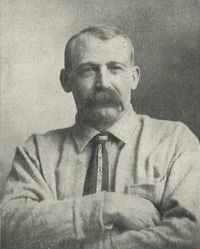 Andy Adams,
A Texas Matchmaker
Andy Adams,
A Texas Matchmaker
“ Nearly every windmill on the ranch on our circuit was pointed out, and we passed three of our four tanks, one of which was over half a mile in length. After stopping at an outlying ranchita for refreshment, we spent the afternoon in a similar manner. From a swell of the prairie some ten miles to the westward of the ranch, we could distinctly see an outline of the Ganso. Halting the ambulance, the old ranchero pointed out to his guest the meanderings of that creek from its confluence with the parent stream until it became lost in the hills to the southward. ”
Brantz Mayer, History of the War Between Mexico and the United States…
“ Join to this garb a long sabre, a horse as savage and untamed as himself, and a belt plentifully studded with pistols and machetes, and the ranchero presents himself ready either to join a troop of banditti, or to serve in a body of cavalry.Cowardly as they generally are in the open field when encountering regular troops, yet, in ambuscade, a sudden fight, or, as guerillas, they are both a formidable and cruel foe. Their power of endurance is inexhaustible. ”
Benjamin Moore Norman, Rambles by Land and Water; or, Notes of Travel in Cuba and Mexico
“ Winding between verdant banks, through the broken channel, into the beautiful Panuco, we reached the mole before night-fall, well satisfied with the adventures of the day.Before leaving the town, I wish to introduce to the reader two classes of men, who are somewhat peculiar in their appearance, characters and habits, as well as somewhat important in their relations to the business of the country.The Rancheros are a mixed race of Mexican and Indian blood. They live on the Ranches, or large cattle farms, and act as drovers. ”
“ Alighting at a large rancho, we unceremoniously aroused some sleeping figures—had a mess of scrambled eggs—thence to horse again. We soon gained the highland, by bridle-paths skirting along crests of hills and ravines, until daylight found us ambling from one to the other, in an everlasting up-and-down route, both tiresome and monotonous. Eight leagues of this work brought us to the more elevated region of the plateau—a more open country, with now and then a rancho—cultivated fields—broader roads, and all the signs of approaching a large town ”
 Theodore Roosevelt,
Through the Brazilian Wilderness
(1914)
Theodore Roosevelt,
Through the Brazilian Wilderness
(1914)
“ After five or six hours’ travelling through this country of marsh and of palm forest we reached the ranch for which we were heading. In the neighborhood stood giant fig-trees, singly or in groups, with dense, darkgreen foliage. Ponds, overgrown with water-plants, lay about; wet meadow, and drier pastureland, open or dotted with palms and varied with tree jungle, stretched for many miles on every hand. There are some thirty thousand head of cattle on the ranch, besides herds of horses and droves of swine, and a few flocks of sheep and goats. ”
E. Palmer Conner, The Romance of the Ranchos
“ For the inhabitants of the pueblo, later the City of Los Angeles, the Rancho La Brea has always been one of the most useful of the ranchos. The rancho derived its name from the La Brea Pits where the brea, or crude oil, oozed to the surface to catch prehistoric animals and preserve them for many thousands of years and to catch a few stray cattle in the Spanish days, and also to furnish excellent roofing for the adobes in the Pueblo of Los Angeles. ”
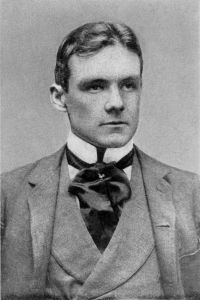 Richard Harding Davis,
The West from a car window
(1892)
Richard Harding Davis,
The West from a car window
(1892)
“ In the summer this ranch is covered with green, and little yellow and pink flowers carpet the range for miles. It is at its best then, and is as varied and beautiful in its changes as the ocean.The ranches that stretch along and away from the Rio Grande River are very different from this; they are owned by Mexicans, and every one on the ranch is a Mexican; the country is desolate here, and dead and dying cattle are everywhere.No ranch-owner, whether he has fifty thousand or five hundred head of cattle, will ever attempt to help one that may be ailing or dying. ”
E. Palmer Conner, The Romance of the Ranchos
“ The lives of two persons seldom parallel themselves more strangely than did the lives of two great California ranchos, the Rancho Los Cerritos and the Rancho Los Alamitos. Both were part of the Manuel Nieto grant made in 1784 by the King of Spain, each was partitioned to a Nieto heir, each became the property of a New Englander and each owner naturalized as a citizen of Mexico. They rivaled each other for the honor of the finest sheep, the fattest cattle, the fastest horses. ”
 Gilbert Haven,
Our Neighbor-Mexico
(1875)
Gilbert Haven,
Our Neighbor-Mexico
(1875)
“ As a log-cabin is a Fifth Avenue house in its germ, so a true rancho is a Spanish castle or Mexican casa grande in its beginning. First logs, then wood, then marble; first mud, then mortar, then marble. This rancho is exactly after the type of Barron's and Escandron's great houses in Mexico; a common gate-way for horses, carriages, men, and dogs; in this case, pigs are added, a luxury not allowed in the city. A door opens to rooms on either side of the gate-way, porter's there, owner's here; then comes a large square court, with rooms opening into it. ”
Various, The Atlantic Monthly, Volume 06…
“ A high mountain, dark with forests, rose on our right; on the left was a long range of grassy hills; but in front all was clear! A government rancho, built under the shade of a couple of tall fruit-trees, stood in the middle of the savanna, and on its farther edge were the cane buildings of a cattle-hacienda, just visible through the wealth of plantain-trees by which they were surrounded, while the cattle themselves were dotted over the intervening space, cropping the young grass, which here looked brighter and fresher than in the valley below. ”
Clarence E. Mulford, The Bar-20 Three (1921)
“ While the outfit concentrated on the western part of the ranch, events of another concentration were working smoothly and swiftly east of the ranchhouse, where mounted men, now free from interference, thanks to their Mexican friends, rode unerringly in the darkness, and drifted cattle into a herd with a certainty and dispatch born of long experience. Steadily the restless nucleus grew in size and numbers, the few riders who held it together chanting in low tones to keep the nervous cattle within bounds. ”
Francis Francis, Saddle and Mocassin
“ Well, there's Animas Valley, the 'rustlers' home,' where Curly Bill and all those boys used to lie up, when they had been sousing it to the 'enlightened citizen' a little too freely. There's the boss ranch in New Mexico! There's where the cattle graze, and graze, and graze upon a thousand hills, and go around laughing to think how much better off they are than other cattle, and saying to one another: 'Cows!' or 'bull, old pard!' or 'steers,' as the case may be, 'ain't we struck it big, eh? ”
“ This ranch was under the management of Isaac Williams, a son-in-law of old Don Antonio Maria Lugo, the man who at one time held leagues and leagues of land all the way from San Pedro to San Bernardino. For many years it was a most hospitable way-station for all travelers from over the plains to Los Angeles. At the time when my father came through the Chino supported ten thousand head of cattle, half as many horses and thirty-five thousand New Mexican sheep. ”
Frank V. Webster, The Boy from the Ranch; Or, Roy Bradner's City Experiences
“ Roy, whose father owned the Triple O ranch, had come out on this round-up about a week previously. On all big ranches it is the custom, at stated intervals to send out a party of men to round-up, or gather together, in herds, the cattle or horses that may have strayed to distant pastures. Sometimes a week or more is spent on this work, the men sleeping out of doors, and making camp wherever darkness overtakes them. During the night they take turns riding around the cattle, to keep them from straying away. ”
F. S. Brereton, Roughriders of the Pampas: A Tale of Ranch Life in South America
“ You say that you will be useless till you know the work required on a rancho. That is not so. Any young fellow who is willing, and does not fight shy when work is in prospect, can make himself of use. A day or two will teach him sufficient, and after that he is becoming more efficient every hour. But I want to tell you something more. This post that you have accepted is no sinecure. You will be about at the first streak of day and galloping over the rancho. Often enough you will be sent off on expeditions to round up cattle and horses, and on those occasions you will not even have a tent. ”
“ The only habitation near it was a shepherd's lonely rancho, standing on an open plain of yellow grass, over which a scattered flock of sheep and a few horses were grazing. I determined to remain in the wood till near noon, then proceed to the rancho to get breakfast, and commence my search for a horse and side-saddle in the neighbourhood. After unsaddling my horse and tying him to a tree, where there were some pickings of grass and herbage about the roots, I lit a cigar and made myself comfortable on my rugs in the shade. ”
Willard F. Baker, The Boy Ranchers on Roaring River…
“ It might be well for us to stay here in the house for the night. We can settle on a bunk house later. The rest of you can make yourselves generally useful. I'll go 'tend to the eats. Mex, we need food! Where's the kitchen?" Apparently understanding, the Mexican led the way toward the rear, followed by the Kid. The lay-out of the place was a great deal like that of the ordinary cattle ranch. Indeed, if one were not wholly familiar with the types of dwellings which dot the Texas border, he would be hard put to show the difference between a cattle and a sheep ranch. ”
Reginald Herbert Mason, Pictures of life in Mexico/Volume 1 (1852)
“ And now, with drooping heads and anxious faces, these three figures crouch down to enter the forlorn dwelling beside them. The rancho (or hut) is a type of whole villages. No human creatures are more wretchedly lodged than the Indians. In districts where trees abound, they generally select the foot of a plantain or palm tree; and leaving an open hole for entrance and egress, they place a few canes upright in the ground; then some thatch, or a bundle of flags, is twisted round them, and the whole is completed by an exceedingly slight roof of the same material. ”
William Henry Bishop, Mexico, California and Arizona (1900)
“ We passed an occasional lonely farm known as a "milk ranch," or "chicken ranch." There are no farms in California: no matter how small the tract is, it is always a ranch. In the strong, warm sunshine chance objects on the bare slopes cast intense, purplish shadows. That of a distant tree is as dark as if a pit had been dug under it. That of a bird, flying low, is followed as distinctly as the bird itself. ”
Calderón de la Barca, Life in Mexico (1843)
“ Every day we discover new beauties in the environs. And one beauty we saw on entering a small rancho, where they were painting jicaras at a table, while a woman lay in the shaking fever in a bed adjoining, which was quite consistent with the place. This was a lady, the proprietress of a good estate some leagues off, who was seated on her own trunk, outside the door of the rancho. ”
E. Palmer Conner, The Romance of the Ranchos
“ Picture a people browned by the sun, happy, prosperous and carefree. Picture a white-walled hacienda on each of the ranchos, every one open with a never failing hospitality and welcome. That was California when the Americans took it.With the advent of American ownership the tide of population turned to California in a never ending stream. By sail, steamboat, covered wagon and finally by train came a new people. The great Spanish ranchos soon passed to new owners and took on a new character. There is a record of Spanish ranchos traded for nearly every commodity and necessity. ”
Dabney Herndon Maury, Recollections of a Virginian in the Mexican… (1894)
“ While in San Antonio, Major Dick Howard and I purchased a cattle ranch on the Cibolo River, about twenty five miles from the town. The house was an unusually good one for that time in Texas, being built of hewn logs, well plastered and floored. It stood upon a hill in a fine grove overlooking the road from San Antonio to the Gulf. We had fifteen hundred head of breeding cattle, and proposed to send into Mexico for one hundred mares, and to raise mules, and I intended to resign and live on the ranch. ”
 Frederic Remington,
Pony Tracks
Frederic Remington,
Pony Tracks
“ Bailey and Bell, ranch foremen, and as dauntless spirits as ever the Texas border nurtured; the ranch bookkeeper, a young man “short” on experiences and “long” on hope; Epitacio, an Indian hunter, since outlawed; William, the colored cook; four buckskin Mexican punchers; an old man who was useless for practical purposes, but who was said to be “funny” in Spanish; and two burro men. We were that day to go to the farthest outlying ranch, called the Casa Camadra, and then to stop for a short hunt and to give the punchers time to “gentle” some steers for work-cattle. ”
C. K. Shepherd, Across America by Motor-cycle
“ Nothing remained but a great mass of sun-baked hoof-marked mud, and here and there a skeleton lying upon it. The ranches of New Mexico are of huge size and cover enormous areas. True, a few good years mean a fortune to the rancher, but one bad one means ruin. Hundreds of ranches had been ruined the previous year, I found, and several thousand head of cattle had died from the drought. As I passed along, their skeletons lay strewn at the roadside, sometimes singly, sometimes in groups of a dozen or more. ”
 Stewart Edward White,
The Killer
Stewart Edward White,
The Killer
“ The old ranching days of California are to all intents and purposes past and gone. To be sure there remain many large tracts supporting a single group of ranch buildings, and over which the cattle wander "on a thousand hills." There are even a few, a very few—like the ranch of which I am going to write—that are still undivided, still game haunted, still hospitable, still delightful. ”
Evelyn Raymond, Carlota of the rancho (1909)
“ Carlos sprang up and merrily bestrode the line-mark, crying:“One leg is in my native land and one upon foreign soil! That’s the way my father says it. This—” putting his hand upon a tuft of grass—“is in Mexico. This other in the United States. Our rancho is the southeast boundary of our own country. Our house was built hundreds of years ago by the good priests who came to teach the Pueblos about our Lord. That’s why they named it Refugio, the House of Refuge. Because it wasn’t only to help folks to go to Heaven, it was to give them shelter when they were persecuted. ”
