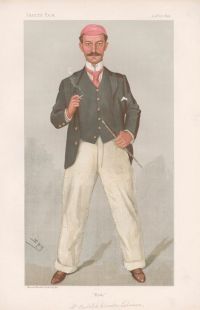
“ There is as much difference between sculling and rowing as there is between a single cyclist racing without pacemakers, steering and balancing himself and making his own pace, and a man in the middle of a quintette merely pedalling away like a machine at another man's pace, and not having the balance or anything else solely under his control. ”
Sculling
Definition and stakes
The theme of “sculling” has been addressed by authors such as R. C. Lehmann, Walter Bradford Woodgate, Basil Thomson, active 1866-1874 Robert Henderson and Various. It is often associated with terms like rowing, sculler, boat, oar and stroke.
Quotes about “sculling”
“ Sculling is so entirely an art by itself, that a man might just as well ask a painter how he produces an impression on a canvas as ask a sculler why he can scull, or how it comes that so many good oarsmen cannot scull. ”
Three Hundred Things a Bright Boy Can Do
“ The rower sits near the side of the boat, the sculler in the centre of the seat. The sculls are lighter than oars, the action quicker. There are from thirty to forty strokes a minute in sculling, but the average is about thirty-two. The boy who goes out sculling alone is often his own steerer, and so needs to keep a sharp look-out over his shoulder. Having taken a seat in the centre, stretch out your legs to their fullest extent and adjust the stretcher. Grasp the sculls, one in each hand, by the handles, and bend your body forward until your head is well over your knees. ”
 Walter Bradford Woodgate,
Boating
Walter Bradford Woodgate,
Boating
“ The leg action, as compared to swing, should be just the same when sculling as in rowing. That is, the slide should last as long as the swing. Now, in sculling, a man should go back much further than he does when rowing an oar. When he has an oar in his hand there is a limit to the distance to which he can spring back with good effect. His oar describes an arc; when he has gone back beyond a certain [136] distance the butt of his oar-handle will come at the middle of his breast or even more inside the boat. In such a position he cannot finish squarely and with good effect. ”
“ This, although a hard matter to explain, is partly accounted for by what I have said above, in that sculling is so greatly a matter of delicate touch and handling. Even good oars are as often as not clumsy and wanting in a quick light touch. Very few really big men have ever been fine scullers. ”
“ Sculling differs so vastly from rowing that no man who has not tried his hand at both can appreciate how really wide apart they stand; and the fact that sculling depends to such a great extent on one's innate sense of touch and balance, makes it extremely hard for a man who has tried his hand with some success at both sculling and rowing to explain to the novice, or even to the veteran oarsman, wherein the difference lies. ”
“ This inability to assimilate one's style to that of another man, or body of men, may be the reason why some excellent amateur scullers proved inferior oars, or it may be that they can go at their own pace and not at another man's. I myself have often felt on getting out of a sculling-boat into an Eight great difficulty and much weariness at being compelled to go on at another man's pace, and only to easy at another's order. If you are practising for sculling as well as rowing there is nothing like being captain of an Eight or stroke of a Pair or Four. ”
Walter Bradford Woodgate,
Boating
“ The best makers of oars and sculls too often turn out sculls which are not ‘pairs,’ and when this is the case the action of him who uses them cannot be expected to be even on both sides of his frame. Having got suitable sculls, let the sculler arrange his stretcher just a shade shorter than he would have it for rowing. He can clear his knees with a shorter stretcher when sculling than when rowing, as he can easily see for himself. A stretcher should always be as short as is compatible with clearing the knees. ”
Basil Thomson, The Fijians: A Study of the Decay of Custom
“ In shape and size the sua resembles the oar of a ship's cutter. Thrusting it down perpendicularly into the water between the hull and the outrigger, and using the cross-tie as a rowlock, the sculler describes short, semicircular sweeps with the blade, throwing his weight against the handle in front of him as he stands upon the deck. When two are sculling they swing in time, but in opposite directions, and there is no exercise that displays the grace of the human body in action to better advantage. ”
Walter Bradford Woodgate,
Boating
“ A good steerer in sculling will correct his course even to half a stroke; if through a bend, or a wave, or other cause, he sees one hand has taken the other a little round by the time that the sculls are crossing, he will row the other hand home a trifle sharper, and so bring the keel straight by the time he feathers. When a sculler gets more settled to his work, and has got over the first difficulty of clearing his hands at the crossing, he will begin to acquire the knack of bringing the boat round to one hand, without any distinct extra tug of that scull. ”
“ In scull-racing the advantage of the lead is greater than in rowing, as a sculler can help his own steering by watching the direction of the other's craft. Yet you should never sacrifice your wind to obtain the [Pg 173] advantage, for recollect that in sculling you can never take a blow or an easy for even a stroke. If you are behind, never turn round to look at your opponent, as by doing so you lose balance and pace, and many a good man has lost a race by so doing. Keep just so close up to your man as to prevent him giving you the disadvantage of his back wash. ”
“ Vivian Nickalls, for a long man, was a fine sculler, handicapped by an awkward finish and handicapped also by the fact that he never entirely gave his time up to sculling only—his chief characteristic being a fine, healthy, long body swing. ”
“ In modern sculling-boats a man must use swivels, for the reach of the sculler extends to a point which he could not reach with fixed rowlocks, as his sculls would lock before he got there. As he moves forward he is constantly opening up, his arms extending on either side of his body; but in rowing, one arm swings across the body, and unless you are going to screw the body round towards the [Pg 155] rigger, and thus sacrifice all strength of beginning, you cannot fairly reach beyond a certain point, which is just as easily and comfortably attained with fixed rowlocks as with swivels. ”
“ Training for sculling requires more time and practice than training for rowing. If it takes an Eight 6 weeks to get together and fit to race, it takes a Four 9 weeks, a Pair 12 weeks, and a Sculler 15 weeks. If a man is training for both rowing and sculling at the same time, and racing in both on the same day, it takes lengths and lengths off his pace, for rowing upsets all that precision so necessary in sculling. ”
Walter Bradford Woodgate,
Boating
“ Therefore a man accustomed to row on slides, and whose legs are more or less habituated to a certain extension coupled with swing when rowing, must keep a watch upon himself when sculling lest his rowing habits should make him finish his slide prematurely, when he needs to prolong his swing for sculling. Unless his slide lasts out his swing, his finish, after legs have been extended, will only press the boat without propelling her. ”
Walter Bradford Woodgate,
Boating
“ In rowing an oarsman is guilty of fault if he meets or even pulls up to his oar. In sculling, with a very long swing back it is not a fault to commence the recovery of the body while the hands are still completing their journey home to the ribs. The body should not drop, nor slouch over the sculls while thus meeting them. It should recover with open chest and head well up, simply pulling itself up slightly, to start the back swing, [137] by the handles of the sculls as they come home for the last three or four inches of their journey. ”
“ The firm drive will start the swing of the body, [Pg 164] which may be continued a fraction of time after the slide has finished. You will find that when you have driven your slide back your body will have swung well past the perpendicular (and in sculling you may swing further back than you are allowed to in rowing) . When in that position a sculler is allowed to do that which an oarsman must not, viz. he may help to start his recovery by moving his body slightly up to meet his sculls as they finish the stroke. ”
Walter Bradford Woodgate,
Boating
“ A long-legged man, sculling, may use a much longer slide than a short man. But in an eight, if the long man fits his stretcher as if for sculling, he will be doing more than his share, and may be unable to shoot so long a slide through in the required time, except by dint of ‘hurrying’ it; and, if he does this latter, the result is to cripple his swing, as shown supra. There must be a certain amount of give-and-take in arranging slides in an eight or four oar. That length of slide is best which all the crew can work simultaneously and effectively, preserving uniformity of swing and slide. ”
“ But always remember if you are at all evenly matched, that however bad you feel yourself, your opponent is probably in just as bad a plight. Talking of pace reminds me of how soon even the best scullers tire. In sculling a course against time at Henley, a good man may get to Fawley, the halfway point, in about the same time as a Pair, and yet will be half a minute slower from that point to the finish; and for the last quarter-mile the veriest tiro can out-scull a champion, provided the latter has gone at his best pace throughout. ”
“ No oarsman who has won a race at a regatta in which the construction of the boats was restricted, shall compete as a junior in any such race after the end of the current year.A junior sculler is a sculler (A) who has never won a sculling race at a regatta other than a race in which the construction of the boats was restricted; or a race limited to members of one club; (B) who has never competed for the Diamond Sculls at Henley, or for the Amateur Championship of any country. ”
“ As many as fifty entries are sometimes received for Junior Sculling, for though an Eton boy may have no chance of winning a race, he will start, just for the sport of racing and improving his rowing, a proceeding which might well be imitated at Oxford or Cambridge. Each boy who starts in one of these races has to wear a jersey trimmed with a distinctive colour, and carry a flag in his bows; and it is extraordinary what ugly combinations some of them choose and think beautiful. ”
“ You are your own stroke, captain, crew, and cox, and success or failure depends entirely and absolutely upon yourself. No one else (worse luck) is to blame if things go wrong.The pace of a sculling-boat is strictly proportionate to the quality of its occupant. A good man will go fast and win his race; a bad man cannot. A good man in an Eight cannot make his crew win; and a bad man in an Eight may mar a crew, but he can also very often win a race against a crew containing better men than himself.People have often asked me why a first-class oar should not of necessity be a good sculler. ”
“ Big, strong men also generally grip with great ferocity the handles of their sculls, and these being small, the forearm becomes cramped, and gives out. Many good oarsmen have never tried to scull, and those who have generally give it up after a first failure, which is more often than not [Pg 161] due to want of attention to detail. What passes for good watermanship in an Eight is mere clumsiness in a sculling-boat, and, as a matter of fact, there are far fewer really good watermen than the casual observer imagines. ”
“ I am inclined to regard this as the real foundation of New South Wales professional sculling, which afterwards culminated in the performances of Beach and Searle. The mother colony is the only one of the group which has produced a professional sculler of any class. Amongst amateurs none has yet appeared who could be placed in the first rank.In all the Colonies there are rowing associations which regulate and control amateur rowing. Of these, New South Wales alone has attempted to maintain the amateur status on English lines. ”
active 1866-1874 Robert Henderson, The Barb and the Bridle
“ Again, a great point to be observed is to maintain such a position as will enable the rider to turn with the hounds at the right moment; resolutely resisting any temptation in order to cut off ground, to turn too soon, and risk spoiling sport by crossing their line.It should be remembered that it is quite as easy to jump the fences when one is in the front rank, as it is when sculling along with the rear guard, and much safer, because the ground always affords better foothold and landing, when it has not been poached up by a number of people jumping. ”
Various, Harper's Round Table, August 18…
“ He should take a long breath, and then fall backwards in the water gently, making a sort of sculling movement with his hands, at the same time raising his arms upwards until they are stretched as far out from the shoulders as he can and slightly above the lines of the shoulder-blades. ”
Walter Bradford Woodgate,
Boating
“ Defeated men can always suggest excuses for failure, and Kelley, for years after that race, averred that he had not been beaten on his merits; he had been kept waiting a long time at the post, and was cold and stiff at the start. In those days, whether in University matches or in public sculling races, the lead was a matter of special importance. In the first place the old code of rules were in force, which enabled a leading sculler to take his opponent’s water, to wash him, to retain the captured course, and to compel his adversary to row round him in order to pass him. ”
Walter Bradford Woodgate,
Boating
“ A sculler who does not swing back further than when he is rowing, will do best to row his sculls home just as he would an oar.In racing all men like a lead. If a sculler can take a lead with his longest stroke, swinging back as far as he can, and can feel that he is not doing a stroke too fast for his stamina, by all means let him do so; but let him be careful not to hurry his stroke and thereby to shorten his back swing simply for the sake of a lead. Many a long-swing sculler spoils his style, at all events for the moment, by sprinting and trying to cut his opponent down. ”
Walter Bradford Woodgate,
Boating
“ The sculler can afford to ease his recovery in return for the strain of his long stroke. Also lest his long swing should press the boat’s bows, he can ease her recovery as well as his own, so soon as the main force of the long drag comes to an end. In the writer’s opinion, unless a sculler really does go back à la Casamajor & Co. with straight arms and stiff back, and until his sculls come out of the water almost of their own accord as he brings his hands in, it is not an advantage for him to pull himself up to his handles to this trifling extent at the finish. ”
Walter Bradford Woodgate,
Boating
“ The hang back, and the sloppy feather, which are to be seen in so many second-class scullers, may almost invariably, if the history of the sculler be known, be traced to want of nerve and of confidence in early days to feather boldly, and to lift the sculls sharp from the water, regardless of rolling. Of course, for the nonce, the sculler can sit steadier, and therefore make more progress, if he thus steadies his craft with his blades momentarily flat; and it is because of this fact that so many beginners are seduced into the trick. ”
Walter Bradford Woodgate,
Boating
“ In most gigs there is a want of room between thowl and stopper. A sculler requires a wider rowlock than an oarsman, because his scull [129] goes forward to an acuter angle than an oar, with the same reach of body. Nothing puts out a sculler’s hands more than a recoil of the scull from the stopper, for want of room to reach out. The sculler should examine whether his rowlocks are true; the sills of them should be horizontal, not inclined, and most of all not inclined from stern to bow ”
