Tidal friction

Definition and stakes

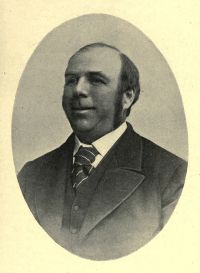
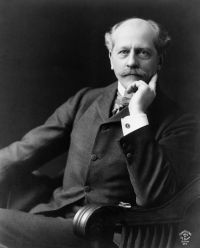
Portrait of George Howard Darwin George Howard Darwin,  1911 Encyclopædia Britannica, Volume 26… (1911)

“ Now tidal friction must diminish the rate of increase of rotation due to contraction, and therefore if tidal friction and contraction are at work together the epochs of instability must recur more rarely than if contraction alone acted. If the tidal retardation is sufficiently great, the increase of rotation due to contraction will be so far counteracted as never to permit an epoch of instability to occur. Since the rate of retardation due to solar tidal friction decreases rapidly as we recede from the sun, these considerations accord with what we observe in the solar system. ”
Source: Wikisource

George C. Comstock,  A Text-Book of Astronomy

“ Consequences of tidal friction upon the earth.—This process of moving the moon away from the earth is a cumulative one, going on century after century, and with reference to it the moon's orbit must be described not as a circle or ellipse, or any other curve which returns into itself, but as a spiral, like the balance spring of a watch, each of whose coils is a little larger than the preceding one, although this excess is, to be sure, very small, because the tides themselves are small and the tidal influence feeble when compared with the whole attraction of the earth for the moon. ”
Source: Gutenberg

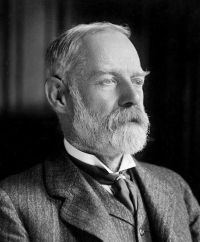
Portrait of Percival Lowell Percival Lowell,  The Evolution of Worlds (1910)

“ For tidal friction proceeds to lengthen the twenty-four or other hours first to weeks, then months, then years, and at last to infinity; thus bringing the sun to a stock-still on the meridian, to flood one side of the world with perpetual day and plunge the other in eternal night. ”
Source: Wikisource

Get perspective with Kwize: daily news enlightened by great literature