Summary

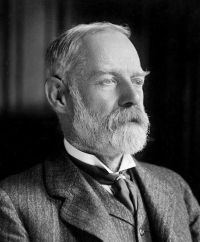
Portrait of George Howard Darwin George Howard Darwin 1911 Encyclopædia Britannica, Volume 26… (1911)

If every particle of the earth and ocean were being urged by equal and parallel forces there would be no cause for relative motion between the ocean and the earth. Hence it is the departure of the force acting on any particle from the average which constitutes the tide-generating force. Now it is obvious that on the side of the earth towards the moon the departure from the average is a small force directed towards the moon; and on the side of the earth away from the moon the departure is a small force directed away from the moon.
Source: Wikisource

Portrait of George Howard Darwin George Howard Darwin 1911 Encyclopædia Britannica, Volume 26… (1911)

Thus, if the genesis of the moon was deferred until a late epoch in the history of the terrestrial mass, the mass of the moon relatively to the earth would be likely to differ from the mass of other satellites relatively to their planets. If the contraction of the planetary mass be almost completed before the genesis of the satellite, tidal friction will thereafter be the great cause of change in the system; and thus the hypothesis that it is the sole cause of change will give an approximately accurate explanation of the motion of the planet and satellite at any subsequent time.
Source: Wikisource

Portrait of George Howard Darwin George Howard Darwin 1911 Encyclopædia Britannica, Volume 26… (1911)

We may conceive the moon's tide-generating force as making a wave in the canal and continually outstripping the wave it generates, for the moon travels along the equator at the rate of about 1000 miles an hour, and the sea is less than 13 miles deep. The resultant oscillation of the ocean must therefore be the summation of a series of partial waves generated at each instant by the moon and always falling behind her, and the aggregate wave, being the same at each instant, must travel 1000 m.
Source: Wikisource

Get perspective with Kwize: daily news enlightened by great literature